You should probably give this chapter a quick scan to pick up the gist of it. Basically, it states that Zen Buddhism is just as dangerous as any other religion when it becomes known as "state" religion, gets too wrapped up in politics or sinks to much in aesthetics.
http://www.strippingthegurus.com/stgsamplechapters/zen.asp
This should not be news to any of us...religion can be dangerous, Buddhism is no exception. Priests or Roshis, yogis or gurus can all be people or get caught up in the power of their position.
Some of the bigger zen names are in here: Kapleau, DT Suzuki, Soen and Harada. Much of what they quote is of the pre-WWII stuff when Japan was still largely imperialistic and at the same time condemning Buddhism as foreign and un-Japanese in relation to the native Shinto religion. Either way, Buddhist monks went to great lengths to prove their patriotism and nationalism and thus you get the "march, march, boom, boom" statement.
I'm not saying that these are right, but to be honest, these events have happened in most religions, philosophies and even scientific thought (ie. the silly evolution and eugenics debacle). Anyway, give it a read... But I really can't speak to the truth of the statements made in this books - some comments were deliberately taken out of context and do not shed a fair light on these teachers or their eras.
Read it and make your own decisions. But remember - Always be wary of someone trying to sell you heaven or enlightenment. Be critical of ALL teachings, not just the ones you don't like.
[Edit: I recieved this link to a paper called "The Zen Master in America: Dressing the Donkey with Bells and Scarfs" from a tweet by c4chaos (sweet, sweet twitter) that looked to be interesting and along the same lines. ]
No Illusions,
Friday, July 17, 2009


Thursday, July 16, 2009
Buddhist Ideal and the teachings of Shaku Soen
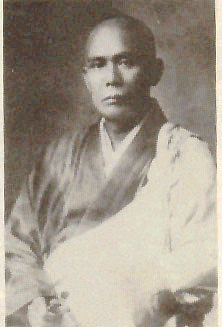
Some bits and pieces of Shaku Soen's Dharma talks.
...It is not the buddhist ideal to escape worldliness and enter into a realm of eternal stillness. This sometimes misunderstood by individuals who read too much into the concepts of "no-mind" or emptiness. Buddhists do not shun struggle and conflict if the cause is worth contending for or defending. Buddhists will not hesitate to sacrifice for it not only in this life but in all of their future lives (this does not infer reincarnation but rather the concept of individual actions inspiring individuals of future generations - each in essence is an extention of your own life.) ...
...It is not buddhistic to hanker after personal immortality and to construct diversity of theories to satisfy this illegitimate desire. Do whatever you think right and be sincere with it and the work will take care of itself, with or without immotality...
...Some may think that this is fatalism or determinism, but every clearheaded thinker would see in this not a fatalistic conception of life but a hopeful solution of existance, a firm belief in the final triumph of good over evil, and the calm assurance that the individual lives as long as it identifies with a noble thought, worthy work, exalted sentiment, uplifting impulse, in short, with anything that cements the brotherly tie of all mankind...
... The predominant tendency of Buddhism towards inellectuality...the reason why Buddhism is always ready to stand before the tribunal of science and let her pass a judgement upon its merits or demerits is due to this intellectual tenor...
... the practical side of Buddhism: The aim...is to dispel the clouds of ignorance and to make shine the sun of enlightenment. We are selfish because we are ignorant as to the nature of the self...Buddhist do not recognise any original sin, but acknowledge the existance of ignorance and insist on its total removal as the surest means of enlightenment...
...what the Buddhist practical faith is...1) to cease from wrongdoing, 2) to promote goodness and 3) to enlighten the ignorant...it has nothing mysterious, nothing superstitious, nothing idolatrous, nothing supernatural.
Evangelicals Buddhist Deathmatch

[Edit: Ok, maybe I was alittle hasty...If the issue is xstians coming in to convert Buddhists in poor countries...We should probably get up off of our collective asses and send some support so that they would not be so susceptible to conversion from evangelicals. If it is an issue of Buddhists doing the same thing to other religions..then Hell NO]
Read the full story over at Buddhist Channel. They have a crapload to say about this new Evangelical book that is coming out called "Peoples of the Buddhist World: A Chritian Prayer Guide"
They go from 0-60 in about one paragraph:
Make no mistake: this most conspicuous book is enterprisingly well done. But it has a hidden agenda: This book serves as a layout and roadmap of Xtian evangelical interests and zeal. It is a precise blueprint, a battle plan drawn to craftily attack the peoples of the Buddhist world.
Wow...a blueprint...for battle? Scary...
We have lost Afghanistan and Pakistan (East and West) to Muslim invaders, India and Nepal to Hindus and far eastern regions of the Middle East to hard line Muslims. Having lost so much, how much more are we waiting to lose? This is a question that every progressive Buddhist needs an answer to. Despite having survived the historic onslaught of Islamic invaders, these unknown Buddhist lands face the grim reality of losing their communities to the onslaught of Christian evangelism. 20th century South Korea is an example of how easy it is indeed for Buddhism to fall prey to aggressive evangelism.
Ummm...fine but maybe if they were converted so easily then they are fine with the religions they have. Muslim invasions aside, it seems that India and Nepal the buddhist path just sorta whithered away...it happens. And "we lost"...we, I'm not mourning any loss that happened how long ago?
Wow, this article goes on for awhile but my understanding is that it is stating that Buddhist missionaries would be somewhat better than Christian ones.
This is untrue - Evangelism is just as bad from the Buddhist as it is from the Christians or anyone else. When you provide service in return for conversion then you are doing something malicious to those people. It is evil, plain and simple. Let them make their own choices over religion and some SECULAR humanitarian aid would probably be appreciated or at least from religious groups with no goddamned strings attached.
No Illusions,
Wednesday, July 15, 2009
I aint no marshmallow nor vegetable nor mineral

[Edit: 07.16.09 Well, upon reviewing this person's blog post once again, I think that I did not hit the root of the problem. The truly sad thing here is that Mr. Lutheran is basing his entire view of a very complex and spread out religion/non-religion on ONE experience. From that ONE experience, he solved all of the complexities and nuances of the dharma by a singular sitting...if he sat and didn't like it and wanted to stop then fine...but don't judge every other buddhist from that experience (it would be similar to me judging all Lutherans from your idiotic blog). And as far as teachers or roshis having their own issues and problems- check out a biography on Ghandi. You'd be surprised...]
The folks over at Progressive Buddhism compiled a nice little list of misconceptions that some individuals may hold about Buddhism. That would be nice if those misconceptions would help this fellow but I doubt it.
[Edit: damn it they beat me to it. I was going to list some of those quotes...I will still but I will also add some of my own colorful commentary]
Buddhism is very attractive to the youth of today, who thinks its going to offer them something called enlightenment, whatever that is. (Well, granted, enlightenment is a difficult concept and I am sure that later on this individual will figure it out but FUCK...all you have to do is hit wikipedia or one or two basic books on Buddhism to get a decent idea of it...well, I'm sure it will get better.) It seems to mean not wanting anything (ok...maybe) and becoming a vegetable (huh?) or a mineral(FUCK!...What?). Buddhist actually consider rocks and stones to be citizens I think this is b/c they want to be as inert as a rock (Seriously, a LITERAL reading of some fucking quote. You are an idiot. Refer to earlier comments about reading a fucking book.)
Vietnam was Buddhist and now look (Fuck you genius, South Vietnam was largely ANTI-Buddhist. Please refer to earlier comment about READING A FUCKING BOOK).
There are no criteria for anger within Buddhism. You are never supposed to be angry. (Great! So I'm not gnashing my teeth right now trying to think of a way of fitting a size ten boot in a size nine asshole. Gosh, thats a relief.) Buddhism doesn't even have moral criteria (Please to refer to the Eighfold Path , the Ten Precepts and any book by Dogen...check my blog...links right to what you need) If someone chops your leg off, your job is to remain sanguine. (I may not be very smart but I am assuming that "sanguine" means screaming so loud that my other leg falls off.)
...but when gurus do something to you, you are just supposed to go along with it.(wouldn't know, never "groveled" before a guru or roshi before. However, Buddha pretty much said that we NEED to evaluate everything including Buddhism...you should try evaluating Lutherism sometime, obviously you may be confused...just saying...As a note to any practicioners out there - Always question your teacher, no matter what the color or style ofthe robes).
Ok...I'm out of steam and I think I want to watch the rest of Grand Turino.
No Illusions,
Tuesday, July 14, 2009
Plan "B" from Outer Space

I love Buddhist Geeks. Their podcast is great. But something about this one just irks me somewhat. Let me tell you why...
[from Progressive Buddhism] The latest Buddhist Geeks podcast is an interview with Zen teacher Norman Fischer who argues in favour of secular and therapeutic expressions of Buddhist wisdom, such as Jon Kabat-Zinn's Mindfulness Based Stress Reduction.
Secular expressions, fine. But therapeutic expressions of Buddhist wisdom? No. And here is why. When you take Buddhism and lend it to the field of medicine (even a field as soft as counseling or psychology), you take the chance of making it an "alternative" or New Age remedy for something that is best handled by actual doctors and not monks or roshis or dipshits like me with some interest in religion. I don't care if it is Christian or Buddhist or Muslim wisdom, it means that your treatment is based upon belief and not science.
Also this just reeks of profit. Can I copywrite it?
[from Buddhist Geeks] As Buddhism transitions to the West, we see that it is doing so in a couple different ways. Some forms look more like their original Asian roots, while others are secular and non-Religious in their presentation. Zen teacher Norman Fischer, an early 2nd generation teacher in the lineage of Shunryu Suzuki Roshi, calls the more traditional forms part of "Plan A" and the more secular forms, "Plan B."
I do have respect for Suzuki Roshi's teachings but is this the correct path for the foundation he built for Zen in the West? Some alternative meditative treatment? Why do the secular sects of Buddhism have to be paired with nonsensical, clinically unproven pseudo-science, charlatan snake-oil? (Do we get to spin prayer wheels to cure cancer, or maybe we walk around stupas to cure impotence). Buddhism has the same "therapeutic" and scientific integrity as any other religion - namely...none. I might as well freaking pray or speak in toungue or faith heal...
In this interview we discuss with Norman the importance of Plan B approaches, like Jon Kabat-Zinn's Mindfulness-based Stress Reduction. We also discuss his personal experience teaching Plan B at places like Google. Finally, we explore how the livelihood of trained and competent meditation teachers may relay heavily on Plan B approaches.
In going down this path we are making promises that we cannot keep. We are promising ease and comfort. True Buddhist meditative practice is anything but easy and comfortable, it is exactly the opposite. This is in every way as bad as the beatnik/hippy zen that became so popular in the 60's because of the mysticism that surrounded it. However, these days we trade in mysticism for pseudo-science.
And if you want to see where this eventually leads click here, but I warn you - it isn't pretty. I got white hairs just looking at it.
Cheers,
Monday, July 13, 2009
Suzuki Roshi - Don't underestimate the meditative value of a smack in the mouth.
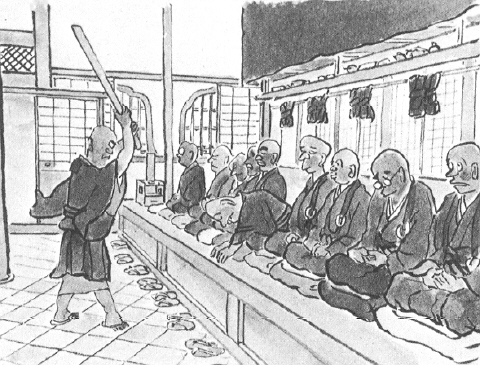 Shunryo Suzuki Roshi, as always, delivers an eloquent talk on a difficult topic. It also helps that violence is included...I love zen-violence
COMMENTARY BY MASTER SHUNRYU SUZUKI
ON MODEL SUBJECT NO. 20 FROM THE BLUE CLIFF RECORDS
[from blog Suzuki Dharma Talks] April 1963
- Zen may be said to be the practice of cultivating our mind to make it deep and open enough to accept the various seeds of ideas and thoughts as they are. When this kind of perfect acceptance takes place, everything will orient itself according to its own nature and the circumstances. We call this activity the Great Activity.
- Reality can be said to be the bed that is deep and soft enough to accept everything as it is. When you accept everything, everything is beyond dimensions. The earth is not great nor a grain of sand small. In the realm of Great Activity picking up a grain of sand is the same as taking up the whole universe. To save one sentient being is to save all sentient beings. Your efforts of this moment to save one person is the same as the eternal merit of Buddha.
- For a person who wants to understand Buddhism logically, it may be difficult for him to understand why he should study over and over again stories such as are collected in the Hekiganroku (Blue Cliff Records). Yet, when a student realizes how difficult it is to incorporate into his daily life what he learns in these stories, he will acknowledge the necessity of practicing zazen and reading. This practice and reading will in turn encourage him to read these stories over and over again. To do this over and over means perfect acceptance.
- Finding out the significance of everyday activity is the Great Activity.
Today's Problem:
- In Japan we call this era civilized life the "instant age" because of the prevalent idea that quick solutions to problems are possible without difficulty. This idea takes many forms-instant coffee, instant Sukiyaki, operations for physical disease, pills for mental illness. In spite of all the benefits from our civilization, it is difficult for people to remain strong enough to be happy physically and mentally. Why? Perhaps because a most important point is missing.
- Support from without is sometimes too strong, sometimes too weak, sometimes only partial, and sometimes harmful to other parts. The operation must be successful and in addition the patient must survive. The important point is to arrange ourselves from inside. Orientation from our inmost nature is wanted. The problem is how to make use of our civilization and not be ruined by it. The solution to this problem is Zazen; by sitting we have to resume to our own nature and by Great Activity we should acquire absolute freedom.
Main Subject:
- Attention! Ryuge asked Suibi, "What was Bodhidharma's intention in coming to China?" Suibi said, "Pass me the meditation chin-rest." [When a Zen monk sleeps in zazen posture, he rests his head on a wooden board called a zenpan or chin-rest.]
- Ryuge handed Suibi the chin-rest and then Suibi struck Ryuge with it. Ryuge said, "If you strike me, I will let you. But, after all, that was not the intention of the patriarch coming to China."
- Ryuge later visited Rinzai. He asked Rinzai, "What was the intention of Bodhidharma in coming to China?" Rinzai said, "Pass me the meditation mat." No sooner had Rinzai received the mat then he struck Ryuge with it.
- Ryuge said, "If you strike me, I will let you do so; but that is not the Patriarch's intention in coming to the west."
Interpretation of the Main Subject:
- According to the Appreciatory Word of Setcho, the compiler of these stories, Ryuge was struck because he did not understand why Suibi wanted the chin-rest and Rinzai asked for the meditation mat. Their treatment of Ryuge was in the realm of Great Activity and helped Ryuge understand Bodhidharma's Zen. There are no regulations in the Great Activity. A chin-rest and a meditation mat can be used for scoldings slaps.
- This power of Great Activity should be acquired by meditation (sitting quietly). There was no other intention in Bodhidharma, Suibi, and Rinzai; but he knew that these intentions had nothing to do with his own Great Activity. In other words, he was enlightened in Bodhidharma's Zen.
- A long time after this event, Ryuge said in his answer to a monk, "I do recognize the Great Activities of those two Zen Masters, but that has nothing to do with Bodhidharma's Zen."
[This transcript is a retyping of the existing City Center transcript (thought to be based on notes by Baker-roshi). It is not verbatim. No tape is available.]
Hulk Zen Banner Zen

If you are familiar with me then you know that I have a distinct distaste for the term "zen" used as a descriptor of other things (ie. the zen of marketing) as well as the term Zen to infer a mystical ethereal quality, which has been popularized in the west by various self-help zombies and new age gurus.
Now part of this is funny since I often title things with the "Zen and the..." in my blogs. Although, granted, I do try to make the relation funny or at least ironic when I do it. Whether or not I suceed in that endevour will be judged by history.
However the concept of "mystical" Zen still annoys the crap out of me. Zen is constantly inferred to grant practicioners with some mystic or supernatural qualities (or at least the teachers or purveors of wisdom are assumed to) or that even the concept of Zen, while complicated, is endowed with some ethereal foundation. Nothing about Zen is mystical, spooky or supernatural. It just isn't. You may want it to be soooo much but still...it isn't. Deal with it.
You can even pretend. You can give your practice a really cool sounding name like "Dark Zen". Oooooo...I feel all special and mythic when you make it sound like that. Maybe I should call my own practice something cool like "Epic Zen" or "Hulk Zen".
ZEN SMASH!!!
Wow, that would be awesome. That would make my mundane little practice seem so much more interesting. It could even get me some followers and maybe even a book deal. Imagine that...all I have to do is lie alittle and stretch the truth abit and grow my hair longer, maybe get a cool goatee, Oh! and black, i need to wear lots of black. Black everything. Maybe learn some kung-fu. That should help....
Lets not make this more than it actually is...a meditation school.
Zen is quiet and gradual. It is an abbreviation. A form and a style of meditation. Why it got abbreviated in the first place, I have no idea. Who cares.
Zen is loud and abrupt. Sure, why not? It is sometimes and sometimes it isn't. But quiet or loud, gradual or abrupt, simple or complex; the one thing Zen is not is fucking magical. Sorry.
...anyway...I thought I could provide a brief outline of Zen Buddhism and Zen practice. In my opinion (humble as it is) if you function in the way below you are on the Zen Buddhist path. Whether or not you want to call yourself one is entirely up to you. Personally, to me, Zen isn't a religion in the classical sense - it is a path - one that can mix with any other religion or belief system.
Meditation:
- All Buddhist schools focus in some way on meditation. In some the primary form is scholarly study of sutras (meditative in a way), others utilize visualizations (mental or actual physical representations of buddhas or bodhisattvas), mundas (positions of hand or body) and mantras ("power" words or phrases, nembutsu).
- Zen focuses on zazen or seated meditation. Meditation can be silent with no-thought (shikintaza) or with a focus (koans, riddles). Most, if not all, schools of Zen focus on breathing as the first step in mediative practice.
- Where Zen really moves away from the rest is that the zazen is only a first step in Zen practice. It is more than quieting and focusing the mind. It is more than finding the still point - that area of your practice where we can sit, presently, in the moment. The goal then is to transfer that feeling to all aspects of life. It should be there when we laugh, cry, work, play and eat.
- This is the reason that kinhin (walking meditation), samu (working meditation) and chanting are used in Zen practice. In each of these activities we focus the same attention. We process less during the tasks but reflect more.
- The best description is your reflection in a pool of water (cliche!). When the water is disturbed and waves are appearing the reflection in the water is difficult to make out. But once the water clears you can see that reflection perfectly. These waves will always happen in your mind as well as in the pool. But once we get that reflection for the first time it never goes away. We now know what we are looking at no matter how obscured it gets...that is our buddha-nature.
No illusions,

Subscribe to:
Posts (Atom)

