Showing posts with label zen. Show all posts

Saturday, October 10, 2009

Science, Art and Zen

You may not realize this about me but I have been working on a Masters in Paleontology/Geology for the past few years at SDSMT and have always been amazed at how beautiful many scientific illustrations and photographs can be. Unfortunately these pieces are largely unrecognized as the pieces of art that they are. I was pleased to find this listed under one of the past exhibitions at the American Museum of Natural History.

"John Daido Loori, scientist, photographer, and Zen master, explores the link between Buddhism and artistic inspiration with more than 25 striking abstract photographs of Point Lobos State Reserve in California. His photographs of kelp strands on the shore, algae, starfish, and sea-tossed stones echo the contours of larger landscapes and the curves of the human body. Contemplative and sensuous, the images bridge a gap between viewers and the world around them."

The only photographs from John Daido Loori Roshi that I have seen previously were his black and white ones but the color ones are beyond beautiful. The combination of art, Zen, scientific photography and natural beauty are overwhelming. If Daido Loori Roshi included a scale bar with these pieces, I would call them perfect.

This exhibit ran in 2005 and I hope they consider running it again to honor the memory and art of John Daido Loori Roshi.

Beach FlowerSea Debris
Subtle BeckoningWave Echo

All photographs are from the AMNH Website and copyrighted © by John Daido Roshi

Friday, October 9, 2009

Meditation on Death, Zombies and Buddhas


[This post was written before the news of Daido Roshi's death on Friday October 9th. Daido Roshi has always been a great influence to me...especially the way that he accepted and encouraged lay-practice. And in doing so, aided in my own development and growth. I take this time to reflect upon his teachings and ability; his compassion and his wisdom. He is a giant in American Zen and his humble steps led to great vibrations in own growing community. Thank you and Cheers, Daido.]

Many zendos or places of practice will have the Evening Gatha displayed in some prominence with the words "Life and Death are of Primary Importance". Well...yes, obviously they are but Buddhism (at least some of the Buddhism that is currently espoused in the Western Convert community) place a huge emphasis on the living part and largely ignores to dying part. All butterflies and growth about "how to live more mindfully" or "how meditation can help you live a happier life" with the topic of death is largely belittled or ignored. That somber specter is glossed over with the sometimes saccharine perception of Modern Buddhist thought.

Buddhaghosa stated in Chapter VIII of the Visuddhimagga ("Path of Purification").

A bhikkhu devoted to mindfulness of death is constantly diligent. He acquires perception of disenchantment with all kinds of becoming (existence). He conquers attachment to life....Perception of impermanence grows in him, following upon which there appear the perceptions of pain and not-self. But while beings who have not developed mindfulness of death fall victims to fear, horror and confusion at the time of death as though suddenly seized by wild beasts, spirits, snakes, robbers, or murderers, he dies undeluded and fearless without falling into any such state. And if he does not attain the deathless here and now, he is at least headed for a happy destiny on the break up of the body.


While nowhere near a bhikkhu, nor any plans to be one, I do understand that mindful attention to death is an important aspect to my Buddhist practice. To focus on the fact that life is impermanent is a daily, almost unconscious, task. But more importantly concern and focus one the fact that death is imminent. Concern with what would happen to my family if I were to die. Focus on this while driving to work, sitting at home or walking to the store. To focus on the fact that death could come at anytime, unbidden and unexpected, to me or to those closest to me. Yet with all this mindfulness the idea of death is still terrifying to me - even with the acceptance of my own impermanence.


Why was this so pressing?


People think that only others will die. They forget that sooner or later they will, too. They carry on without so much as a thought that death could possibly happen to them. Then they're shocked when it comes on them unexpectedly. How foolish! [Suzuki Shosan]

What is the primary concern in religious practice? - Put aside everything and only study death. Always study death, free yourself from death, and when death really comes you will not be flustered. In order to save others, knowledge is necessary. [Suzuki Shosan]


The study of and focus on was there but I was still insisting that I wasn't going to die. My focus was always on "if" I died or the possibility of something happening to me that was unexpected. It was never, in my mind, an absolute or a definite occurrence. I was an accident. Now the focus isn't on the "when" or "how". Those concepts are worthless and without meaning. The "if" of my impermanence turned to an actuality.

    1. I am of the nature to grow old. There is no way to escape growing old.
    2. I am of the nature to have ill health. There is no way to escape ill health.
    3. I am of the nature to die. There is no way to escape death.
    4. All that is dear to me and everyone I love are of the nature to change. There is no way to escape being separated from them.
    5. My actions are my only true belongings. I cannot escape the consequences
      of my actions. My actions are the ground upon which I stand.

While Buddhaghosa focuses on the bhikkhu's perception and conception of death and while Shosan rolls on with the insistence of focusing on death as a meditative tool (almost like a koan) to unravel the true meaning of religion experience; the 5 Remembrances cuts through the noise and circumstance of death to the actual realization of it.


So...the "take home" message is simple: Zombies are much more Buddhist-y than Vampires. Vampires sit around and look pretty and never age - undead but ageless. Zombies force us to look at ourselves in the now. Zombies shamble around, slowly decaying, getting slower, they make more noise. We shamble around, slowly decaying, getting slower, we make more noise now than before (creaks and whistles and groans). Embrace your inner-zombie. Its not really Buddha-nature but it may help to focus on the fact that we will grow old and die and then (maybe) walk the earth as a mindless automaton.

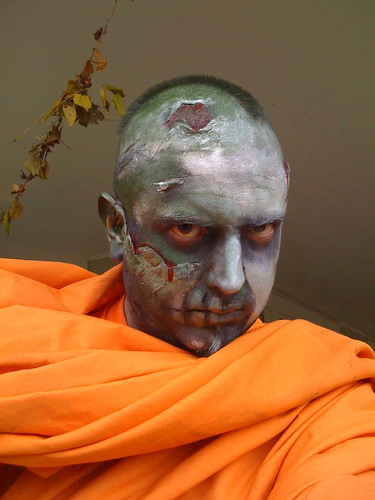
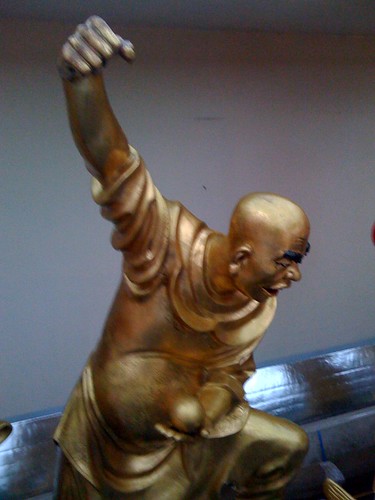
So for Halloween I was going to be a Zombie but I'm going with this guy instead.


If that dude isn't a Zen Master in disguise, I don't know who is.


Cheers,


Remember if you meet the Buddha walking down the street, kill it. If you meet a zombie walking down the street, KILL IT. If you meet Zombie-Buddha walking down the street, RUUUNNNNN!!


Tuesday, October 6, 2009

A Roshi of Worth.


I have always been moved by Daido Roshi's work, words and ability. His book Finding the Still Point aided my practice as I began to sit again as well his translations of Dogen.

I plan to dedicate my practice tonight to Daido Roshi in thanks for all of his striving. I can hopefully dedicate something longer in the future. Please join me in this dedication.


Cheers,

Monday, October 5, 2009

Zendo Oops: From bad to worse and beyond...


Have fun with these - I thought I would lighten things up a bit. The "bad" category are all true occurances while the other categories are usually what I thought about immediately after the "oops" that kept me laughing for most of the sitting period.

I previously put these out as tweets.


Zendo Oops #1:


  • Bad: Setting Hair on fire while opening altar.

  • Worse: Setting hair on fire while opening altar and spontaneously screaming "Jesus Monkey F#ck Christ!"

  • Beyond: Eating the altar.

Zendo Oops #2:


  • Bad: Sucking on Jolly Racher during Zazen and having red drool come out of your mouth.

  • Worse: Sucking on Jolly Rancher, having the red drool and then pretending to be a zombie during kinhin.

  • Beyond: After zazen and kinhin with the red drool and zombie-walking - Screaming "Brrraaaaiiiinnnsssss!" repeatadly during the Heart Sutra.

Zendo Oops #3:


  • Bad: Having your fly open during dokusan.

  • Worse: Noticing that you fly is open and mention to Roshi that you think you just peaked into your "Buddha Nature"

  • Beyond: Pretending your "Buddha-Nature" is a Keisaku and repeatedly striking practitioners for not paying attention.

Zendo Oops #4:


  • Bad: Farting, at any time, in the zendo is pretty bad.

  • Worse: Farting in rhythm to the Mokugyu during any chanting service or whenever suffering is mentioned.

  • Beyond: Blaming it on Roshi and yelling "KATSU!"

Zendo Oops #5:


  • Bad: Cracking jokes during Dharma talk.

  • Worse: Joking about crack during Dharma Talks.

  • Beyond: All of the above and then taking a hit.

Zendo Oops #6


  • Bad: Punctuating any conversation in a zendo or during dokusan with "F#ck Yeah!"

  • Worse: Follow it up with a "Dead-Arm" punch to the shoulder.

  • Beyond: Have a deep conversation with the Buddha statue and then stare at everyone suspiciously.

Last Zendo Ooops:


  • Bad: Dead leg after zazen and doing zombie walk kinhin *step, ddrraaaggg, step dddrrrraaaaagggg*

  • Worse: Eating another Jolly Rancher and repeating Zendo Oops #2.

  • Beyond: Giving the person in front of you a "Flat Tire" and then staring at them like they're the asshole.

Zendo Oops Bonus:

  • Bad: Sharing aride to sesshin and singing "108 bottles of beer on the wall, 108 bottle of beer, take one down pass it around and into Buddhist hell you go!" for the entire ride.

  • Worse: Actually drinking 108 bottles of beer on the way to sesshin.

  • Beyond: The horrible beer farts during zazen the next day coupled with the hideous "Hotei's Log" you left as a present in the zendo's "Room of Thinking".

Cheers,

Saturday, October 3, 2009

No Place Like Home - Reflections of a Zen Home Practitioner


Going Back to the Sangha -


I recall the reason why I went back to sitting with a brick and mortar sangha - the upcoming birth of my daughter about 15 months ago. During my wife's pregnancy I got an urge to get back into my practice in a very "real" way; to find people around my area that I could connect with on the level that I felt that my practice was at. This is not to say that I thought my practice was any stellar event. However, when my father refers to my practice as my daily yoga and my wife occasionally rolls her eyes when I talk about it, one comes to the conclusion that a different atmosphere and perhaps, venue, is needed. Either way, I was feeling the need to substantiate it in some way.


I did my research and looked into some area sanghas - one Tibetan, one Theravada and one Zen. I made the phone calls and asked about how each group approached their practice. Was it on a regular schedule? Lay or monastic? Was it completely independent or associated with a larger institution? Mostly meditation or devotional? Large or small group? Cost and Fees?


More importantly, how did the people feel to me when I spoke to them on the phone or in person? Lucky for me, each group was what I was looking for. Small, personal with only loose affiliations to larger centers or organizations and no or minimal costs and fees. I was taking my time, enjoying this new search and exploration. I still can not believe my luck in finding so many small, independant sanghas in my area.


My search somewhat changed when I heard on the news about a father that threw his 18 month years old baby across a room and into a wall. I knew the foster family (I worked with the foster mother) that was taking care of the child previously and they just recently had to give up the child to the actual parents who were just out of rehab. It wasn't two months later that this happened. The foster family cared deeply about the children under there care and repeatedly made mention of the fact that they believed the children to be in danger.


I don't think too many people realized how much this affected me when it occurred. I couldn't stop thinking that it could easily be me as that father. Not really that father since, he was a drug addict and just out of jail. Rather, a father that loses control, gets frustrated and in a moment of stupidity - does something horrible. I was never a violent person. Never got into fights or started altercations with people but I was always angry and intense. Would it really be that small of a leap?


The next day I walked into that little zendo and started to accelerate my practice. I never really expressed how much it would have taken me to get through those doors again otherwise. It was difficult to approach strangers about something as personal as my home-practice. But the idea that I would soon be walking into fatherhood - a situation that was completely unknown to me and with which I had no previous experience - pushed me through those doors. I started to sit again with a group and chant and engage other Buddhists. I started this blog.


When I walked into the zendo for the first time, a long-time member walked up to me and we started to talk about why I was interested in starting my practice there. I told her that I would be having a daughter soon and I wanted to prepare myself for it by engaging in public Buddhist practice again. To myself, however, I told the truth. The truth that I wanted to start out of compassion for my daughter - out of the fear that I would be as horrible as that man who threw his child.


Before we walked into the meditation room to start the first sitting the lady I was talking to mentioned that she heard that the little boy in the news that got thrown had just died from his injuries. I sat that day harder than I ever sat before or since. In between my sore ankles and burning thighs, I sat for the benefit of one sentient being that morning and have been striving ever since.


When I walked out the lady came up to me and said "I wish more fathers would sit". I agreed. The whole concept of "sitting for the benefit of all sentient beings" became slightly less esoteric that morning.
Cheers,

Saturday Morning Dharma Mouth-Punch


This is going to be a new ongoing weekly feature of my blog - The Saturday Dharma Mouth-Punch!

The concept is simple: I will review a blog -from the past week that either gave me a good Dharma punch in the face (good) or deserves a good kick in Hotei's sack (bad). Get it? It works both ways. I can either give it or receive it. I'm like a sour patch kid...I start off sour but I can be sweet in the end.

For my first run at this - I am bringing back an old favorite - Mujaku from the The Zennist. Mujaku delivered a sweet Dharma Mouth-Punch with his post on Stuart Lach's article The Zen Master in America: Dressing the Donkey with Bells and Scarves. Stuart does an amazing job of outlining, in a respectful manner, some of the more dramatic American Zen scandals as well as successfully dismantling the "Roshi Ideal" so prevalent in the West. Any practitioner of Buddhism (not just Zen) needs to read this before following any teacher, guru, roshi or rishi.

The truly amazing part about the article is that Lach actually is able to steer away from sensationalizing these scandals and succeeds in making you feel for the Roshi's own human failings (for the most part, at least). Equally amazing is that Mujaku was able to devote an entire post to someone else's opinion without bashing Western Buddhism in the process. My lip is still bleeding - The Dharma it has a killer left.


However, Mujaku is also receiving a good kick in Hotei's sack for stealing a post that I have been toying with for three months. I have been playing around with a Zen scandal post - tweaking here and editing there - and was hoping to post it soon and Mujaku just *zip* pulls the rug from under me.

Fie on you Mujaku and your beautiful post! Now go get some ice on that sack!

Cheers,

Wednesday, September 30, 2009

Only Half a Buddhist


A post in the blog All Considering came up with a quick and easy definition of what a "real" Buddhist is...
A real Buddhist, in my view, and in the Traditional Asian view, is someone who has taken refuge. That is, in a solemn ritual they have taken refuge in the Buddha, the Dharma and the Sangha. I have not done that so I'm not officially a Buddhist.

Really? A ceremony makes a Buddhist real? While I won't stomp over some one's opinion or their personal definitions of Buddhism, I will make an attempt to better define what a Buddhist is. Although, granted, my definition will be as flimsy as any other definition offered. It is next to impossible to say what being a Buddhist means to such a diverse group of practitioners but I can go deeper into how I define myself as a Buddhist.

The ceremonial aspect of taking refuge in the 3 Jewels is important step in the practice of Buddhism but does not define a Buddhist as real or not. Most Buddhists will take those vows eventually in the evolution of their practice but it is by no means necessary to make it "official" by involving a monk or priest or piece of paper. I made those vows for myself one morning after a horrific event in my life. The bottom of my pail fell out and it was time to refill it. I took the vows and I began daily practice and I am a Buddhist. If I took those same vows in front of a monk or priest they would have meant next to nothing compared to when I was driven through my own experience to make them. Which would make me a "real" Buddhist, I wonder.

This is not to say that the "official" taking of refuge (or the precepts or intense meditative retreats) is without merit. They serve a purpose in deepening one's commitment to their practice and to Buddhism. Also, if one is looking for guidance with their own exploration of Buddhism then it is important to ascertain whether or not a teacher is "authentic". In the end it is really up to the individual how much emphasis they put on the ritualistic or organizational aspects of Buddhist practice. I put great emphasis on the ritualistic but very little on the organizational. This is not a definite - It is just my practice now.

Whether you want to call your self a Buddhist is up to you, the individual, to decide. If you are a practicing Christian or Jew and wish to label yourself as a Buddhist as well - then by all means - Do so. If it helps your practice and understanding of the Dharma then do it. If you don't feel that the label of Buddhist is right for you or if you think that your practice is contrary to the fundamental teachings of the Buddha then do not call yourself one. It means very little to me whether or not you consider yourself a Buddhist. If you are applying the Dharma to your own life in a way that fits your life - Then I couldn't be happier.

Now, I may be mistaken but a "solemn" ritual does not necessarily entail monastic representation for one to take refuge. I take refuge daily in my own practice but I have no specific ceremonial experience to speak of. Do I really need someone to tell me that it isn't "real" unless it is witnessed by a monastic or lay-ordained practitioner? I don't try to pretend to be anything that I am not. I am not lay-ordained or a monastic and I have very little experience in the realm of monastic practice. My practice is mostly home-centered and with a small lay sangha (mostly, two are lay-ordained). This does not make my practice and experience any less relevant compared to someone with more practice in a monastic setting.

My thoughts are simple in this manner - You learn from what resources are available to you at this time in your life. Don't spend your days wishing that you had a larger sangha or a monastery close by. Or a specific school or sect that is nearer to what you think Buddhist practice should be. Use what is available to you now. Your only enemy is a lack of striving.

Its really all just tools. We are trying to build something...why would you worship the specific hammer that you are using when the big picture is the process of building. Zen is my hammer for now but it may be that sometime in the future a new tool is needed...just have to wait and see.

Cheers,

[Jack Daw is a non-lay-ordained home practitioner of Buddhism. He has no specific lineage or teacher. Instead he grabs what he can like a crow picking a carcass. He currently practices Zen but that could change as the wind does not blow from the same direction everywhere. He does however think that all beings deserve compassion. He is also fighting a three day flu and feeling quite pissy right now - but this will pass.]

Friday, September 25, 2009

Virtual dharma resources for REAL practice


In an effort to help some of those home-practitioners that don't have access to a physical sangha or zendo and rely almost completely on home practice to study the Dharma and further their own growth, I though I would list some of the online resources out there. There are plenty of others out there but these came to mind....


  • White Wind Zen Community Long Distance Training Program - The practice of Zen is experiential and instruction is based on your actual experience of doing the practice. As soon as possible after reading the transcript and sitting for a full half hour according to the instructions it contains, please write to the monastery to let us know that you read the "Beginner's Mind Workshop" transcript, sat and would like to receive further instruction. Please include in your email some detail concerning what you experienced while sitting and write out any questions that came up. Your email will be answered by a practice advisor or a Dharma Teacher in residence at Dainen-ji and this will be the beginning of an exchange for the purpose of clarifying your understanding of Zen practice so that you can eventually apply as a public student of Ven. Anzan Hoshin roshi.


  • Treeleef Zendo - This zendo is dedicated to students of Zen Buddhism who cannot travel to a zen center or who otherwise wish personal contact with a zen teacher... [a full review of this site is here]

  • Wild Fox Zen Blog - The Moon Reflected in the Water: 100 Day Practice Period begins on Saturday for those practicing from afar. The expectations might seem a bit more than you can handle - zazen, Heart Sutra, study, webinar, capping phrases - and if you think so, it might be just right....Anyway, there is still a seat open for you in the virtual practice zendo. If you want to jump in, shoot me an email (wildfoxzen@gmail.com) or register via Facebook by Wednesday. No previous practice period experience necessary. [I think this session is closed but they seem to be willing to do this again, I hope].

  • 108 Days - Follow along with the posts for 108 days of meditation. No longer an active blog so engagement is limited but a good way to slide into a daily routine.


  • AudioDharma - The Insight Meditation Center (IMC) is a community-based urban meditation center for the practice of Vipassana or Insight meditation. We are a non-residential center in Redwood City, California, dedicated to the study and practice of Buddhist teachings. IMC offers a broad range of practice and community activities. This includes a weekly schedule of meditation sessions, dharma talks (talks on Buddhist teaching and practice), classes, group discussions, yoga practice and a variety of meditation and study retreats. IMC began in 1986 as a gathering of individuals who meet in order to learn, support and deepen their mindfulness practice. It is an informal group, and those interested in mindfulness meditation are heartily welcome to participate whenever they wish. IMC does not require payment for any of our teachings or meetings. The support of our teachers and all our center expenses is done through the voluntary donations of our community. The group is guided by Gil Fronsdal. [Gil may be the closest thing to a bodhisattva that I will ever meet...the man kicks ass]


  • BuddhaNet - Its got everything you would ever need, I think, for a full home practice. Sans an actual teacher. [Enough info to make your brain go *pop*!]


  • Blogs - Plenty but start at digitalZENDO and The Zennist for an example of two polar opposites in a broad array of fantastic blogs out there. [I can't even start too explain how many are out there but I like these two since they give two very different views of Buddhist and Zen practice]

This list is by no means meant to be extensive and it is skewed towards Zen practice by Buddhists on Purpose (lol, hilarious term. Makes me think of "Pigs in Space") but if you know of any other resources please list them in the comments and I'll toss them in...


Cheers and welcome to Buddhist Purgatory (I should rename my blog that, Thanks Kyle!),

Thursday, September 24, 2009

Silent Chanting


One of my biggest concerns when I began an actual flesh and blood sangha practice was the prospect of chanting aloud. I have sat in meditation for years (not in one stretch) and was comfortable with that aspect of public practice. The altar opening, ritual, bowing and prostrations were equally familiar to me since I spent years performing them on my own in my home. I did not feel self-conscious or nervous about applying in public what I already did at home for a number of years.

Chanting on the other hand, I approached with extreme trepidation. On the surface level, there was the fact that some of the chants were in Japanese or Sanskrit that led to my nervousness. I screwed up the pronunciation of many of the Japanese phonemes or would get lost on the page as my eyes struggled to keep up with the chanting and my brain was lagging far behind in reminding my lips which phonemes were pronounce in which ways.

But language was really only scratching the surface. The material contained in the "Pure Land" sutras seemed shockingly similar to the prayers that were offered in a Christian prayer. It felt like I was asking or beseeching some outer-worldly power to intervene in my behalf. It was not aiding me in focusing on my practice at all. In fact, it was doing the opposite.

Until I ran across this explaination by Ven. Anzan Hoshin roshi that helped put this into perspective:


In chanting practice you needn’t be shy, needn’t hold back and whisper. You’re not praying to gods or angels or Buddhas. You are manifesting the power and integrity of breath, sound, and posture as this sound of the moment. Allow the sound to swell from the hara in your lowest natural voice register. Abandon hesitation and self-consciousness and feel the sounds vibrating in belly, throat, and mouth. Feel air as breath being drawn in and released as sound. Penetrate the ten directions with this chanting and wake up all beings by exerting both the dignity of the words and the dignity of your expression of them.


Just as when I focus my breathing while meditating, I began to focus on my breathing while chanting. The actual words became less and less important as they became more internalized in to my routine. I would start chanting and continue without reading the words or even thinking about the words as they came out of my mouth. My voice is still horrible and I fumble (horribly) over the Japanese sometimes but I rarely even care. I like to yell. Its fun. And it has no focus beyond the pushing of the air out of this poor wind bag.
The mind is clear and traceless, it does not ponder the meaning of the words as you chant. An alert posture, pure intention, and moment to moment awareness actualize the meaning of the words.


"Pure Land" sutras or not. It doesn't matter as much anymore. I may not particularly "like" a particular sutra for some reason but in essence reciting it is the same as reciting any other one - its just air being pushed from my lungs.

Focus on the sutra's whole presence first, then focus on the words that come and then on the sounds that arise, leave your mouth and disperse. Soon, you don't even hear the words anymore, they don't matter. Just like the ringing of a bell, the sound is impermanent and drifts into silence - You know that they were there but they're is no evidence of there presence. In understanding the origin and trajectory of those sounds we pay homage to our own innate Buddha-Nature. It doesn't matter what the content is or if the language is familiar or not. It all breaks down in the same way. They all disperse into silence. We chant silence.

Chanting, allow this jewel to shine and, in so doing, see that the jewel has no boundaries and is never limited by any single facet or reflection of light. The Four Great Vows are the essence of the Bodhisattva’s energy, the Heart sutra the Bodhisattva’s mind and so on. Express and actualize these in each sound, each moment of chanting, sitting, walking, working, breathing. In so doing, liberate all beings, all times, all directions, all sounds, all breaths.

Cheers,

Wednesday, September 23, 2009

To sit or not to sit.


Every Sunday I discover the same dilemma when I get up in the morning and get ready to head to the zendo for our morning practice - I look at my wife and child and get a pang of guilt. Guilty that I am heading out to do something enriching for myself instead of stay back and doing something enriching with or for them. Now I wish I had wonderful sutra quotes to insert here or wisdom from ancient or contemporary masters, but I don't. So I went with the only thing I do have - my gut.


And my gut decided to hang back and go with my daughter to the local park for some time on the swings and let my wife work on her thesis in peace. No sitting and staring at a wall for me. No chanting of the Heart Sutra or prostrations. Instead I was heading to a park. But it all came together for me in shocking brilliance when I got to hear her (my little Samsara Baby of 16 months) say "Weee!" for the first time on the swings. We then spent 20 minutes throwing pieces of recycled shredded-tire padding up a slide and watching them come down. It was meaningful and mindful - Maybe it wasn't zazen and all austere and Buddhisty and stuff but it was me and my daughter sharing a moment that will never repeat itself. One that will never come again. One that faded away as quickly as it arose. One that probably, for her, is already forgotten.


So my home-practice oscilates between sitting zazen with a sangha and living the daily life of a homemaker. The life of a Buddhist and a father. Trying to remove oneself from the attachments of daily life but taking such joy in them at the same time.


Sometimes the words of the Evening Gatha mean so much more outside of the zendo:


Let me respectfully remind you,
life and death are of supreme importance. Time swiftly passes by,
and opportunity is lost. Let us awaken,
awaken. Take heed,
do not squander your life.

To me this is simply a fact of knowing when to bow - To humbly accept the teaching and opportunities presented in front of me at that specific time and place. To squander those opportunities would be poor form and weak practice. We awaken to the moment as that moment itself awakens in front of us. No plans and no schedules. I planned to sit that day but an opportunity blossomed in front of me. If I rigidly stuck to my Sunday schedule I would have missed the chance to see my daughter happy at that moment and at that time.


I suppose the Evening Gatha was written with enlightenment in mind -telling us not to squander what little time we have in frivolous activities. Instead we should strive ever-forward to realize ourselves. Well, I'm no monk nor am I a "serious" student but I think I can see the Path when she looks up at me, smiles and takes my hand.


Pretty soon my Samsara Baby will be Samsara Grown-Up and hopefully will still be willing to take my hand, smile and lead me to a bar.


Cheers y'all. Don't squander.


Tuesday, September 22, 2009

Virtual Dharma


A new conversation started on the authenticity and utility of "virtual" sanghas vs. "flesh and bone" sanghas has started up.

Personally, I think both are viable and real outlets of the Dharma and perfectly good training and practicing tools. Each has its own strengths and weaknesses. A "virtual" sangha gives an opportunity for many of us in the more rural areas of the US connect with teachers, practitioners and schools that we would not ordinarily be privy to due to geographic and logistical constraints. At the same time a "virtual" sangha does not provide the same type of support as a "flesh and bone" sangha nor does it give the same depth of practice.


I do believe that while I do connect with my "flesh and bone" sangha (I am fortunate that my locale does sport two, formerly three, small sanghas). However, being able to branch out online did much to prepare me for eventual daily practice as well as gave me the support to approach my local sangha with my interest in practice. As with most things, I think a combination of both produces the best results. I sit weekly with a "flesh and bone" sangha but attend virtual retreats (due to time and monetary restraints) online. I am not in the position to attend "real" Dharma Talks but ones podcasted by zendos and by AudioDharma, ZenCast and DharmaRealm serve the purpose more than addequately.


To call this support "not nourishing" seems drastic (I wash plenty of dishes). A sangha is partly about communication. By discouraging virtual sanghas you also discourage teachers to actual reach out to practitioners that don't have a local sangha to practice as well as discouraging individuals to broaden their horizons past what is outside their front door.


I will concede that eventually, a serious Buddhist practitioner needs to confront an actual, authentic teacher for instruction. But whether it is online or face-to-face - It doesn't matter, there is some benefit to be gotten. The bottom line is that any practitioner that is serious needs to access what is available to them by virtue of their situation and location. Whether that be online blogging and chats with other practitioners or sitting with a group or combination of both. At the same time any teacher that is serious about reaching people (especially those that do not have the luxury of local temple or monastery to guide their growth) needs to utilize emerging tools to reach them.


So thank you to all of my "Virtual" Sangha-siblings and Dharma-guides. You all inspire me to practice daily and critically examine myself constantly. You keep me striving.

Its all just tools.


Cheers,


Thursday, September 17, 2009

Weekly Dharma: Day 6 - Sweeping


My capping phrase for the week of 9/13


In Zen there are only two things: you sit, and you sweep the garden" - Oda
Sesso


This statement, short though it is, has always spoke volumes to me. In fact the last three words "sweep the garden" could stand alone in its sublime subtleness. To me it says that any of our actions through out the day are a form of Zen meditation regardless of what they seem to others around us or whether or not we realize that they are ourselves. From a distance, it may seem that I am cleaning out my car or washing dishes or sweeping but in my mind I am staring at a wall, following my breath - even if I don't realize it.


I may only have 15 minutes in the morning to actually sit and meditate but my entire day is one long sesshin with countless opportunities to follow the Way - countless opportunities to be engaged - countless opportunities to live the Bodhisattva ideal (this is not to say that I am successful, only that the opportunities are there for me to attempt it). One doesn't need to attend extensive retreats or teisho or talks or even be well-read in the Dharma. We really don't need much more than we already have in front of us to practice correctly and seriously. So when sitting no longer helps you to realize your Buddha-Nature; sweep the floor. When the floor is clean then wash the dishes. Some of us sit for our entire lives. For some the floor never gets clean.

...and just like with my floor; neglect leads to more dirt, more dust. Wonderful! More Sweeping!


Cheers,


[ I am currently doing a 100 day "virtual" retreat with Wild Fox Zen. Practice will consist of daily sitting, chanting of the Heart Sutra, explorations into the Genjokoan as well as occasional webinars and weekly posts. I previously did something similar with Chalip's 108 Days. I would recommend this sort of retreat to any rural or isolated home-practitioner that would like some more intensive practice. Posts will be short and blunt. Feel free to comment. Any insight will only help further my practice and will be much appreciated.]


Friday, September 11, 2009

Practicing our Faults in Zen


In a recent post by Jaye over at digitalZENDO he mentioned that...
1. There's only one barrier to not Awakening the Mind. Ourselves. Intellect can be a nice prize, but it doesn't work out to well in Zen. I'm not sure if I mentioned this but it's possible to be "too smart," in Zen. Sometimes we are so intellectual that it makes it impossible to connect and express our intuitive, non-analytical nature. Put another way, intellectualizing is like having a hurricane force wind and then trying to shoot an arrow though a keyhole that's 300 feet away. Good luck with that.

...and while Jaye had a myriad of good points over there and I would love to comment on all of them, I am going to stick with just the concept of over-intellectualizing Zen practice.

When we read too much and attach to much to the philosophy of Buddhism I think we lose touch with the practical, day to day practice of Zen. This is not to say that study is bad or detrimental but it can not be our sole understanding of Buddhism. If we only understand Buddhism through the written record of the sutras or recent commentaries we are limiting ourselves to the understanding of how others practice rather than how we practice.

So...how do we practice? [I am taking a quick break to play in the dirt with Eliza] The quick answer is - we strive. That is it. We strive to be better parents, neighbors, workers, bosses, spouses and offspring. How we do that is completely up to the individual and that individual's history. When people start tossing out terms like "enlightenment", "Luminous Mind" or "Buddha-Nature" they are over-intellectualizing it. We need to move away from the actualizations of those concepts and more towards the actions we take. Those actions will be determined by our faults. If we need to intellectualize anything - we should intellectualize how much we suck in the Three Worlds (I sucked in the past, I suck in the present and in all likelihood I will suck in the future).

To borrow the metaphor introduced by Jaye: We need to stop staring at the keyhole and start paying attention to the actual crafting of our arrows and the stringing of our bows. Without which we will never even have a ghost of a chance of hitting that keyhole.

In the words of Suzuki Shosan:


I don't know the value of the Buddha Way but when it comes to my faults, I know them all too well...you'll have to be prepared to hear over and over about my regret...I know of nothing else of value. You may think that I'm just being humble, but I'm actually sinking into the lowest pit of hell.


I agree. All I know are my faults and those faults craft my present and future practice. I am striving to better myself and remove those faults. Only then can I fashion an arrow to hit that keyhole.


Cheers,


Wednesday, September 9, 2009

Zen Inklings


Just a few recent interactions that got my Buddha-Mind rolling...


To a roaming couple of Mormons:
  • Mormons: You're Buddhist?

  • Me: Yes. You're Mormons?

  • Mormons: Yes.

  • Me: Wonderful! [hands raised in air for hug] We now understand each other!

  • Mormons: [laughing] Is it that easy?

  • Me: [hug not received] Should it be more difficult?


The Middle Way:
  • Seated at a Booth at a college Community Resource Fair between previously mentioned Mormons on one side and on the other side the local Gay/Lesbian/Bisexual/Transgender Alliance. The Mormons' table had pamphlets and Bibles. The GLBTA table had flavored condoms and purple tubes of something (they were promoting an AIDS fundraising walk). My only thought was that I truly AM the middle path in this case. [No offense to either GLBT or the Church of the Latter Day Saints. Both groups were delightful.]


Twitter conversation with a Viking:
  • @ZendirtZendust: Ok, Ironic that a buddhist would talk about moderation while getting blotto.

  • @PaganViking: Everything in moderation, including moderation. [of course pagan viking is an alias. Why welcome anyone else on board a sinking, depraved ship such as this?]
Hope you learned something.

Cheers,

Tuesday, September 1, 2009

Dharma Drinks


Marcus was nice enough to let me know that he mentioned me in a post about drinking and the Precepts in Buddhist practice where he quoted a past post of mine. Which is fine. It is a well written post and, as with all posts of merit, it made me think. I would recommend everyone check it out. Here is the quote about me...


Just two weeks ago, in an otherwise excellent blog, a zen practitioner wrote, beneath a photo of two people at a bar, that "sometimes 'skillful means' requires oyster shooters and grotesque amounts of wheat beer". Maybe. But this sounds less like 'skillful means' than 'a skillful excuse' to me. I prefer the advice of Master Thich Naht Hahn: "To persuade one person to refrain from drinking is to make the world safer for us all."


First off, thank you for the complement. "Excellent" is a descriptor I rarely get to hear. But my post was mostly on compassion and positive teaching and very little on beer or drinking so I take some exception on the "otherwise" part of your comment.


Actually, the comment about drinking was simply meant to express the need to expand our understanding of teaching beyond temples, zendos, monasteries and meditation halls. We need to approach all aspects of our lives through a lens of compassion. That even includes drinking and celebrating (which are occurrences in any householder's life) and which are, frankly, aspects of the lives of many Buddhists and non-Buddhists alike so why not apply the same lessons of the Dharma to those situations (Hell, seems like they would be right at home there). I still go to a happy hour every once in a while and sometimes even meet up with some Buddhists and talk Dharma. It is non-traditional but hardly bad. But this does punctuate some points recently made by some other bloggers - That much of our practice is up to our own interpretation and insight rather on what others insist as the proper or "real" way of practicing. The 5th Precept is a great example.


While some approach the precepts from the view of prohibitions I prefer the following view:


The Precepts
The precepts are a condensed form of Buddhist ethical practice. They are often compared with the ten commandments of Christianity, however, the precepts are different in two respects: First, they are to be taken as recommendations, not commandments. This means the individual is encouraged to use his/her own intelligence to apply these rules in the best possible way. Second, it is the spirit of the precepts -not the text- that counts, hence, the guidelines for ethical conduct must be seen in the larger context of the Eightfold Path.

The first five precepts are mandatory for every Buddhist, although the fifth precept is often not observed, because it bans the consumption of alcohol. Precepts no. six to ten are laid out for those in preparation for monastic life and for devoted lay people unattached to families....


The above phrasing of the precepts is very concise and leaves much open to interpretation. One might ask, for example, what exactly constitutes false speech, what are untimely meals, what constitutes sexual misconduct, or whether a glass of wine causes heedlessness (from the 5th precept to not take intoxicating drinks and drugs causing heedlessness.).


I prefer Buddha's conversations with householders as opposed to the ones to monks. These conversations revolved around the need to be moderate and careful in the indulgences of worldly life. If you need to drink, at least drink to the benefit of all sentient beings (OK, I made that one up but it makes a great toast) and keep your wits about you. If you decide to make the choice to not drink as a part of your practice then great, but remember that your choices are not meant for everyone. There is a fine line that we walk between the reading and interpreting the Dharma and fundamentalism. The moment you say that someone is not a "real" Buddhist for some reason - you start straddling that line


Much of what the Buddha taught to the Householder revolved around happiness in this present life:


There are four things that lead to the welfare and happiness of a family man in this very life. What four? The accomplishment of persistent effort, the accomplishment of protection, good friendship and balanced living...and what is balanced living? A family man knows his income and expenditures and leads a balanced life, neither extravagant nor miserly, so that his income exceeds his expenditures rather than the reverse...by so much the scale has dipped down by so much it has tilted up, so the family man knows a balanced life.

The wealth thus amassed has four sources of dissipation: womanizing, drunkenness, gambling and evil friendship. Just as in the case of a tank with four inlets and outlets, if one should close the inlets and open the outlets, and there would not be adequate rainfall, a decrease rather than an increase of the water could be expected in the tank so that these four things bring about an increase...


For me this reads less of prohibition and more along the lines of balancing out one's life. The sources of dissipation are negatives when brought to a specific extreme. The analogy of rainfall and the tank infers (to me at least) that there is a definite balance to be struck with the vices listed. "Womanizing" doesn't preclude sex and neither does "drunkenness" preclude anyone from drinking. Instead it serves as a lesson in the balancing of extremes. A warning to keep things moderate. While these dissapations are hardly positive (they are framed as something that dissapates happiness, after all) in nature they are only viewed as a negative when they are abused or harm others.


So the point from my original post...


So what happens after we spend all that time gaining knowledge and staring at a wall? Someone comes to learn from us and what do we do? We grab all that knowledge and force it upon the person. We toss quotes and terms and postures and chants. That is not teaching. That is throwing information and hoping that some will get lucky and stick. A good teacher needs to approach a student and determine his/her ability, intent and drive. Then from that assessment we teach to the individual and not at him. That is compassionate teaching and that is Zen.

With those thoughts in mind try to focus how you can practice from day to day without implicitly stating that another teaching is incorrect or unbalanced...and that sometimes "skillful means" requires oyster shooters and grotesque amounts of wheat beer.


If you drink, ensure that you do no harm to others or to yourself when you drink. It is as simple as that. If you wish to take the precepts of a monk and renunciate all worldly pleasures and attachements, then by all means take those on yourself. For me, I am a householder and I try to keep the balance.

Cheers,


Wednesday, August 19, 2009

Athiests Love Buddhism!

If you have not read the post on One-City on the secularization of Buddhism - I highly recommend that you do. While lengthy, it does bring up some great points and controversies in a positive manner. However....


Despite comments otherwise, we have already witnessed the secularization of Buddhism, it happen as soon as it hit our shores and I am so glad it did. Once Buddhism became more popular in the West, the huge doctrinal push was towards zazen and meditative practices...practices that were not ordinarily undertaken by lay-practitioners of Buddhism in the East - Buddhism needed a new cultural base. The best description I heard of this new movement was from a practicing friend who commented that he wished to be something more than a layperson and not exactly a monk. He wanted the discipline but not the asceticism - the Buddhism but not the Bullshit. (so the language may be insulting but I do not mean to infer that non-western Buddhism is Bullshit - far from it - It serves its purpose in the political climate and culture that it is exposed to. I expect the same to happen here, Buddhism will flow into whatever societal need that is available - funerary, meditative, social or doctrinal).

So the secular West attached itself to Buddhism - specifically Buddhist practice and philosophy but left Buddhist ritual and rites on the sidelines. The drive was towards an individualistic and non-hierarchical system because that is what people needed it to be. I don't think this was done for a distaste of the more esoteric and religious aspects of Buddhism (personally, I enjoy much of the esoteric as well as the transcendental aspects of my practice), but rather because that role was already taken by other religions in the West. Buddhism was providing something different. I think what it was providing was some amount of control. That control is all about the choice.

Rather than being viewed as a "stripping down" of Buddhist teachings, I prefer to see it as a broadening of Buddhist practice. We are not culturally designated a specific school, sect or vehicle and it is thus much easier for us to meld different traditions together into a cohesive whole-practice. One that fits into our lives and our needs. Control.

But while this freedom is invigorating, the simple fact is that we are practicing without a real framework (its the double-edged sword of Independence). The type of framework that develops over hundreds of years of practice and infrastructure is the type we are lacking. And while I tend to be wary of those frameworks and what they can (but not necessarily do) represent (close-mindedness, tunnel-vision and group-think) I do appreciate that it does provide a certain amount of spiritual guidance and social structure and, frankly, awesome Buddhist BBQ.

For the poor small-town or Midwestern Buddhist, we have none of that. We rely on what small community we can find or create and then endeavour to teach ourselves what amounts to be a convoluted, lengthy and difficult religious philosophy (the entire Pali Canon that is translated into English takes up at least 5 feet of shelf space). A secular, cohesive approach makes that much easier for the lay-person to get started in practice or to at least understand the basics is important - no matter what the label is.

From the words of Soen Roshi:

To get this chance to practice the dharma is very difficult. To be here as a human being is very difficult. Among uncountable sperm and egg...you are here. Wonderful chance. Congratulations.

Yes, congrats! Cheers! We all practice Dharma. Maybe from a DVD or maybe from a zendo hall. Maybe in Sanscrit and Pali or secular terms. Maybe simplified or maybe complex....we only stop our practice when we sit back and judge others and tell them...

...you are doing it wrong.

So strive on with your analytical meditation or with your Sutta Nipala, with your Hardcore Zen or your Big Mind. I honestly don't care but I hope that it works for you and you are a happier person for it...and if it doesn't work then go tantric or yogacara or zen or tibetan or maybe secular or forest style or Shin or Nichiren or just sit with a bunch of hippies in your hometown or a bunch of conservatives in your law office or do like me and sit with your child and enjoy every minute of it because, brother, if we learn one thing...its that it don't last for more than a moment - this wonderful chance - and then is gone.


Cheers,

Friday, August 14, 2009

The Blood Pool Hell Sutra


Generally, Zen priests and monks are not seen as mediators and benefactors of the afterlife for their practitioners. However, in medieval to early modern Japan, priests took exactly this role; mostly in the role of funerary practices that guaranteed movement of the deceased into a Buddha Land or traditional heaven through priestly intervention over a period of up to 33 years after the deceased's passing.


More interesting though is the placement of women in Japanese Zen as being intrinsically tainted and inevitably fall into the pits of the Blood Pool Hell. The torments of which was described by a young girl possessed Buddhist nun in 1730:


"Six times a day we come out of the pool to drink blood. If we refuse...frightening demons come and torture us with metal rods before being thrown back into the blood pool. In the blood pool, countless insect like creatures with metal snouts come to pierce our skin and worm into our flesh to suck our blood." [From Duncan Williams' "The Other Side of Zen"]

The Ketsubonkyø, or the Blood-bowl Sutra, is a sutra composed in China around the end of the 12th century or the beginning of the 13th.4 It describes how Mokuren(Mu-lien, MaudgalyÃ¥yana), disciple of the Buddha famous for his supernatural or magical powers, descended to hell to save his mother. This narrative differs from the classic Mokuren story, as told in the Yü-lan p’en ching (Urabonkyø), which we explored in Chapter Three. In that story as it appears in the Buddhist cannon, Mokuren saves his mother from the realm of hungry ghosts. Here, however, we find her sunk in hell submerged in an enormous pond, or lake, of menstrual and birth blood. She is in the company of a multitude of women there who suffer abuse at the hands of the hell wardens and are forced to drink the blood. They are punished like this, the sutra explains, because the blood produced by their bodies spills on the ground and offends the earth gods, or ends up in rivers from which the water to make tea for holy men is drawn. This hell, called chi no ike jigoku (blood pool hell) in Japanese, threatens damnation for the sin of female biology. (It is worth noting that late medieval Japanese visual representations illustrate another hell for women who are unable to bearchildren, the umazume jigoku). [from Childbirth, Violence and the Mother's Body by Hank Glassman]

It was later explained that only the recitation of the Ketsubonkyo (Blood Pool Hell Sutra) by Zen priests or use of talismans sold by the temple would save and free women from this hell. The priest was then visited in a dream by Jizo who told him of the location of the sutra in a marsh behind the monastery.


Women, according to tradition, inevitably fell into this hell due to the evil karma accrued from the dispensing of menstrual blood and blood from childbirth that seeps into the ground and then spoils deities sacred to the native Shinto religion as well as Buddhists deities and monks. Offerings made from water which has been stained by blood (even from soiled clothes that were washed in rivers) in turn, rather than placate the Deity or Buddha, would instead anger them.


The promotion of the idea of women being intrinsically polluted and thus absolutely unable to avoid the Blood Pool Hell was promoted primarily by the Soto Zen sect as well as that pollution to be passed onto the activities and purposes of men. The failure of the construction of a temple or a specific artifact could be blamed upon the pollution of women within proximity to the site.


Many are attracted to Buddhism because of a sense of egalitarianism and gender equality but with the Blood Pool Hell Sutra we have an example of a culture of mysogany being accepted, promoted and propagated by Zen priests.


Just something to keep in mind. Here is one of the several versions of the sutra:


Bussetsu Mokuren shokyo ketsubon kyo
[from "Menstration Sutra Belief in Japan" Takemi Momoka
Japanese Journal of Religious Studies 10/2-3 1983]

Once the Buddha took 1250 biksus into the middle of the Deer Park. At that time, the venerable Mokuren put the following question to the Buddha: Once I went to such-and-such a prefecture, and saw in the middle of a large field there a Hell composed of a pond of menstruation blood. This pond was some 84,000 jujana wide, and in the middle women who were wearing handcuffs and ankle chains were undergoing hardships. The demon who was the lord of this Hell came here three times a day and forced the women sinners to drink the polluted blood; if they refused to do so, he would beat them with an iron rod. Their screams of anguish could be heard from great distances away. The sight of this made me very sad, and so I asked the Lord of the Hell why the women were being forced to undergo such hardships. He replied that the blood the women had shed during the birth of their children had polluted the deity of the earth and that, furthermore, when they washed their polluted garments in the river, that water was gathered up by a number of virtuous men and woman and used to make tea to serve to holy men. Because of these acts of uncleanliness, the women were now forced to undergo sufferings.

Thus Mokuren used his holy powers to come to the seat of the Buddha and to inform him of what he had seen with his eyes. He asked, then, what he needed t o do for the women to be saved from their punishments in the pond of blood. The Buddha then answered, teaching Mokuren how t o save the women. He said it would be necessary for them to respect the three treasures of filial piety, to call on Mokuren, to hold a Blood Pool Liberation service, to hold a Blood Pool Feast, to read sutras, to have an esoteric ceremony, then to make a boat and float it off. At that time a five-colored lotus flower would appear in the middle of the Blood Pond. Then, he said, all of the women sinners would be saved, and reborn in the Buddha's land.

For the most part it seems that this particular belief and practice no longer occurs in Japan in any form but I would be curious if anyone knows if there are any remnants of this practice still alive.


Cheers,

Thursday, August 13, 2009

Compassionate Teaching of Zen with beer


Inspired from Knowledge and Practice – Zen Idea, Zen Praxis Part 2 as well as several conversations had over the past few days:

According to Zen, we should take great care in clarifying both the limitations and the potential of knowledge, as well as practice, and do our utmost to maintain a proper balance of both.


This always seems to be a conversation that starts up on between the scholarly and the experiential - a long held debate that comes in many forms. One promotes study and sutras and the other promotes the experience of Zen in daily life and meditation (or some combination). Both sides banter back and forth, slinging examples, quotes and insights at each other. An argument centered around the worth of either of these stances is, in the end, meaningless - all hot air and stiff breezes.


When we sit back and view, truly dissect and examine our practice and our Buddhist faith, whether it stems from a scholarly or an experiential background, the center of that practice is, in essence - compassion. Pure and simple. No more and no less. Yet this fact gets lost in dialogues of proper meditative practice and mindfulness excercises. We lose it in the commentaries of Zen figures long dead and gone, in ceremonies no longer significant to us. We sit and concern ourselves with posture or philosophy; books and sutras; chanting and bowing. But boil all of that away and what do we have....


...nothing if we forgot about compassion. Our study and our practice is an expression of our True Buddha-Nature; an expression of compassion. That is and always be the Buddhist drive. We can balance the sutra study and the meditation but if at the base of either there is no compassion then there is no Buddhism. There may be a quiet mind or a great understanding of philosophy and buddhist concepts but there is no Buddhism.


Knowledge itself is not a problem. It is in fact, essential to Zen. What is repudiated and denounced is the failure to put it to use.


Exactly. Knowledge (physical, mental or intuitive) is useless without the compassion that should accompany it. Without the understanding that individuals are suffering constantly in this world and we, as Buddhists, take it upon ourselves to aid in the alleviation of that suffering, we get lost and we go nowhere. We study and meditate in order to cease suffering - not to argue that our method is better than the guy's next door. We do all this to help others...period. Without that it is just mind-candy and dead languages; armchair philosophy and bedside reading.

So what happens after we spend all that time gaining knowledge and staring at a wall? Someone comes to learn from us and what do we do? We grab all that knowledge and force it upon the person. We toss quotes and terms and postures and chants. That is not teaching. That is throwing information and hoping that some will get lucky and stick. A good teacher needs to approach a student and determine his/her ability, intent and drive. Then from that assessment we teach to the individual and not at him. That is compassionate teaching and that is Zen.

With those thoughts in mind try to focus how you can practice from day to day without implicitly stating that another teaching is incorrect or unbalanced...and that sometimes "skillful means" requires oyster shooters and grotesque amounts of wheat beer.
Cheers,

Sunday, August 9, 2009

Failing Practice, Frail Practice: Examinations of Homeowner Zen


Inspired by a recent post on Progressive Buddhism , Digital Zendo as well as C4Chaos's #openpractice tag on Twitter I thought I would quickly review and examine my own practice in an open forum. Equally inspired by my thesis advisor, I will attempt to keep it less than 500 words.

I consider myself a Zen Buddhist. This preference stems more from the fact that it is one of the few sects I have direct experience in actual practice than a real solid attachment to the teachings.

With only a small Buddhist population in my area, I rely largely upon books, blogs and podcasts for my Dharma. Many are accessible and based upon the Pali Canon while others discern more personal expositions into the practice. While I appreciate both types and the guidance from either can be helpful, I find that my own practice is beginning to wane slightly.

I make an active attempt at practice every morning. I prepare for zazen with some yoga stretches and a quick workout (this old bag of bones is not as flexible as it once was) and then open my altar and sit for 15 minutes (I used to be able to devote more but with child and work at 8:00, I am limited in time). Then I chant the Maka Hannya Haramitta Shingyo repeat my vows and listen to a relevant podcast or engage in some working meditation (dishes always need washing and floors always need sweeping).

Practice with my sangha is where I have been particularly lax. I usually attend a Sunday 9:00 zazen and chanting service at the Laughing Teabowl Zendo (a grass-roots Zen group that meets in Rapid City). It is usually a small group of 8-12 that is organized by two lay-practitioners (both have jukai). We meet in a yoga studio and operate the service as is standard in a Soto Zen temple. We take turns in opening the altar, timing zazen and striking the kesu, announcing kinhin, striking the mokugyo and leading the chants. We are loosely affiliated with the Great Mountain Zen Center in Lafayette, Colorado and have two weekend sesshins a year attended by Gerry Shishin Wick Roshi and Ilia Shinko Perez Sensei. Both qualified teachers (although I have yet to attend a seshin) have developed The Great Heart Way (a secular approach to Buddhism – Nothing new here).

At one point my home-practice was a panacea for the changes I was expecting in my life: A new, more challenging job, a child on the way and changes in my academic study. However, while a sublime experience in the preparation for these changes; my Zen practice has become superficial as of late and not holding the same depth as it was previously. Did the practice help me in the preparation for changes but not in the execution and follow through of those same changes? Did this bag of wind blow too hard and I am now simply out of breathe and waiting to inhale again? Or for all of my big words on home-practice, is my own practice deficient and lacking and needs guidance?

510 words.

Cheers,


PS - Kyle much love for the inclusion of "Sweep the Dust, Push the Dirt" in your "My Twelve: Best Buddhist Blogs by Individual Practitioners". I feel that I am undeservedly in lofty company. All of the blogs you listed were from intelligent and insightful practitioners (my personal favorites being Jaye Seiho Morris and Mujaku) as well as some others that I was not familiar with but am very happy to now discover and annoy. Cheers for the inclusion on the list!


shit. that is now way over 500 words.

Buddhism finds home in some Churches

From the Denver Post: Buddhism stengthens ties to Church

What in the recent past seemed exotic and foreign is now almost routinely folded into "the fold." Buddhism is not only accepted as a mainstream American religion, it is a path increasingly trod by faithful Christians and Jews who infuse Eastern spiritual insights and practices such as meditation into their own religions.


I've stated before that most of my practicing sangha are primarily Christians who utilize Buddhism or meditation in addition to or as a supplement to their primary Christian faith. It is encouraging that at least some churches accept this as an important aspect of spirituality that is often found lacking in Christianity - the comptemplative.

The Pew Forum's Religious Landscape Survey in 2007 found that seven in 10 Americans who have a religion believe there is more than one path to salvation. A growing number of people are contemplating more than one each. And they are contemplating contemplation itself.


Yay! 7 out of 10 Americans are not close-minded idiots. I am impressed but doubtful with this number. Would all those differing paths be Christian, perhaps? Hmm?

There are Jubus — Jews who bring Buddhism into their practice of Judaism — and Bujus, who are Buddhists with Jewish parents. Then there are UUbus, or Unitarian Universalist Buddhists, and Ebus, or Episcopalian Buddhists. There are Zen Catholics.


Damn, do we need to label everything? "No, sir! I am not a Buddhist...I'm a Buju". Yeah, I'll being saying that out-loud anytime soon. Zen Catholic does have a fancy ring to it though.

"There is a definite trend and movement that will not be reversed," said Ruben Habito, a laicized Jesuit priest, Zen master and professor of world religions at Southern Methodist University in Dallas. "We are in a new spiritual age, an inter-religious age."

Judaism, Catholicism and Islam have rich traditions in contemplative practices, yet these had all but disappeared from everyday congregational life. For many Christians cut off from the past, or alienated from the faith of their upbringing, Buddhism has served as the bridge to ancient wisdom.

"We sensed that the Eastern religions, with their highly developed spirituality, had something we didn't have," Keating said. "In the last generation, 10 to 20 years, some didn't even think there was a Christian spirituality, just rules — do's and don'ts and dogma they didn't find spiritually nourishing. It's important to recover the mystical aspects of the gospel."


No problem there...rules suck and get in the way of everything. I like the blurring of the edges between spiritual and religious outlets. This is even occurring within Western Buddhism itself - practitioners are attempting to combine different vehicles together to better serve our own spiritual needs. Some complain that this is going against the "true" Buddhist teachings or blur the edges too much to the point that it is degrading the Dharma. For the most part historically different vehicles, sects and schools adapted teachings from each other and monasteries would often be filled with both Theravada and Mahayana monks. Evidently, some even included Christian monks and missionaries (if you really want the citation, I can look it up but seriously, its a freaking blog).

A great blog to check out this blog of a great melding of Christianity and Zen - Although granted it's Sweden...

Christian contemplative practices were lost or weakened in the Protestant Reformation and later in the Great Awakening — religious revolutions in colonial America that advanced the themes of Protestantism.
I am so psyched that I can just sit back and blame Kirby. Damn you Kirby, you f-ed up Christianity. I'm kidding Kirby, no need to comment here....ever.

The Buddha was non-dogmatic and non-authoritarian — a compassionate guide, not a god, Buddhist texts say. The Buddha was silent on the subjects of a supreme being and the immortality of the soul.

"Buddhism is more about spiritual practice than believing in certain doctrines," Habito said. "There are more definitive and particular requirements for saying 'I am a Christian.' " Yet the fusion of strong Buddhist elements with mainstream Christian religion has created a backlash, Simmer- Brown said.


*Heavy Sigh* - Well, no wrong. Buddhism does have dogma and sure as hell is authoritarian (currently reading about Togagawa Japan) but the preferred Western view tends to be that Buddhism lacks all those things that makes Christianity unpalatable to many.

In "The Three Pillars of Zen" Kapleau describes 5 levels of Zen Practice. This melding falls well within the second level "Gedo" Zen or "Outside Way" Zen where you incorporate Zen spiritual practice into another spiritual framework to further and enhance your spiritual path.

Overall, an encouraging article with a positive message.

Cheers,