I'm moving so follow me on over to...
www.zendirtzendust.wordpress.com
New and improved with new Thesis Updates! (Happy now, Sean?)
Same load of crap but with a prettier layout.
Tuesday, October 13, 2009


I'm coming out!

Well, its been a few months coming. I never really expected anyone to read this blog and what started as a training requirement for a new job has become a consistent part of my practice as well as a positive (and sometimes, not so positive) way of interacting with my iSangha. So for those reasons I am making a few changes:
- I am shooting over to Wordpress since I like the layout better and I am in the mood for a wee bit of a change.
- I am dropping the whole "Jack Daw" thing. Again, this blog started as a training requirement for my employment. It was either keep a nice blog with my name on it for everyone to see and say "Oh, what a nice blog" or keep it anonymous and say what I feel about things that matter to me. If I could do it over again, I would have gone by my actual name. So as much as I like crows...I am dropping the screen name.
- It's my freaking birthday today so it would be nice if you went over to www.zendirtzendust.wordpress.com and leave stone (o) and a few twigs (_) so that I know that you were there.
- Hopefully I have some other cool announcements to make in the near future but we will wait and see....
Cheers,
John
Monday, October 12, 2009
UR Buddha Nature has a flavourz
Filthy, evil lolcats! I knew they would find the BuddhaDharma irresistible.

Sunday, October 11, 2009
Musical Stairs
This is lovely! Thanks to Phil Plait from Bad Astronomy for posting it.
I needed this today. I'm stuck at work (again on the day where the sangha is doing an extended zazen session), its snowing outside and, from what I understand, my heater at home is not working.
To top it all off - I have no lunch nor dinner to speak of today.
That being said. I would gladly take it again on the snout if I would get a chance to play musical stairs.
Cheers,
I needed this today. I'm stuck at work (again on the day where the sangha is doing an extended zazen session), its snowing outside and, from what I understand, my heater at home is not working.
To top it all off - I have no lunch nor dinner to speak of today.
That being said. I would gladly take it again on the snout if I would get a chance to play musical stairs.
Cheers,
Comments on Buddhism, Atheists and Amitabha.

From "The Message of the Buddha" by K.N Jayatilleke (via The Zennist)
What is the Buddhist answer to this question? What the Buddha a Theist, an Atheist, an Agnostic or a Positivist? The answer is fairly clear. Given the above definition of God [in The Book of Common Prayer] in its usual interpretation, the Buddha is an atheist and Buddhism in both its Theravada and Mahayana forms is atheism.
Atheism here is defined as the denial of the existence of God with a big "G". Usually when defined by the captital "G", the God we are talking about is a creator god. One that made everything we see around us including us and anything else we may stumble across. Most consider this to be the Judeo-Christian "God" when referenced as such but it can also include Islam, Hinduism, or any religion with a set and organized creation myth that involves supernatural creation of the world.
I agree with The Zennist when he asserts that Buddhism, in general (there may be sects or practices that I am not familiar with) does not fall in line with a standard Deist outlook. Being an atheist can also vary from no belief in a creator God to no belief in anything of a supernatural/transcendental origin or belief. Even with the most extreme of Atheist views, Buddhism still barely falls outside of its realm.
Some assert that the Amitabha Buddha takes the place of a creator God and is thus the Pure Land Sects are a Deistic religion. Again, I think this in part due to a fallacy of viewing an Eastern Religion through Western, Christian eyes. "We (Western Christians) have a creator God so they (Asian Buddhists) must have one as well". Then you see people praying and making offerings to the Amitabha Buddha and you assume that Buddha is a deified.
From my very basic understanding of Pure Land Buddhism, the Amitabha was once a human monk that transcended into a Buddha Realm and promised to grant liberation to any that recited his name. While supernatural and transcendental in nature, the Amitabha Buddha is far from a creator God and more or less provides another path to enlightenment. A method that requires an "other" power to help achieve it rather than focusing on just personal practice.
So, personally, I consider myself an agnostic. And, personally, I think Buddhism does not specifically deny a creator "God" but rather considers it unimportant in the grand scheme of things. The primary focus of Buddhism is not on higher powers but rather personal practice. That personal practice, however, can be a mixture of reliance upon the compassion of past Buddhas as well as personal striving to achieve enlightenment or liberation.
What is of prime importance to me is that the practice of Buddhism does not require the acceptance of higher powers or supernatural entities. You can practice perfectly well from a completely secular stance. The Buddha was a human and figured out a way to cease suffering and be happy. I wish to cease my own suffering and be happy.
Simple as that. From there you make your choice to follow the path and begin your practice. Your practice may always be strictly secular and atheistic or it may move in to more transcendental areas. Either way, it is fine. It is your practice and you need to use what works for you. Just don't mistake choice with ease. Just because you have choice does not mean that your practice must be easy. There should always be a sense of striving in your practice.
Cheers,
Saturday, October 10, 2009
Science, Art and Zen
You may not realize this about me but I have been working on a Masters in Paleontology/Geology for the past few years at SDSMT and have always been amazed at how beautiful many scientific illustrations and photographs can be. Unfortunately these pieces are largely unrecognized as the pieces of art that they are. I was pleased to find this listed under one of the past exhibitions at the American Museum of Natural History.
The only photographs from John Daido Loori Roshi that I have seen previously were his black and white ones but the color ones are beyond beautiful. The combination of art, Zen, scientific photography and natural beauty are overwhelming. If Daido Loori Roshi included a scale bar with these pieces, I would call them perfect.
This exhibit ran in 2005 and I hope they consider running it again to honor the memory and art of John Daido Loori Roshi.


All photographs are from the AMNH Website and copyrighted © by John Daido Roshi
"John Daido Loori, scientist, photographer, and Zen master, explores the link between Buddhism and artistic inspiration with more than 25 striking abstract photographs of Point Lobos State Reserve in California. His photographs of kelp strands on the shore, algae, starfish, and sea-tossed stones echo the contours of larger landscapes and the curves of the human body. Contemplative and sensuous, the images bridge a gap between viewers and the world around them."
The only photographs from John Daido Loori Roshi that I have seen previously were his black and white ones but the color ones are beyond beautiful. The combination of art, Zen, scientific photography and natural beauty are overwhelming. If Daido Loori Roshi included a scale bar with these pieces, I would call them perfect.
This exhibit ran in 2005 and I hope they consider running it again to honor the memory and art of John Daido Loori Roshi.
All photographs are from the AMNH Website and copyrighted © by John Daido Roshi
Saturday Morning Dharma Mouth-Punch
The Best Laid Plans of Boobs and Buddhists:

Wait...attractive women at a sesshin? Why did no one tell me? I've been practicing in my bedroom all this time and out in the sangha-world there are crazy amounts of breast-brushing and boob-touching. Damn, I've been doing it all wrong...
Jiggly Implements...hehe.
I could have thought of plenty more fodder to come up with. Something along the lines of wearing nothing but a rakusu and knee high boots. But I am going off topic here.
The simple honesty of this post was refreshing. Many in the Zen and Buddhist community almost want to ignore feelings or pretend that they don't feel. Whether the emotions are angry, sexual or jealous in nature, we do feel them and what is more - We accept them. It seems so simple to allow thoughts to pass from the mind while we are sitting but the simple truth is that it is difficult. Thoughts are tenacious and clingy and thrive on conflict. Sometimes they may just need to play themselves out.
When a wave comes in towards us we can do a few things - We can let it take us to the shore and crash down on us, we swim away and avoid it or we can bob. Buddhists strive to bob. We can't control the wave of thoughts that hit us but we can keep them from breaking us on the rocks. Learning to bob and stay bouant in an ocean of thoughts is, perhaps, one of the most important lessons we can learn in our practice.
The zafu isn't a place where we fall away from the world, sinking into our own sphere of oblivion. We aren't "marshmallows on pillows". It is a place that we ride those emotions and thoughts that come to us on a daily basis in a contained environment and on our terms. I've found, in my experience, that many of those emotions that I want to avoid come out in waves while sitting - almost as if to rouse me into action - FIGHT, FUCK, FLEE - All very primal and all never basic. I ackowledge those emotions, wave "hi" and let them pass. Or, rather, I let myself pass through them.
So thank you for that thought provoking and blunt post, Genkaku. It was much appreciated and well-recieved.
Cheers,

This week's Dharma Mouth-Punch came from Genkaku with his very inspired post on...what of all things? Boobs!
Once upon a time during a sesshin or intensive Zen retreat, I accidentally brushed lightly up against the breast of an attractive woman during kinhin, or walking meditation. That one small touch worked as surely as a shiny spark plug and I returned to the meditation cushion sporting an explosive sex fantasy and a first-class hard-on. Thank goodness for the billowing cloth of meditation robes.
Wait...attractive women at a sesshin? Why did no one tell me? I've been practicing in my bedroom all this time and out in the sangha-world there are crazy amounts of breast-brushing and boob-touching. Damn, I've been doing it all wrong...
The woman I brushed up against had excited my mild-fantasy attention in the past, but that small touch in those circumstances broke the dam and flood waters consumed me. No pun intended, but ... Jesus Fucking Christ! For the better part of a forty-minute period of zazen, I just did sex ... mind sex, phone sex, Kama Sutra sex, giddy sex, lustful and lusty sex, sneaky sex, honest sex, sex beneath the moon, sex beneath the sun, sex with jiggly implements, loving sex ... sex, sex, sex, sex, sex ... it went on and on and on and on until...
Jiggly Implements...hehe.
Towards the end of the sitting, I realized I was repeating myself. I just couldn't think of another permutation or speed or satisfaction or delight. I had run out of imaginative gas. I had run out of options. I had run out of what I imagined was endless. At first, this recognition shocked and dismayed me. Sex, after all, was an emotional, life-force biggie. It was important. It was a gimme of the first magnitude. My dismay made me try even harder to resurrect and reconstitute my fantasy life, but the harder I tried, the more it underscored my inability to come up with fresh fodder.
I could have thought of plenty more fodder to come up with. Something along the lines of wearing nothing but a rakusu and knee high boots. But I am going off topic here.
The simple honesty of this post was refreshing. Many in the Zen and Buddhist community almost want to ignore feelings or pretend that they don't feel. Whether the emotions are angry, sexual or jealous in nature, we do feel them and what is more - We accept them. It seems so simple to allow thoughts to pass from the mind while we are sitting but the simple truth is that it is difficult. Thoughts are tenacious and clingy and thrive on conflict. Sometimes they may just need to play themselves out.
When a wave comes in towards us we can do a few things - We can let it take us to the shore and crash down on us, we swim away and avoid it or we can bob. Buddhists strive to bob. We can't control the wave of thoughts that hit us but we can keep them from breaking us on the rocks. Learning to bob and stay bouant in an ocean of thoughts is, perhaps, one of the most important lessons we can learn in our practice.
The zafu isn't a place where we fall away from the world, sinking into our own sphere of oblivion. We aren't "marshmallows on pillows". It is a place that we ride those emotions and thoughts that come to us on a daily basis in a contained environment and on our terms. I've found, in my experience, that many of those emotions that I want to avoid come out in waves while sitting - almost as if to rouse me into action - FIGHT, FUCK, FLEE - All very primal and all never basic. I ackowledge those emotions, wave "hi" and let them pass. Or, rather, I let myself pass through them.
So thank you for that thought provoking and blunt post, Genkaku. It was much appreciated and well-recieved.
Cheers,
Friday, October 9, 2009

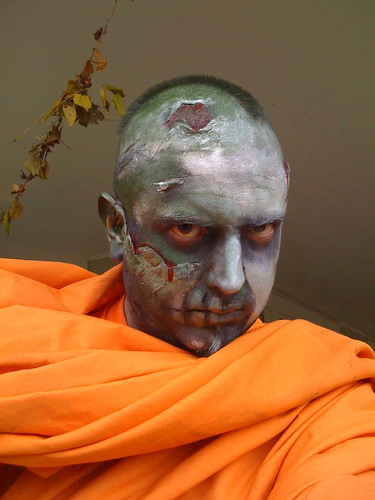
Meditation on Death, Zombies and Buddhas
[This post was written before the news of Daido Roshi's death on Friday October 9th. Daido Roshi has always been a great influence to me...especially the way that he accepted and encouraged lay-practice. And in doing so, aided in my own development and growth. I take this time to reflect upon his teachings and ability; his compassion and his wisdom. He is a giant in American Zen and his humble steps led to great vibrations in own growing community. Thank you and Cheers, Daido.]
Many zendos or places of practice will have the Evening Gatha displayed in some prominence with the words "Life and Death are of Primary Importance". Well...yes, obviously they are but Buddhism (at least some of the Buddhism that is currently espoused in the Western Convert community) place a huge emphasis on the living part and largely ignores to dying part. All butterflies and growth about "how to live more mindfully" or "how meditation can help you live a happier life" with the topic of death is largely belittled or ignored. That somber specter is glossed over with the sometimes saccharine perception of Modern Buddhist thought.
Buddhaghosa stated in Chapter VIII of the Visuddhimagga ("Path of Purification").
While nowhere near a bhikkhu, nor any plans to be one, I do understand that mindful attention to death is an important aspect to my Buddhist practice. To focus on the fact that life is impermanent is a daily, almost unconscious, task. But more importantly concern and focus one the fact that death is imminent. Concern with what would happen to my family if I were to die. Focus on this while driving to work, sitting at home or walking to the store. To focus on the fact that death could come at anytime, unbidden and unexpected, to me or to those closest to me. Yet with all this mindfulness the idea of death is still terrifying to me - even with the acceptance of my own impermanence.A bhikkhu devoted to mindfulness of death is constantly diligent. He acquires perception of disenchantment with all kinds of becoming (existence). He conquers attachment to life....Perception of impermanence grows in him, following upon which there appear the perceptions of pain and not-self. But while beings who have not developed mindfulness of death fall victims to fear, horror and confusion at the time of death as though suddenly seized by wild beasts, spirits, snakes, robbers, or murderers, he dies undeluded and fearless without falling into any such state. And if he does not attain the deathless here and now, he is at least headed for a happy destiny on the break up of the body.
Why was this so pressing?
People think that only others will die. They forget that sooner or later they will, too. They carry on without so much as a thought that death could possibly happen to them. Then they're shocked when it comes on them unexpectedly. How foolish! [Suzuki Shosan]
What is the primary concern in religious practice? - Put aside everything and only study death. Always study death, free yourself from death, and when death really comes you will not be flustered. In order to save others, knowledge is necessary. [Suzuki Shosan]
The study of and focus on was there but I was still insisting that I wasn't going to die. My focus was always on "if" I died or the possibility of something happening to me that was unexpected. It was never, in my mind, an absolute or a definite occurrence. I was an accident. Now the focus isn't on the "when" or "how". Those concepts are worthless and without meaning. The "if" of my impermanence turned to an actuality.
- I am of the nature to grow old. There is no way to escape growing old.
- I am of the nature to have ill health. There is no way to escape ill health.
- I am of the nature to die. There is no way to escape death.
- All that is dear to me and everyone I love are of the nature to change. There is no way to escape being separated from them.
- My actions are my only true belongings. I cannot escape the consequences
of my actions. My actions are the ground upon which I stand.
While Buddhaghosa focuses on the bhikkhu's perception and conception of death and while Shosan rolls on with the insistence of focusing on death as a meditative tool (almost like a koan) to unravel the true meaning of religion experience; the 5 Remembrances cuts through the noise and circumstance of death to the actual realization of it.
So...the "take home" message is simple: Zombies are much more Buddhist-y than Vampires. Vampires sit around and look pretty and never age - undead but ageless. Zombies force us to look at ourselves in the now. Zombies shamble around, slowly decaying, getting slower, they make more noise. We shamble around, slowly decaying, getting slower, we make more noise now than before (creaks and whistles and groans). Embrace your inner-zombie. Its not really Buddha-nature but it may help to focus on the fact that we will grow old and die and then (maybe) walk the earth as a mindless automaton.
So for Halloween I was going to be a Zombie but I'm going with this guy instead.
If that dude isn't a Zen Master in disguise, I don't know who is.
Cheers,
Remember if you meet the Buddha walking down the street, kill it. If you meet a zombie walking down the street, KILL IT. If you meet Zombie-Buddha walking down the street, RUUUNNNNN!!
Thursday, October 8, 2009
"True Buddhism in Virtual Reality"
Yuttadhammo over at "Truth is Within" had an interesting idea for furthering our iSangha practice - eChanting!
Indeed, a great idea! Chanting by oneself loses so much of the experience of what can be an integral part of your home practice. It may not catch on but it seems worth a shot and I appreciate the effort.
Follow this link to The Buddha Center. I love their slogan "True Buddhism in Virtual Reality". It seems to be a virtual reality monastery or temple with avatars walking around different rooms for different events (I wonder if I can bring a staff and cast Cure Light Wounds?). That may be a bit much for me but I love the effort in capturing new technologies to reach out to home-practitioners.
Personally, I like to have resources like this in reserve for when I can't make it to the zendo (read: yoga studio backroom) to sit and chant with the sangha. I already have substituted podcasts of Dharma Talks for the "real" thing since there is a real lack of Dharma teachers out here in snowy South Dakota.
Cheers,
We've managed to set up a karaoke style international chanting session over the Internet; participants hear the leader's (me's) voice and follow along based on the text that pops up verse by verse. An interesting experiment; not sure if it will catch on, but it does seem like a nice idea allowing people to come together to hear and reflect upon the Buddha's teaching from around the world. Afterwords I will sometimes give a verse by verse explanation of the Pali and concepts discussed therein. Here's a picture:
Indeed, a great idea! Chanting by oneself loses so much of the experience of what can be an integral part of your home practice. It may not catch on but it seems worth a shot and I appreciate the effort.
Follow this link to The Buddha Center. I love their slogan "True Buddhism in Virtual Reality". It seems to be a virtual reality monastery or temple with avatars walking around different rooms for different events (I wonder if I can bring a staff and cast Cure Light Wounds?). That may be a bit much for me but I love the effort in capturing new technologies to reach out to home-practitioners.
Personally, I like to have resources like this in reserve for when I can't make it to the zendo (read: yoga studio backroom) to sit and chant with the sangha. I already have substituted podcasts of Dharma Talks for the "real" thing since there is a real lack of Dharma teachers out here in snowy South Dakota.
Cheers,
Buddhists on Twitter -THE TWANGHA!

I wasn't planning on posting this morning. I didn't really have too much to say but I came across Jaye's post over at digitalZENDO on the benefits and detriments of twitter in relation to Buddhist practice. That, plus the fact that I am presenting to the Library Board next week on the usefullness of twitter for expanding and marketing library services led me to want to reiterate a few of Jaye's points.
The expression, "Social Media," gets kicked around a lot, but what does that really mean? For me that's simple. Community. I live in an area where I'm very far away from actual Zen centers and temples. While I'm aware of a group that sits near by, it's like "theoretical physics zen," and I'm not really in to hyper-analytical posturing. That's not Zen. That's getting lost in the dark and you might not make it back.
The above being said is my motivation for using twitter. I'm looking help expand and support my practice and that of others. My teacher is in Seattle, Washington and though I have regular conversations with he and a few of the Sangha members there, I recognize that I find it useful, to have a steady and consistent group of people that I can share practice with, supporting each other through the grinds over day-to-day life.
Beautiful! The whole point is community and epxanding our practice by sharing it with and learning from practitioners we would never have contact with otherwise. Personally, I connected with Jaye via twitter and I know that he has helped me deepen my practice and I hope that I have done the same for him. Reciprocity is what twitter is all about.
I am also fairly far away from any temples or large zendos and always appreciate the fact that I can expand and broaden my practice and get into contact with other practitioners in a fairly quick and easy manner. I am also familiar with the "academic book club" school of Buddhist practice that Jaye is alluding to and I wholeheartedly agree that it is not my cup of tea. Academic discussions are fine but I need to find people who actually sit and ritualize in their practice.
I am also fairly far away from any temples or large zendos and always appreciate the fact that I can expand and broaden my practice and get into contact with other practitioners in a fairly quick and easy manner. I am also familiar with the "academic book club" school of Buddhist practice that Jaye is alluding to and I wholeheartedly agree that it is not my cup of tea. Academic discussions are fine but I need to find people who actually sit and ritualize in their practice.
Where twitter can be a hassle and hindrance to Zen practice is there's people with what I might call "wayward," motivation. The endless marketing can be a nuisance. The over-reliance of quotes can be disappointing. I feel like if you're using a quote, tell me how you applied it to your life, so that I can learn from you. Otherwise quotes are just dead words to me.
Again, I agree for all the good out in the Buddha-twittersphere-land, there is plenty of annoying crap. I try to keep my follower and folllowing list clear of those so feel free to peruse through and find some people that share your voice. Twitter can also become a distraction. While it is nice to connect with people we should also not forget that while it is enriching to contact with people far away, there are also probably a few good-old fashioned home-practitioners close by as well.
The one big difficulty is to actually express yourself the small window that twitter provides. I enjoy myself with my quotes and retweets and try to bring a small spark of humor into what can tend towards a solemn practice.
Here is the list that Jaye provided. I follow mostly the same group and agree that these are some good Twangha-folks!
Here is the list that Jaye provided. I follow mostly the same group and agree that these are some good Twangha-folks!
@NuclearDwight @HappiForever @Quiverymoments @InfiniteSmile @jhalifax @UpayaChaplains @MauraAura @Tobuno @Kwansahn @ZenStorm @c4chaos @mindonly @LaurieHawley @sondrafaye @christiekoehler @pixelsrzen @thinkingplace @iDharma @sharingair @PennyStinkard @thebermuda @DharmaTalks @DrumsofDharma @ZenDirtZenDust @ljikob @BuddingBuddhist @BaltimoreZen @mindsatori @EllenSka @Elfspear @dhammagirl @aquietmind @Niptuckbill @triggerwicked @MyFengShuiLife @ryderjaphy @NotOneNotTwo @BirdOnAZafu @cdashiell @MindDeep @DhammaLinks @ksclarke @seiun_hosei @holymonky @Lawrencejiko @claudia_m @Buddhism_Now @rambonie @EarthLifeShop @tomotvos @anadanewsman @RSR108 @winsloweliot @binduwiles @tricyclemag @DivineMissWhite @12stepbuddhist @NaropaU
And a few of my own...
@newzdude76@dovemck@reformed_buddha@carolann3888@slowzen @mixdgreens
@buddhasbrewing @constancenow@dhammaway @totalyogastorm @mdbdba@ogmin @duffmcduffee @lazybuddhist @Layman_Pang @gravestomper @zenbija @mujaku @buddhagirlAZ @majidrazvi @digitalzendo
I have to say that I have enjoyed the conversations I've had with other Buddhists on twitter. I get the opportunity to learn quite a bit and it gives me a taste of how others approach their practice.
Cheers,
Wednesday, October 7, 2009
The Story of Suddhipanthaka

@Margaret_Scott via twitter was nice enough to send me this link to one of my favorite Buddhist stories and also the one that I named this blog for. My earlier rendition of this tale was somewhat lacking and I was unable to find the source of the tale to improve it. Originally from the Amitabha Sutra.
The Story of SuddhipanthakaSuddhipanthaka was in the group of people that represents foolishness and dull capacity. His foolishness and dull capacity were the workings of the law of cause and effect. He was also in the group that was diligent in eliminating karmic obstacles.
He was the slowest of the Buddha’s students and had the poorest memory. When he was taught a four-line verse, he could not memorize the lines even after several days of trying to learn them. When he chanted the first line, he forgot the next lines. When he was taught the second line, he forgot the first line.
His elder brother, also a monastic, told him that he was too slow to learn from the Buddha and that he should go home. Suddhipanthaka burst into tears. The Buddha saw this and asked Suddhipanthaka why he was crying. He told the Buddha that his brother wanted him to go home.
The Buddha told him to stay and gave him a broom. He then taught Suddhipanthaka to concentrate on the broom and sweep the floor every day. As he swept, Suddhipanthaka was to repeat just two words, “sweep” and “clean.”
Before long, Suddhipanthaka attained enlightenment and arhatship. The other monastics wondered how he had accomplished this. The Buddha said that Suddhipanthaka had been a highly accomplished Dharma master in the previous lifetime. But he always held back when he gave lectures because he was afraid that others would surpass him in their achievement if he taught everything he knew. His slowness in this lifetime was a karmic result of teaching grudgingly.
I love this tale. Thanks @Margaret_Scott, I am in your dept!
Cheers,
Tuesday, October 6, 2009
A Roshi of Worth.

I have always been moved by Daido Roshi's work, words and ability. His book Finding the Still Point aided my practice as I began to sit again as well his translations of Dogen.
I plan to dedicate my practice tonight to Daido Roshi in thanks for all of his striving. I can hopefully dedicate something longer in the future. Please join me in this dedication.
Cheers,
The Worth and Worthlessness of Roshis

Wild Fox Zen produces some great posts but I loved this one. It spoke to me as a practitioner with a sangha (both online and "brick and mortar"), as a home-practitioner and as one seeking guidance. Of course by saying I loved it, I mean that I disagreed with it as much as I agreed with it.
It opens with a definition of "self-styled" Zen:
That is all well and good and true except for that last statement - "we don't need to make a commitment". Yes, we should mold and create our own practice. We should not be limited by what the ancients told us about their practice. We should not follow in their footsteps. It is a waste of time to mimic the masters. We need to forge our own practice and commit ourselves to it. We are the stick hits us to keep our attention. We, in the long run, are our own best teachers. All teachers make mistakes and are flawed. That does not mean that we don't learn from them. Even in one zendo with one teacher their will be as many "ways" as students sitting.
I believe that one's practice of Buddhism does not really start until the bottom of the pail falls out or you have some sort of epiphany. One can practice Buddhism before that event and it is a legitimate practice. However, from my own personal experience, one's practice does not deepen until they hit the bottom and get to look up. I hate to think that this sounds very "born-again" but the reason for our practice is suffering and suffering will deepen it. When our suffering (whatever that suffering may be) reaches a point where we see the stark reality of it and we truly realize the 4 noble truths then our practice is deepened. Meditation or teachings or guidance may be an aid to deepening our practice but in the end it comes from us. You can't fake this shit. It just happens.
I think the choice of following a specific teacher or lineage is an important step in deepening one's practice but it is not a step to be taken lightly. Too many rush to teachers with the thought that practice would be meaningless without one. With or without a teacher, the person that will be deepening your practice with be YOU and you alone.
I also don't think that one teacher is all that you need. As your practice develops, evolves and matures I think that you will navigate yourself towards a teaching that is appropriate to your goals. A teacher is not a lifelong commitment - it is a pit stop in your life-long practice. I started with secular Buddhism and moved to Zen as I got older and my practice began to ripen. I expect that as it matures more it may lead me to a specific teacher and guide or to a completely different expression of the Dharma altogether.
Yes! Finally someone who doesn't equate home-practice with ease. Usually if you mention that you are a home-practitioner you are recieved as a neophyte - a person with only the barest understanding of the Dharma because you are not affilliated with a teacher. For whatever reason that a home-practitioner chooses that practice - it is unfair to assume that it is less than practice with a sangha or in a monastic setting.
A home practitioner usually has difficulty in determining how and when to practice so there is an unusually long period of "trail and error". As you sculpt your practice with little or no guidance from a teacher, you discover what works and what doesn't. A teacher may be able to blaze the same trail in a shorter period of time but the home-practitioner proudly wields a machete in clumbsy swings as they begin to hew themselves a path.
Sometimes that path leads to a zendo or meditation hall or temple and sometimes it doesn't. Either way our shoes should be worn through and our machete sharp.
Cheers,
It opens with a definition of "self-styled" Zen:
we ought to pick and choose practices that seem right to us and we ought to do practice in a way that we like and we don't need to make a commitment to go deeply into any one tradition because teachers are bums and make mistakes and so it's best to dig many shallow wells.
That is all well and good and true except for that last statement - "we don't need to make a commitment". Yes, we should mold and create our own practice. We should not be limited by what the ancients told us about their practice. We should not follow in their footsteps. It is a waste of time to mimic the masters. We need to forge our own practice and commit ourselves to it. We are the stick hits us to keep our attention. We, in the long run, are our own best teachers. All teachers make mistakes and are flawed. That does not mean that we don't learn from them. Even in one zendo with one teacher their will be as many "ways" as students sitting.
In contradiction, and imHo, all the old ways teach that a precondition to really beginning to practice Buddhadharma is to recognize that "our way" is the way of suffering and the necessary (but insufficient) first step on the path for both home leavers and home dwellers is some form of renunciation, a dropping our self-styled ideas and taking up the way of freedom.
In other words, you gotta be sick of your self to begin practice.
I believe that one's practice of Buddhism does not really start until the bottom of the pail falls out or you have some sort of epiphany. One can practice Buddhism before that event and it is a legitimate practice. However, from my own personal experience, one's practice does not deepen until they hit the bottom and get to look up. I hate to think that this sounds very "born-again" but the reason for our practice is suffering and suffering will deepen it. When our suffering (whatever that suffering may be) reaches a point where we see the stark reality of it and we truly realize the 4 noble truths then our practice is deepened. Meditation or teachings or guidance may be an aid to deepening our practice but in the end it comes from us. You can't fake this shit. It just happens.
Of course, in entering the kind of practice I'm talking about, a wise person investigates a teacher and tradition carefully for several years and if they jump in the ocean.
I think the choice of following a specific teacher or lineage is an important step in deepening one's practice but it is not a step to be taken lightly. Too many rush to teachers with the thought that practice would be meaningless without one. With or without a teacher, the person that will be deepening your practice with be YOU and you alone.
I also don't think that one teacher is all that you need. As your practice develops, evolves and matures I think that you will navigate yourself towards a teaching that is appropriate to your goals. A teacher is not a lifelong commitment - it is a pit stop in your life-long practice. I started with secular Buddhism and moved to Zen as I got older and my practice began to ripen. I expect that as it matures more it may lead me to a specific teacher and guide or to a completely different expression of the Dharma altogether.
One qualifier: especially for home-based practitioners, it isn't so simple as doing exactly what you're told, although that might be a good thing at the beginning. As a person develops practice legs, it is important that they walk on their own and to declare the truth with their own voice.
Yes! Finally someone who doesn't equate home-practice with ease. Usually if you mention that you are a home-practitioner you are recieved as a neophyte - a person with only the barest understanding of the Dharma because you are not affilliated with a teacher. For whatever reason that a home-practitioner chooses that practice - it is unfair to assume that it is less than practice with a sangha or in a monastic setting.
A home practitioner usually has difficulty in determining how and when to practice so there is an unusually long period of "trail and error". As you sculpt your practice with little or no guidance from a teacher, you discover what works and what doesn't. A teacher may be able to blaze the same trail in a shorter period of time but the home-practitioner proudly wields a machete in clumbsy swings as they begin to hew themselves a path.
Sometimes that path leads to a zendo or meditation hall or temple and sometimes it doesn't. Either way our shoes should be worn through and our machete sharp.
Cheers,
Monday, October 5, 2009
Zendo Oops: From bad to worse and beyond...

Have fun with these - I thought I would lighten things up a bit. The "bad" category are all true occurances while the other categories are usually what I thought about immediately after the "oops" that kept me laughing for most of the sitting period.
I previously put these out as tweets.
Zendo Oops #1:
- Bad: Setting Hair on fire while opening altar.
- Worse: Setting hair on fire while opening altar and spontaneously screaming "Jesus Monkey F#ck Christ!"
- Beyond: Eating the altar.
Zendo Oops #2:
- Bad: Sucking on Jolly Racher during Zazen and having red drool come out of your mouth.
- Worse: Sucking on Jolly Rancher, having the red drool and then pretending to be a zombie during kinhin.
- Beyond: After zazen and kinhin with the red drool and zombie-walking - Screaming "Brrraaaaiiiinnnsssss!" repeatadly during the Heart Sutra.
Zendo Oops #3:
- Bad: Having your fly open during dokusan.
- Worse: Noticing that you fly is open and mention to Roshi that you think you just peaked into your "Buddha Nature"
- Beyond: Pretending your "Buddha-Nature" is a Keisaku and repeatedly striking practitioners for not paying attention.
Zendo Oops #4:
- Bad: Farting, at any time, in the zendo is pretty bad.
- Worse: Farting in rhythm to the Mokugyu during any chanting service or whenever suffering is mentioned.
- Beyond: Blaming it on Roshi and yelling "KATSU!"
Zendo Oops #5:
- Bad: Cracking jokes during Dharma talk.
- Worse: Joking about crack during Dharma Talks.
- Beyond: All of the above and then taking a hit.
Zendo Oops #6
- Bad: Punctuating any conversation in a zendo or during dokusan with "F#ck Yeah!"
- Worse: Follow it up with a "Dead-Arm" punch to the shoulder.
- Beyond: Have a deep conversation with the Buddha statue and then stare at everyone suspiciously.
Last Zendo Ooops:
- Bad: Dead leg after zazen and doing zombie walk kinhin *step, ddrraaaggg, step dddrrrraaaaagggg*
- Worse: Eating another Jolly Rancher and repeating Zendo Oops #2.
- Beyond: Giving the person in front of you a "Flat Tire" and then staring at them like they're the asshole.
Zendo Oops Bonus:
- Bad: Sharing aride to sesshin and singing "108 bottles of beer on the wall, 108 bottle of beer, take one down pass it around and into Buddhist hell you go!" for the entire ride.
- Worse: Actually drinking 108 bottles of beer on the way to sesshin.
- Beyond: The horrible beer farts during zazen the next day coupled with the hideous "Hotei's Log" you left as a present in the zendo's "Room of Thinking".
Cheers,
Saturday, October 3, 2009
No Place Like Home - Reflections of a Zen Home Practitioner

Going Back to the Sangha -
I recall the reason why I went back to sitting with a brick and mortar sangha - the upcoming birth of my daughter about 15 months ago. During my wife's pregnancy I got an urge to get back into my practice in a very "real" way; to find people around my area that I could connect with on the level that I felt that my practice was at. This is not to say that I thought my practice was any stellar event. However, when my father refers to my practice as my daily yoga and my wife occasionally rolls her eyes when I talk about it, one comes to the conclusion that a different atmosphere and perhaps, venue, is needed. Either way, I was feeling the need to substantiate it in some way.
I did my research and looked into some area sanghas - one Tibetan, one Theravada and one Zen. I made the phone calls and asked about how each group approached their practice. Was it on a regular schedule? Lay or monastic? Was it completely independent or associated with a larger institution? Mostly meditation or devotional? Large or small group? Cost and Fees?
More importantly, how did the people feel to me when I spoke to them on the phone or in person? Lucky for me, each group was what I was looking for. Small, personal with only loose affiliations to larger centers or organizations and no or minimal costs and fees. I was taking my time, enjoying this new search and exploration. I still can not believe my luck in finding so many small, independant sanghas in my area.
My search somewhat changed when I heard on the news about a father that threw his 18 month years old baby across a room and into a wall. I knew the foster family (I worked with the foster mother) that was taking care of the child previously and they just recently had to give up the child to the actual parents who were just out of rehab. It wasn't two months later that this happened. The foster family cared deeply about the children under there care and repeatedly made mention of the fact that they believed the children to be in danger.
I don't think too many people realized how much this affected me when it occurred. I couldn't stop thinking that it could easily be me as that father. Not really that father since, he was a drug addict and just out of jail. Rather, a father that loses control, gets frustrated and in a moment of stupidity - does something horrible. I was never a violent person. Never got into fights or started altercations with people but I was always angry and intense. Would it really be that small of a leap?
The next day I walked into that little zendo and started to accelerate my practice. I never really expressed how much it would have taken me to get through those doors again otherwise. It was difficult to approach strangers about something as personal as my home-practice. But the idea that I would soon be walking into fatherhood - a situation that was completely unknown to me and with which I had no previous experience - pushed me through those doors. I started to sit again with a group and chant and engage other Buddhists. I started this blog.
When I walked into the zendo for the first time, a long-time member walked up to me and we started to talk about why I was interested in starting my practice there. I told her that I would be having a daughter soon and I wanted to prepare myself for it by engaging in public Buddhist practice again. To myself, however, I told the truth. The truth that I wanted to start out of compassion for my daughter - out of the fear that I would be as horrible as that man who threw his child.
Before we walked into the meditation room to start the first sitting the lady I was talking to mentioned that she heard that the little boy in the news that got thrown had just died from his injuries. I sat that day harder than I ever sat before or since. In between my sore ankles and burning thighs, I sat for the benefit of one sentient being that morning and have been striving ever since.
When I walked out the lady came up to me and said "I wish more fathers would sit". I agreed. The whole concept of "sitting for the benefit of all sentient beings" became slightly less esoteric that morning.
Cheers,
Saturday Morning Dharma Mouth-Punch
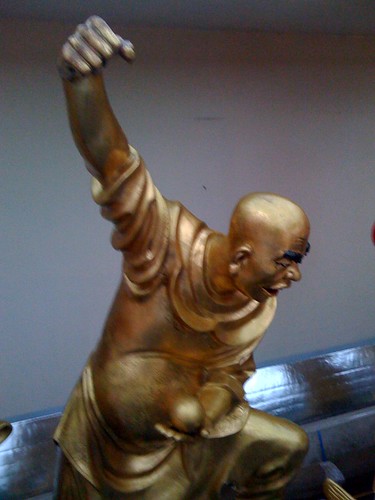
This is going to be a new ongoing weekly feature of my blog - The Saturday Dharma Mouth-Punch!
The concept is simple: I will review a blog -from the past week that either gave me a good Dharma punch in the face (good) or deserves a good kick in Hotei's sack (bad). Get it? It works both ways. I can either give it or receive it. I'm like a sour patch kid...I start off sour but I can be sweet in the end.
For my first run at this - I am bringing back an old favorite - Mujaku from the The Zennist. Mujaku delivered a sweet Dharma Mouth-Punch with his post on Stuart Lach's article The Zen Master in America: Dressing the Donkey with Bells and Scarves. Stuart does an amazing job of outlining, in a respectful manner, some of the more dramatic American Zen scandals as well as successfully dismantling the "Roshi Ideal" so prevalent in the West. Any practitioner of Buddhism (not just Zen) needs to read this before following any teacher, guru, roshi or rishi.
The truly amazing part about the article is that Lach actually is able to steer away from sensationalizing these scandals and succeeds in making you feel for the Roshi's own human failings (for the most part, at least). Equally amazing is that Mujaku was able to devote an entire post to someone else's opinion without bashing Western Buddhism in the process. My lip is still bleeding - The Dharma it has a killer left.

However, Mujaku is also receiving a good kick in Hotei's sack for stealing a post that I have been toying with for three months. I have been playing around with a Zen scandal post - tweaking here and editing there - and was hoping to post it soon and Mujaku just *zip* pulls the rug from under me.
Fie on you Mujaku and your beautiful post! Now go get some ice on that sack!
Cheers,
Fie on you Mujaku and your beautiful post! Now go get some ice on that sack!
Cheers,
Friday, October 2, 2009
Unrequited Vipassana Love Demons
 Picture from Wat Arun, Thailand
I love Brooke from Wandering Dhamma - I know it's sudden - but sometimes she blows my mind. I have never heard a more clear and concise description of the secular Buddhism as this...
Because Buddhist meditation, especially vipassana, has been divided out from and is seen as separate from the Buddhist religion, it can be considered an example of a portable and exportable version of an indigenous Asian tradition. It has become portable because of its non-specific religiosity and few institutional connections. Among Western Buddhists, vipassana meditation has been popular because it has been interpreted as having this universal, transcultural quality. This kind of thinking is certainly true in some American Buddhist circles. In Wendy Cadge’s study of a convert community in Cambridge, Massachusetts, titled Heartwood, she finds that the Buddha’s teachings are primarily conveyed through meditation instruction. Many Western vipassana meditation teachers adapt and present the teachings in a Westernized way so that practitioners often call themselves vipassana meditation students rather than students of Theravada Buddhism.
I especially like this definition which, from my experience, is how many of my Sangha-mates view Buddhism in general and Zen practice in particular (not overtly or specifically religious). This way that compartmentalized aspect of "an indigenous Asian tradition"moves into whatever devotional or cosmological framework you already have established (from your experience or upbringing). And while Brooke is primarily referencing vipassana in her post; I think that the same can be said of Zen meditation as well.
Since this portable Buddhism has sort of a luggage theme running with it, I'm not sure if I would call those that utilize meditation in the course of their spiritual and religious explorations converts. I believe I will call them Buddhist Travelers and they will be required to identify themselves by wearing pointed red hat like that gnome from the Expedia commercials.
So Brooke...I know we are both already attached but there is always reincarnation, right? Maybe we will come back as bunnies.
Too much?
Cheers,
Thursday, October 1, 2009
Cookie-Cutter Buddhist Practice

All roads lead to the same mountaintop.
Be a lamp unto yourself. Work out your liberation with diligence.
We all have a responsibility; to ourselves and to others, to those we never met and those that we spend our daily lives with, to strangers and to lovers, to aspire to our own liberation. Damn, those words sound far too lofty to be coming from me. I am a bag of wind.
However, it seems to me that we are often stuck in the middle of a pissing match between opposing (really?) schools and sects. Teachers and roshis engage in a Dharma Combat that seems more appropriate for the Jerry Springer Show than for a meditation hall.
Organizational Buddhism is fine but don't get too wrapped up into the hype that it sometimes represents. When someone, Roshi or not, tells you that their path is the correct one and all others are wrong - they are stifling your growth and building their own ego. For me, the truth seems simple. The mountain has many paths to the top but not every one is right for every practitioner. We choose our own route. Take the time to learn about the other paths and incorporate what seems right into your own practice. Ignore the boundaries that the patriarchs and the past have placed upon us. Ignore whether or not it is "authentic" or not. Ignore whether or not your practice is the same practice that your sangha-mates participate in. If your practice includes other religious and spiritual outlets, then go with it.
In the long run, all of us (Roshis, monks and lay persons) are walking bags of dung but even dung-sacks deserve a practice that is individual to them. Be a Buddhist pirate and pillage these schools for what is useful to you and leave the rest. Settle down with one if you pillaging days are over but remember that it may only be temporary. It may be time to take to the seas again.
Pirates are awesome.
Cheers,
Pirates are awesome.
Cheers,
Wednesday, September 30, 2009
Only Half a Buddhist

A post in the blog All Considering came up with a quick and easy definition of what a "real" Buddhist is...
A real Buddhist, in my view, and in the Traditional Asian view, is someone who has taken refuge. That is, in a solemn ritual they have taken refuge in the Buddha, the Dharma and the Sangha. I have not done that so I'm not officially a Buddhist.
Really? A ceremony makes a Buddhist real? While I won't stomp over some one's opinion or their personal definitions of Buddhism, I will make an attempt to better define what a Buddhist is. Although, granted, my definition will be as flimsy as any other definition offered. It is next to impossible to say what being a Buddhist means to such a diverse group of practitioners but I can go deeper into how I define myself as a Buddhist.
The ceremonial aspect of taking refuge in the 3 Jewels is important step in the practice of Buddhism but does not define a Buddhist as real or not. Most Buddhists will take those vows eventually in the evolution of their practice but it is by no means necessary to make it "official" by involving a monk or priest or piece of paper. I made those vows for myself one morning after a horrific event in my life. The bottom of my pail fell out and it was time to refill it. I took the vows and I began daily practice and I am a Buddhist. If I took those same vows in front of a monk or priest they would have meant next to nothing compared to when I was driven through my own experience to make them. Which would make me a "real" Buddhist, I wonder.
This is not to say that the "official" taking of refuge (or the precepts or intense meditative retreats) is without merit. They serve a purpose in deepening one's commitment to their practice and to Buddhism. Also, if one is looking for guidance with their own exploration of Buddhism then it is important to ascertain whether or not a teacher is "authentic". In the end it is really up to the individual how much emphasis they put on the ritualistic or organizational aspects of Buddhist practice. I put great emphasis on the ritualistic but very little on the organizational. This is not a definite - It is just my practice now.
Whether you want to call your self a Buddhist is up to you, the individual, to decide. If you are a practicing Christian or Jew and wish to label yourself as a Buddhist as well - then by all means - Do so. If it helps your practice and understanding of the Dharma then do it. If you don't feel that the label of Buddhist is right for you or if you think that your practice is contrary to the fundamental teachings of the Buddha then do not call yourself one. It means very little to me whether or not you consider yourself a Buddhist. If you are applying the Dharma to your own life in a way that fits your life - Then I couldn't be happier.
Now, I may be mistaken but a "solemn" ritual does not necessarily entail monastic representation for one to take refuge. I take refuge daily in my own practice but I have no specific ceremonial experience to speak of. Do I really need someone to tell me that it isn't "real" unless it is witnessed by a monastic or lay-ordained practitioner? I don't try to pretend to be anything that I am not. I am not lay-ordained or a monastic and I have very little experience in the realm of monastic practice. My practice is mostly home-centered and with a small lay sangha (mostly, two are lay-ordained). This does not make my practice and experience any less relevant compared to someone with more practice in a monastic setting.
My thoughts are simple in this manner - You learn from what resources are available to you at this time in your life. Don't spend your days wishing that you had a larger sangha or a monastery close by. Or a specific school or sect that is nearer to what you think Buddhist practice should be. Use what is available to you now. Your only enemy is a lack of striving.
Its really all just tools. We are trying to build something...why would you worship the specific hammer that you are using when the big picture is the process of building. Zen is my hammer for now but it may be that sometime in the future a new tool is needed...just have to wait and see.
Cheers,[Jack Daw is a non-lay-ordained home practitioner of Buddhism. He has no specific lineage or teacher. Instead he grabs what he can like a crow picking a carcass. He currently practices Zen but that could change as the wind does not blow from the same direction everywhere. He does however think that all beings deserve compassion. He is also fighting a three day flu and feeling quite pissy right now - but this will pass.]
Updated Bat Nha links and info
From Barbara's Buddhism Blog:
A violent mob drove Buddhist monks and nuns from Bat Nha monastery in Vietnam over the weekend, according to several news stories. Agence France-Presse reports that more than 100 monks fled Bat Nha on Sunday when a mob armed with hammers and batons showed up and threatened then. About 200 nuns left Bat Nha earlier today.
The monks and nuns of Bat Nha are followers of the internationally revered Vietnamese Zen teacher Thich Nhat Hanh. Thich Nhat Hanh fell into the bad graces of the Vietnamese government last year when he told an Italian interviewer that His Holiness the Dalai Lama should be allowed to return to Tibet. The government of China then pressured Hanoi into punishing Thich Nhat Nanh's disciples living in Vietnam.
This is less about mixing religion and politics and more about well-respected religious leaders speaking out against brutality and ignorance. Many say that Buddhism is a docile and "removed" religion but its leaders will speak out when necessary and they do so honestly. But it should always be remembered that any "state-sanctioned" religion will lead to ignorance and intolerance even under the best of circumstances. Best of luck to those monks.
For more info:
- Plum Village - Bat Nha Needs Your Help
- Mob, police force nuns to leave Vietnam monastery - Associated Press -Vietnam Buddhist Standoff
- Vietnam Buddhists flee amid threats
- The Reformed Buddhist - Vietnam Govt Raid Buddhist Monastery
- The Buddhist Blog - Urgent Help Bat Nha Monastery Emergency Angry Asian Buddhist - [check for videos] tinh hinh cac thay co het suc kho khan
- The Buddha is my DJ - Bat Nha Monastery
- The Buddhist Blog - Vietnamese Bat Nha Monastery Raid Update
- The Budding Buddhist - Urgent Update: Bat Nha Monastery
Monday, September 28, 2009
The Asian Welder and Bonfires
 I woke up this morning, headed to the dump to drop off some recycling and pick up some wild plums from a friend to make plum wine when I saw a package hanging out of my mailbox. What do you suppose was within the package? Well, a brand new t-shirt from my new Sangha-sibling Hazel from "The Asian Welder" blog!
 So we had a great day of curry, pho (Vietnamese Noodle Soup), spiced cider and bonfires. And I got to wear my fancy new shirt the entire time. The front says "Spark This" if you can't tell from the picture.
 So, please stop by The Asian Welder, check out her work, read a little Buddhism and thank Hazel for me for sending me the sweet, sweet shirt. I can't afford to buy them new anymore so if you got a t-shirt you want me to wear about anything drop a me a line on twitter, send it to me and I'll wear it.
I am a whore for this sort of attention and frankly I love me some t-shirts...maybe next time I'll even pose sexy-like...
Cheers,
Sunday, September 27, 2009
Dirty Watches and Filthy Buddha-Nature

From Zen Flesh Zen Bones:
- 29. No Water, No Moon
When the nun Chiyono studied Zen she was unable to attain the fruits of meditation for a long time.
At last one moonlit night she was carrying water in an old pail bound with bamboo. The bamboo broke and the bottom fell out of the pail, and at that moment Chiyono was set free.
In this way I tried to save the old pail
Since the bamboo strip was weakening and about to
break.
Until at last the bottom fell out.
No more water in the pail!
No more moon in the water!
This reminds me of my own eventual conversion to Buddhism - years of study (in a laid-back bedside table sort of manner) which led up to one explosive moment when the bottom of my pail broke and all the water ran out. That explosive part of anyone's conversion is a stressful and sometimes painful one but one that needs to occur. The reasons will differ from person to person but in the same way an addict needs to hit rock-bottom to see the top - I needed to see my world of attachment for what it was.
In Rinzai Zen this moment can be described as...
A revolutionary experience and insight capable of shattering all categories of thought and sweeping away all academic exercises and turning the world upside down...like a time bomb ticking in the depths of consciousness... [Once Born, Twice Born Zen]
This experience can not be realized until the tension, frustration, doubt and confusion in one's life hits a boiling point - a point where the vessel can no longer contain it - it is kensho or bust! In Soto Zen a less dramatic approach is taken with an...
Enjoyment of one's intrinsic Buddha-Nature...allowing this Buddha-Mind to well up and flow through all areas of one's consciousness and life. One does not begin by building up a strong sense of false and illusory ways of thinking and being, but a positive sense of fundamental well-being...[Once Born, Twice Born Zen]
Most converts fall along the spectrum of these two extremes - maybe not necessarily in Zen practice, itself - but as a gradual move from something else to Buddhism through a nurturing of the Buddha-mind or a drastic switch due to the bottom falling out.
I look at this moment as a convert's initial piece of enlightenment - a fleeting, brief glimpse of kensho as the bottom of our bucket falls out and everything rushes out leaving a husk of the former vessel. Momentarily, unable to hold anything or be filled up again. It doesn't last a long time but whether gradual or sudden we do feel a sense of the absolute at that moment of conversion...at least I did.
Mine was both sudden and gradual. A gradual and slight nurturing of the Buddha-nature (as well as the increases in tension, confusion, frustration and pain) enveloped in all of that samsaric nonsense. Hidden from view but growing slowly. However, at that moment of sudden emptying, the Buddha-nature stands very clear and apparent. But only for a moment. A convert's brief picture of enlightenment. The crack-cocaine of Buddhism.
Mine was both sudden and gradual. A gradual and slight nurturing of the Buddha-nature (as well as the increases in tension, confusion, frustration and pain) enveloped in all of that samsaric nonsense. Hidden from view but growing slowly. However, at that moment of sudden emptying, the Buddha-nature stands very clear and apparent. But only for a moment. A convert's brief picture of enlightenment. The crack-cocaine of Buddhism.
So now that we've seen that jewel and acknowledge and take refuge in it. What do we do with it? The image of a jewel to be polished through practice somewhat goes against my sensibilities. With practice we keep that jewel bright and shiny - radiating out for the world to see. Blah! My jewel, my Buddha-mind, is dingy and tarnished with experience. Unlike a piece of jewelry, my Buddha-nature isn't for public consumption - for others to see and gawk at. It doesn't need to shine forth and glow since I already know that it is there. My wife bought me a turquoise and silver watch for my 30th birthday. It was far too expensive but my wife knew that I would need something to mark that turning point in my life.
Tradition is that a watch such as that is never cleaned or polished. It gathers the dirt and the dust of its owner and it tells a story. My watch has got bits of shale from my summer field work and specks of epoxy and glue from working in the lab. It has blood and has been broken a few times. Fixed but never cleaned. That grime tells a story of where I have been, just like the hands of a mechanic or farmer or accountant - grease and oil, dirt and much, smudges and ink.
A face well-worn from the sun and wind or smooth. It doesn't matter. My Buddha-nature sat and grew slowly, unrealized, through many mistakes and errors of my life and emerged briefly to mark its presence when my bottom fell out. I will nurture it but I refuse to clean it - Refuse to ignore and forget what brought on its appearence. My Buddha-nature will hold those scars of my youth and marks of my old age, my triumphs and my failures. Like my watch that will pass to my daughter after my time with it is done so will my Buddha-nature to the next - both with traces of Pierre Shale and blood, ink and tears, failures and successes.
Cheers,
Saturday, September 26, 2009
Sake and Beer Brewing Update
 Both bottles of sake - Left is filtered once and right is twice filtered - Notice that the left still has sediment at bottle's bottom.
No Buddhism here this morning, just and update on the brewing of sweet sake and Chai Beer.
Sake Update:
 Well, its been a couple of weeks since I started my batch of sake. Above is our co-brewmaster El Blanco Grande and he is holding our fermenter full of rice/koji/yeast slurry. It smells delightful but I may not have steamed some of the rice fully before transfering it to the fermenter - many individual grains are still noticeable. Don't be fooled by the perspective in the picture - that jug hold 5 gallons - El Blanco Grande is just that massive.
The pouring, pasteurizing and filtering of the sake slurry. I learning something new - If you want crystal clear sake (or at least close) add 5 coffee filters to a funnel and pour the liquid through it. It will take forever to filter through but it will come out pretty damn clear. I'm still playing around with methods to get it clearer. Also you could possible just filter once and let it settle for a day in a secondary container and then filter again.
Chai Beer Update:
Looks good. Tastes good and is being moved into the secondary fermenter for another 10 days. Then bottled and conditioned for 3 weeks. If it is tasty and delightful after that time I will post the recipe and about my winter brewing project. Traditional Viking Beer brewed "traditionally" - smoked grains over birch, juniper filter and horned hats. I see the possibility of massive failure in this one but I am excited to spend several hours outside smoking the grains.


Friday, September 25, 2009
Virtual dharma resources for REAL practice

In an effort to help some of those home-practitioners that don't have access to a physical sangha or zendo and rely almost completely on home practice to study the Dharma and further their own growth, I though I would list some of the online resources out there. There are plenty of others out there but these came to mind....
- White Wind Zen Community Long Distance Training Program - The practice of Zen is experiential and instruction is based on your actual experience of doing the practice. As soon as possible after reading the transcript and sitting for a full half hour according to the instructions it contains, please write to the monastery to let us know that you read the "Beginner's Mind Workshop" transcript, sat and would like to receive further instruction. Please include in your email some detail concerning what you experienced while sitting and write out any questions that came up. Your email will be answered by a practice advisor or a Dharma Teacher in residence at Dainen-ji and this will be the beginning of an exchange for the purpose of clarifying your understanding of Zen practice so that you can eventually apply as a public student of Ven. Anzan Hoshin roshi.
- Treeleef Zendo - This zendo is dedicated to students of Zen Buddhism who cannot travel to a zen center or who otherwise wish personal contact with a zen teacher... [a full review of this site is here]
- Wild Fox Zen Blog - The Moon Reflected in the Water: 100 Day Practice Period begins on Saturday for those practicing from afar. The expectations might seem a bit more than you can handle - zazen, Heart Sutra, study, webinar, capping phrases - and if you think so, it might be just right....Anyway, there is still a seat open for you in the virtual practice zendo. If you want to jump in, shoot me an email (wildfoxzen@gmail.com) or register via Facebook by Wednesday. No previous practice period experience necessary. [I think this session is closed but they seem to be willing to do this again, I hope].
- 108 Days - Follow along with the posts for 108 days of meditation. No longer an active blog so engagement is limited but a good way to slide into a daily routine.
- AudioDharma - The Insight Meditation Center (IMC) is a community-based urban meditation center for the practice of Vipassana or Insight meditation. We are a non-residential center in Redwood City, California, dedicated to the study and practice of Buddhist teachings. IMC offers a broad range of practice and community activities. This includes a weekly schedule of meditation sessions, dharma talks (talks on Buddhist teaching and practice), classes, group discussions, yoga practice and a variety of meditation and study retreats. IMC began in 1986 as a gathering of individuals who meet in order to learn, support and deepen their mindfulness practice. It is an informal group, and those interested in mindfulness meditation are heartily welcome to participate whenever they wish. IMC does not require payment for any of our teachings or meetings. The support of our teachers and all our center expenses is done through the voluntary donations of our community. The group is guided by Gil Fronsdal. [Gil may be the closest thing to a bodhisattva that I will ever meet...the man kicks ass]
- BuddhaNet - Its got everything you would ever need, I think, for a full home practice. Sans an actual teacher. [Enough info to make your brain go *pop*!]
- Podcasts - DharmaRealm, Ancient Dragon Zen Gate Dharma Talks, Buddhist Geeks, Rochester Zen Center Teisho, San Fransisco Zen Center Public Lectures, ZenCast [Just a few of my favorites. Plenty more out there from reliable zendos and practice centers. Most have online newsletters too]
- Blogs - Plenty but start at digitalZENDO and The Zennist for an example of two polar opposites in a broad array of fantastic blogs out there. [I can't even start too explain how many are out there but I like these two since they give two very different views of Buddhist and Zen practice]
- Alan Ashley recommends WildMind Buddhist Meditation Resources and Free Buddhist Audio. Thanks!
- Thank you Adam for the recommendation of Urdan Dharma
This list is by no means meant to be extensive and it is skewed towards Zen practice by Buddhists on Purpose (lol, hilarious term. Makes me think of "Pigs in Space") but if you know of any other resources please list them in the comments and I'll toss them in...
Cheers and welcome to Buddhist Purgatory (I should rename my blog that, Thanks Kyle!),
Thursday, September 24, 2009
Silent Chanting

One of my biggest concerns when I began an actual flesh and blood sangha practice was the prospect of chanting aloud. I have sat in meditation for years (not in one stretch) and was comfortable with that aspect of public practice. The altar opening, ritual, bowing and prostrations were equally familiar to me since I spent years performing them on my own in my home. I did not feel self-conscious or nervous about applying in public what I already did at home for a number of years.
Chanting on the other hand, I approached with extreme trepidation. On the surface level, there was the fact that some of the chants were in Japanese or Sanskrit that led to my nervousness. I screwed up the pronunciation of many of the Japanese phonemes or would get lost on the page as my eyes struggled to keep up with the chanting and my brain was lagging far behind in reminding my lips which phonemes were pronounce in which ways.
But language was really only scratching the surface. The material contained in the "Pure Land" sutras seemed shockingly similar to the prayers that were offered in a Christian prayer. It felt like I was asking or beseeching some outer-worldly power to intervene in my behalf. It was not aiding me in focusing on my practice at all. In fact, it was doing the opposite.
Until I ran across this explaination by Ven. Anzan Hoshin roshi that helped put this into perspective:
Chanting on the other hand, I approached with extreme trepidation. On the surface level, there was the fact that some of the chants were in Japanese or Sanskrit that led to my nervousness. I screwed up the pronunciation of many of the Japanese phonemes or would get lost on the page as my eyes struggled to keep up with the chanting and my brain was lagging far behind in reminding my lips which phonemes were pronounce in which ways.
But language was really only scratching the surface. The material contained in the "Pure Land" sutras seemed shockingly similar to the prayers that were offered in a Christian prayer. It felt like I was asking or beseeching some outer-worldly power to intervene in my behalf. It was not aiding me in focusing on my practice at all. In fact, it was doing the opposite.
Until I ran across this explaination by Ven. Anzan Hoshin roshi that helped put this into perspective:
In chanting practice you needn’t be shy, needn’t hold back and whisper. You’re not praying to gods or angels or Buddhas. You are manifesting the power and integrity of breath, sound, and posture as this sound of the moment. Allow the sound to swell from the hara in your lowest natural voice register. Abandon hesitation and self-consciousness and feel the sounds vibrating in belly, throat, and mouth. Feel air as breath being drawn in and released as sound. Penetrate the ten directions with this chanting and wake up all beings by exerting both the dignity of the words and the dignity of your expression of them.
Just as when I focus my breathing while meditating, I began to focus on my breathing while chanting. The actual words became less and less important as they became more internalized in to my routine. I would start chanting and continue without reading the words or even thinking about the words as they came out of my mouth. My voice is still horrible and I fumble (horribly) over the Japanese sometimes but I rarely even care. I like to yell. Its fun. And it has no focus beyond the pushing of the air out of this poor wind bag.
The mind is clear and traceless, it does not ponder the meaning of the words as you chant. An alert posture, pure intention, and moment to moment awareness actualize the meaning of the words.
"Pure Land" sutras or not. It doesn't matter as much anymore. I may not particularly "like" a particular sutra for some reason but in essence reciting it is the same as reciting any other one - its just air being pushed from my lungs.
Focus on the sutra's whole presence first, then focus on the words that come and then on the sounds that arise, leave your mouth and disperse. Soon, you don't even hear the words anymore, they don't matter. Just like the ringing of a bell, the sound is impermanent and drifts into silence - You know that they were there but they're is no evidence of there presence. In understanding the origin and trajectory of those sounds we pay homage to our own innate Buddha-Nature. It doesn't matter what the content is or if the language is familiar or not. It all breaks down in the same way. They all disperse into silence. We chant silence.
Chanting, allow this jewel to shine and, in so doing, see that the jewel has no boundaries and is never limited by any single facet or reflection of light. The Four Great Vows are the essence of the Bodhisattva’s energy, the Heart sutra the Bodhisattva’s mind and so on. Express and actualize these in each sound, each moment of chanting, sitting, walking, working, breathing. In so doing, liberate all beings, all times, all directions, all sounds, all breaths.Cheers,
South Dakota - Buddhist Purgatory
 I woke up this morning to a wonderful post by the Reformed Buddhist mentioning the Purgatory State - South Dakota.
Invent a Buddhist Purgatory and put it in South Dakota where there
really is no difference.
Well, thank you Kyle for thinking of us, luckily the Hungry Ghosts and pretas have left us alone for the moment so Samsara baby and myself could enjoy some zazen this morning (thus the picture, taken only moments before a random attack from roaming Hungry Ghosts). Just so you know what we are up against here is the description of what I have to fight against to get into work every day.
Pretas are invisible to the human eye, but some believe they can be discerned by humans in certain mental states. They are described as human-like, but with sunken, mummified skin, narrow limbs, enormously distended bellies and long, thin necks. This appearance is a metaphor for their mental situation: they have enormous appetites, signified by their gigantic bellies, but a very limited ability to satisfy those appetites, symbolized by their slender necks. [http://en.wikipedia.org/wiki/Preta]
Very scary and you thought ZombieLand was bad! And let me tell you, the Blood Pool Hell Sutra leaves some talking points as well. But, well, home is home and we do our best.
Cheers and Happy Zombie hunting!

Subscribe to:
Posts (Atom)


