Monday, July 20, 2009


Sunday, July 19, 2009
Filthy Filthy White Buddhists

...But on the other hand, the Vietnamese group’s behavior may have reinforced the notion of them as loud and crude foreigners and “outsiders” to the rest of the attendees. As such, failing to confront their behavior could have caused more harm than good in terms of helping to bridge social divisions and dispel lingering cultural stereotypes toward non-Whites and/or foreigners. For me personally, this is a complicated issue that highlights some of the ironies and contradictions involved in being Asian American, as I wrote about earlier in regards to a similar incident in an airport security line — standing up for and defending Asians in racial solidarity, but also being embarrassed and even annoyed by their “foreignness” as an American myself. Wow...a group of people were loud at night. Hmm...to me this is cut and dry. They either didn't know the rules or didn't care. Has nothing to do with race. I appreciate you admitting the complexity of the first incident and that many factors may be in play that you are not aware of. I am sure you will provide the same for the second...
In contrast, the second “racial” incident at the retreat does not involve much ambiguity at all. (Fuck....)
...Specifically, during the retreat, families were assigned to different “service meditation” work groups, helping the monks with different tasks involved with running the retreat, such as cleaning bathrooms, setting up the meditation hall, etc. Our family was assigned to one of three teams who helped to clean up, wash, and dry plates, pots, and utensils after one meal each day. My family and I actually enjoyed this work as it allowed us to give something back to, or at least directly help in the mundane, behind-the-scenes operation of the retreat — a sense of ownership perhaps. We also felt a sense of community in working as a team within not just our family, but with the other families in our group, each of us doing our part to contribute to the larger purpose and becoming closer to each other in the process. I am very familiar with this form of meditation. I actually enjoy it quite much...very surprising being that I am both white and privileged (by privileged I mean that I was raised without serious want by caring parents)
However, after the last meal (lunch) on the last day of the retreat, there were no teams assigned to clean up afterward and instead, the monks asked for volunteers to stay a little bit to wash dishes, etc. Our family was not in a rush to leave so we joined in the effort.
As it turned out, of the 15 or so people who stayed to help clean up, all but one was a person of color — there was just one White person who helped in the cleanup... This is a shame but I still don't think that it is from an over-arching white perception that others should do the cleaning up. And what about the other people who didn't stick around?
...I hate to say it, but the actions of this particular couple and the White attendees present at this last lunch seem to be a microcosm of the White-privileged notion that service work should be left to people of color and that unless they are specifically assigned to do so, many Whites seem to think that they are “above” such “demeaning” work and physical labor. A Buddhist retreat is FAR from a microcosm of society. And I appreciate that whites "seem" to think they are above such things. Well, let me clear this up. We are not. What you probably met at this retreat are what I call "douches" or "dip-shits". It is a category that spans every race that I am familiar with. And seriously, what white privileged notion that service work should be left to people of color. Your observations are colored by your own biases. You are seeing what you want to see.
These two incidents go to show that even at an event that shows us the peace, harmony, and mindfulness that exists in American society and among people from all kinds of backgrounds, in many ways, American society is still quite racialized, even if most of us may be completely oblivious to such dynamics. That seems to easy and ridiculous...being completely oblivious to "dynamics" that causes me to not clean up in a social situation where other minorities may be present b/c subconsciously I believe that they should be doing it?
The simple fact is that both groups probably just did not understand the rules. Since the staff was unable to confront the group of rowdy night-time party animals one can also assume they didn't outline the specifics very well at the lunch. Who knows?
I can't explain it any better than Occam's Razor. Simple explanations are always the best in lieu of new evidence and observation. And the simplest explanation in this case is that the people just didn't know the rules. It is simply in bad taste to make this one event into a racial stereotype especially since it seemed that for the most part this retreat did exactly what it was supposed to do....bring a group of diverse Buddhist practitioners together.
Le is not putting his PhD to good use...actually just the opposite he is driving people away from each other by parading a few personal recollections around as grandiose theories.
All of us need to refrain from making obtuse generalizations. While it is every one's right to say what they wish as long is it is neither inflammatory or slander (and my comments are sometimes both), I think that comments of type from Mr. Le generally hamper rather than help. We all find ourselves drawn to Buddhism and we all come from diverse socio-economic and cultural backgrounds. This is different from many other religions that have a tendency for more cultural and racial segregation (not on purpose but well...Greek Orthodox does limit itself to Greeks and...um, maybe an Albanian or two). As such this diversity is our strength but it can lead to some difficulties as well. We need to understand that what was missed was a valuable "teachable moment" where others on this retreat could have bridged the gap that tends to form. This self-segregation happens and can be just as detrimental to practice and understanding as the forced kind.
I think Kyle over at Progressive Buddhism put it best:
I have seen this phrase a lot, "privileged white people", and I can tell you it is no less offensive than the words "privileged Asian people" when describing an entire race of people. I know my life is not the 'privileged rich white liberal intellectual' that I have seen so many people peg white Buddhists as being; my life is far from fucking privileged. I'd bet dollars to donuts a good majority of the white people that read this and many other blogs have struggled, had very difficult hardships and suffer just as much as many Asians or blacks or Hispanics that live in the West, or around the world today. Does that mean that there aren't white racist Buddhists? Of course not, there are. Does this mean we should brand an entire race of people, based solely on the color of there skin into a narrow minded generalization? Hell no. If I was half white and half Asian, does that mean I am only half privileged and half lazy?
Cheers,
Oh, Bodhi Tree! Oh, Bodhi Tree!
Great post by Gary Busey (The Zennist) on the origin of the Bodhi tree in Buddhism.
I especially like the concluding quote on how Buddhism is really just reformed Brahmanism. I think this is true but that also begs the question...how was it reformed and why? I have always felt that (I have zero to back this up) that it was an agnostic reformation. A movement away from the universal spirit of Brahma and towards a more practical practice.
It seems that the Brahmanistic terms used in the early Buddhist works would make sense since that would be the easiest way to make a new way of thinking accessible to the populous.
Cheers,
I especially like the concluding quote on how Buddhism is really just reformed Brahmanism. I think this is true but that also begs the question...how was it reformed and why? I have always felt that (I have zero to back this up) that it was an agnostic reformation. A movement away from the universal spirit of Brahma and towards a more practical practice.
It seems that the Brahmanistic terms used in the early Buddhist works would make sense since that would be the easiest way to make a new way of thinking accessible to the populous.
Cheers,
Dogen's Shobogenzo Zuimonki Part 1

The Shobogenzo Zuimonki is a collection of short talks, orations, comments on instruction and cautionary tales written by founder of the Soto sect of Japanese Buddhism Dogen (1200-1253) and recorded by his student, Ejo (1198-1280).
It was penned by Ejo between the years of 1235-1237 and remained unpublished for 400 years.
When compared to Dogen's massive opus; the Shobogenzo (Treasury of the True Dharma Eye), the Shobogenzo Zuimonki is a much simpler and basic text without the philosophical delving and the confusing doctrines. Before attempting to tackle the big Shobogenzo, the smaller one may be a better first step. In this series of blog posts, I will be introducing some particular excerpts from the Shobognezo Zuimonki that I have found helpful.
I do not pretend to be an expert in this, but hope that it helps to focus my own practice as well as yours. Comments and criticisms are more than welcome...
One day Dogen instructed:
A monk in China always carried around, with great reverance, a golden image of the buddha and other holy relics. Even while in the monk's living quarters, he constantly burned incense to the relics and showed his respect with bows and offerings.
One day the Zen Master said: "The Buddha image and relics you worship will be of no use later on." The monk disagreed, but hte Master continued:
"This is the handiwork of demons. Throw them away." The monk grew stubborn and started to leave and the Zen Master called after him, "Open your box and look inside." When the monk complied, he is said to have found a poisonous snake within.
As I see it, relics should be reverenced, since they represented the Tathagata's image and his remaining bones. It is wrong however to expect enlightenment by just worshipping them...the Buddha's teaching has established the merit of practicing reverence so that the image and relics offer the same blessings to men and devas as does the living buddha. It is quite true that, if you revere and make offerings to the world of the Three Treasures (the Buddha, the Sangha, and the Dharma are the Three Treasures so the world of the Three Treasures would be a world outside of the cycle of birth and death; a world of enlightenment), you eradicate your crimes, gain merit, remove karma and are rewarded with a positive rebirth. But it is a mistake tothink that you can gain enlightenment in this way.
Since the true discipile follows the Buddha's teaching and seeks to attain the buddha's rank directly you must devote all your efforts to practice in accordance with these teachings. The true practice th at accords with these teachings is concentrated zazen, the most essential element in th e Zen monastery today. Think this over well.
Practical Buddhist Version:
Reverence in objects is nothing but entertainment. By all means show your reverence for the teachings of the Buddha. It is the same as the respect we afford to all the good teachers in our lives. But to think that the incense or statues and icons will do anything for you is foolish. The fact is that the practice of meditation, mindfulness and introspection will lead to an enlightened state and not the trappings of Buddhist iconology (the pictures, stupas, beads, mantras and sutras) itself.
No Illusions,
[Painting of Dogen above by Master Andre Sollier ]
Saturday, July 18, 2009
Buddhism and Gay Marriage
The Huffington Post ran a story on Gay Marriage and Buddhism. More specifically on what the Buddhist "take" on gay marriage is. More on that later...first a comment from the Dalai Lama:
"Dalai Lama rejected same-sex relationships to the surprise of many convert Buddhists, who sometimes too easily assume that Buddhist ethics are consistent with their typically progressive views...."
Yup, he sure did. I never really much liked the Dalai Lama nor Tibetan Buddhism in general but this did sort of cinch the deal for me with that particular Buddhist sect. However, his views to seem to encourage more exploration (compared to most conservative Christian commentaries) on the subject rather than a straight out dismissal of gay marriage. And Buddhist ethics do tend to be rather vague and I think that is done for the specific reason of allowing the person to determine what they believe and not some guru or roshi.
"He did, however, advise gay Buddhist leaders to investigate further, discuss the issue, and suggested that change might come through some sort of theological consensus..."
"the Dalai Lama does not speak for all Buddhists ... he speaks for one slice of the world's Buddhist population. The vast majority of Buddhists do not practice in his tradition -- however much they respect and admire him -- and the Tibetan texts the Dalai Lama refers to were written centuries after the Buddha had come and gone..."
So the question is still open. What does Buddha say about gay marriage? Nothing.
Thanissaro Bhikkhu, abbot of the Metta Forest Monastery in southern California, the Buddha never forbade gay sex for lay people as far as we know. "When he drew the line between licit and illicit sex, it had nothing to do with sexual tastes or preferences," he says, citing early texts. "He seemed more concerned with not violating the legitimate claims that other people might have on your sexual partner."
The Buddhist ethical principle, right action, is probably the closest prohibition to sexual preferences that I can find in the Buddhist canon. The Eightfold Path contains contains this tenet which involves the body as natural means of expression and refers to deeds that involve bodily actions.
Basically bad body actions leads to bad actions of the mind and right body leads to right mind. Right action pretty much plays out like this:
- Do no harm to others.
- Do not take what is not given.
- Abstain from sexual misconduct
In respect to sexual relationships, as long as they are harmless to others (including the individuals in the relationship), go with it. I think the 5 Mindfulness Training of Thich Nath Hanh says it best:
"Aware of the suffering caused by sexual misconduct, I am committed to cultivate responsibility and learn ways to protect the safety and integrity of individuals, couples, families, and society. I am determined not to engage in sexual relations without love and a long-term commitment. To preserve the happiness of myself and others, I am determined to respect my commitments and the commitments of others. I will do everything in my power to protect children from sexual abuse and to prevent couples and families from being broken by sexual misconduct."
No Illusions,
[I would like to hear more about this...if you have any information of the specifics of Buddhism and the topic of homosexuality, I would greatly appreciate your comments]
[Edit: Check this link for a BBC story on Thai Buddhists monasteries changing some internal codes because gay buddhist monks tend to act too "flamboyant" with a great commentary here via The Freethinker]
Friday, July 17, 2009
The Zen of Violence and Drunkedness and Abuse and....
You should probably give this chapter a quick scan to pick up the gist of it. Basically, it states that Zen Buddhism is just as dangerous as any other religion when it becomes known as "state" religion, gets too wrapped up in politics or sinks to much in aesthetics.
http://www.strippingthegurus.com/stgsamplechapters/zen.asp
This should not be news to any of us...religion can be dangerous, Buddhism is no exception. Priests or Roshis, yogis or gurus can all be people or get caught up in the power of their position.
Some of the bigger zen names are in here: Kapleau, DT Suzuki, Soen and Harada. Much of what they quote is of the pre-WWII stuff when Japan was still largely imperialistic and at the same time condemning Buddhism as foreign and un-Japanese in relation to the native Shinto religion. Either way, Buddhist monks went to great lengths to prove their patriotism and nationalism and thus you get the "march, march, boom, boom" statement.
I'm not saying that these are right, but to be honest, these events have happened in most religions, philosophies and even scientific thought (ie. the silly evolution and eugenics debacle). Anyway, give it a read... But I really can't speak to the truth of the statements made in this books - some comments were deliberately taken out of context and do not shed a fair light on these teachers or their eras.
Read it and make your own decisions. But remember - Always be wary of someone trying to sell you heaven or enlightenment. Be critical of ALL teachings, not just the ones you don't like.
[Edit: I recieved this link to a paper called "The Zen Master in America: Dressing the Donkey with Bells and Scarfs" from a tweet by c4chaos (sweet, sweet twitter) that looked to be interesting and along the same lines. ]
No Illusions,
http://www.strippingthegurus.com/stgsamplechapters/zen.asp
This should not be news to any of us...religion can be dangerous, Buddhism is no exception. Priests or Roshis, yogis or gurus can all be people or get caught up in the power of their position.
Some of the bigger zen names are in here: Kapleau, DT Suzuki, Soen and Harada. Much of what they quote is of the pre-WWII stuff when Japan was still largely imperialistic and at the same time condemning Buddhism as foreign and un-Japanese in relation to the native Shinto religion. Either way, Buddhist monks went to great lengths to prove their patriotism and nationalism and thus you get the "march, march, boom, boom" statement.
I'm not saying that these are right, but to be honest, these events have happened in most religions, philosophies and even scientific thought (ie. the silly evolution and eugenics debacle). Anyway, give it a read... But I really can't speak to the truth of the statements made in this books - some comments were deliberately taken out of context and do not shed a fair light on these teachers or their eras.
Read it and make your own decisions. But remember - Always be wary of someone trying to sell you heaven or enlightenment. Be critical of ALL teachings, not just the ones you don't like.
[Edit: I recieved this link to a paper called "The Zen Master in America: Dressing the Donkey with Bells and Scarfs" from a tweet by c4chaos (sweet, sweet twitter) that looked to be interesting and along the same lines. ]
No Illusions,
Thursday, July 16, 2009
Buddhist Ideal and the teachings of Shaku Soen
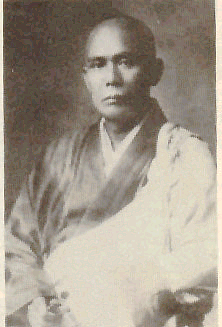
Some bits and pieces of Shaku Soen's Dharma talks.
...It is not the buddhist ideal to escape worldliness and enter into a realm of eternal stillness. This sometimes misunderstood by individuals who read too much into the concepts of "no-mind" or emptiness. Buddhists do not shun struggle and conflict if the cause is worth contending for or defending. Buddhists will not hesitate to sacrifice for it not only in this life but in all of their future lives (this does not infer reincarnation but rather the concept of individual actions inspiring individuals of future generations - each in essence is an extention of your own life.) ...
...It is not buddhistic to hanker after personal immortality and to construct diversity of theories to satisfy this illegitimate desire. Do whatever you think right and be sincere with it and the work will take care of itself, with or without immotality...
...Some may think that this is fatalism or determinism, but every clearheaded thinker would see in this not a fatalistic conception of life but a hopeful solution of existance, a firm belief in the final triumph of good over evil, and the calm assurance that the individual lives as long as it identifies with a noble thought, worthy work, exalted sentiment, uplifting impulse, in short, with anything that cements the brotherly tie of all mankind...
... The predominant tendency of Buddhism towards inellectuality...the reason why Buddhism is always ready to stand before the tribunal of science and let her pass a judgement upon its merits or demerits is due to this intellectual tenor...
... the practical side of Buddhism: The aim...is to dispel the clouds of ignorance and to make shine the sun of enlightenment. We are selfish because we are ignorant as to the nature of the self...Buddhist do not recognise any original sin, but acknowledge the existance of ignorance and insist on its total removal as the surest means of enlightenment...
...what the Buddhist practical faith is...1) to cease from wrongdoing, 2) to promote goodness and 3) to enlighten the ignorant...it has nothing mysterious, nothing superstitious, nothing idolatrous, nothing supernatural.
Subscribe to:
Posts (Atom)


