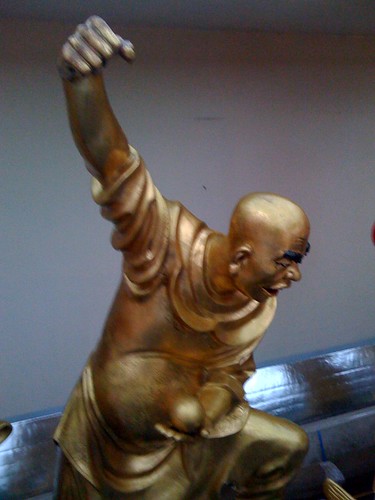
Saturday, July 4, 2009

Zen and War - Excerpts of the teachings of John Daido Loori Roshi


The Main Case:
Xixian Faan of Lushan was asked by a government officer, “When I took the city of Jinling with an army troop, I killed countless people. Am I at fault?” Xixian said, “I am watching closely."
The Commentary:

Priest Xixian’s response, “I am watching closely” is at once fat-headed and misguided. He has missed an opportunity to cause an evil that has already arisen to be extinguished, and to cause good that has not arisen to arise. Both he and the general deserve thirty blows of my stick.

Governments and rulers are traditionally driven by power, politics, and money, and are usually not inclined toward clear moral commitments. However, for a Zen priest to avoid taking moral responsibility when asked is inexcusable. Enlightenment without morality is not true enlightenment. Morality without enlightenment is not complete morality. Enlightenment and morality are non-dual in the Way. One does not exist without the other. Nirvana is not beyond good and evil as is commonly believed. It is a way of living one’s life with a definite moral commitment that is practiced, realized, and verified within the realm of good and evil itself, yet remains undefiled by them.

Setting aside impostor priests and phony followers, you tell me, how do you transform watching into doing, the three poisons into the three virtues? More importantly, what is it that you call yourself?
The Capping Verse:

Utterly devoid of abilities, the guide can’t lead;
lost in self-deception, the evil one can’t find his way.
Take off the blinders, set down the pack and see
beyond god masks and devil masks, there is a Way.

Dharma Talk:
  • Buddhism is normally understood as a very peaceful, even pacifist, religion. But this was not the case in World War II, when Buddhism was deeply integrated into the Japanese war machine. At the time, Buddhism played for the Japanese a role similar to that of Christianity for the Christian crusaders of the Middle Ages, or of Islam for Islamic militants of today: it was a religious, ideological justification of violent acts and the assumption of a position of superiority and dominance.
  • The main case reads: “Xixian Faan of Lushan was asked by a government officer, ‘When I took the city of Jinling with an army troop, I killed countless people. Am I at fault?’” Xixian was a successor in the lineage of Fayan, one of the five great Zen schools in China. Xixian was asked by a government officer, probably a general, “When I took the city of Jinling”— the capital of China at the time—“with an army troop, I killed countless people.” I added a footnote to that line which says, “To kill and destroy is easy. To affirm life and nourish is difficult.” Of course, when you have an army of trained soldiers, it’s easy to annihilate unarmed civilians. Then the government officer asked, “Am I at fault?” The footnote reads, “Cause and effect are one. How can you not know?” Evil actions result in evil effects. Good actions result in good effects. What you do and what happens to you are the same thing. This is pretty basic Buddhism. How could the officer not know?
  • “Xixian said, ‘I am watching closely.’” The footnote: “Stop watching and close the gap, and then there won’t be anything to protect.” What did Xixian mean by “I am watching closely”? Was he offering a teaching, or did he simply give a mild response that would not offend the warrior? Either way, it was definitely not a good enough answer. Definitely not intimate enough.
  • The commentary says, “Priest Xixian’s response, ‘I am watching closely,’ is at once fat-headed and misguided.” It was a thoughtless answer. How could he have answered then? What would you have said to that general? Remember, he was asking for instruction. The Fayan school was said to be the first to employ koans as an instructional method. How about giving the officer a nice koan on the precept, Do not kill? “He has missed an opportunity to cause an evil that has already arisen to be extinguished and to cause a good that has not yet arisen to arise.” Good actions produce good effects. But there is no guarantee. Let’s say that an elderly woman is standing at a curb and a Boy Scout comes up to her and says, “Here ma’am, let me help you across.” But instead of being grateful she starts swatting him with her pocketbook, yelling, “Let go of me! Don’t touch me!” and the Boy Scout gets arrested for molesting an elderly woman. Clearly, trying to do good is no guarantee.
  • “However, for a Zen priest to avoid taking moral responsibility when asked is inexcusable.” When we think of holy wars, western religions always come to mind. The God of Exodus ordered the extermination of the Canaanites. The instruction, according to the Bible, was to show them no pity. The commandment, “Thou shalt not kill,” apparently did not apply to the slaying of gentiles. In 1095, Pope Urban the Second ordered the crusaders to Jerusalem to kill the enemies of God. He said, “A horrible tale has gone forth and a cursed race, utterly alienated from God, has invaded the lands of the Christians. Tear that land from the wicked races and subject them to yourselves.” In response, the people began shouting, Deus volt! Deus volt! “God wills it.” This then became the battle cry of the Crusades. In two days, Christian soldiers slaughtered 40,000 Muslims they saw as non-human filth. Nowadays, Islamic terrorists proclaim, “God is great!” as bombs explode the world over in the name of God and religion.
  • On the other hand, Buddhism has always been seen as a religion of peace. How many times have we heard that there’s never been a Buddhist war? And beyond that, there are well-known examples of Buddhist pacifism. It is said that when the Shakya kingdom was threatened with invasion, the Buddha sat in meditation in the path of the advancing soldiers and stopped the attack. We also know that the Indian king Ashoka converted to Buddhism and dissolved his army. For hundreds of years, peace reigned in the land and the Buddhist teachings were promulgated. Ashoka’s stone edicts still exist as proof of his remarkable achievements. Later, when the dharma traveled to Tibet, the barbaric tribes were pacified. And in our own century, during the Vietnam War, Buddhist monks set themselves on fire to protest the fighting.
These are all positive examples. This is the way we think of Buddhism. But there’s also a dark side to our heritage—namely the Japanese Zen establishment’s dedicated support of the imperial war machine from the late 1800’s through World War II. This is very complex terrain.

In 1939, Zen Master Harada Sogaku made the statement, “If ordered to march, ‘tramp-tramp’… or shoot ‘bang-bang’—this is the highest manifestation of the wisdom of enlightenment, the unity of Zen and war. It extends to the furthest reaches of the holy war now underway.”

Harada preached that, “It’s the essence of truth that the Japanese people are chosen people whose mission is to control the world. The sword that kills is also the sword that gives life… Comments opposing the war are foolish opinions of those who can see only one aspect of things and not the whole.”

Yasutani Roshi, right alongside Harada Roshi and in our own lineage, was also pro-war. Actually, Yasutani Roshi was an ardent, right wing nationalist and anti-communist even after the war. He used vitriolic language, calling for universities to be smashed one and all, and referred to union workers as “traitors of the nation.”

Then there was Shaku Soen, one of the first Zen masters to come to the United States. He used phrases such as “just war” or “holy war,” stating that Japan was engaged in a war of compassion, fought by bodhisattva soldiers against the enemies of Buddha. Rinzai Zen master Nantembo preached, “There is no bodhisattva practice superior to the compassionate taking of life.”

Kodo Sawaki, teacher of Deshimaru and one of the great Soto patriarchs of this century, was an evangelical war proponent. In 1942 he made the statement, “It’s just to punish those who disturb the public order. Whether one kills or does not kill, the precept of forbidding killing is preserved. It is the precept forbidding killing that wields the sword. It is the precept that throws the bomb.” The precept that throws the bomb? That’s pretty astonishing abuse of Zen language. He also insisted, as did other Zen teachers, that killing done without thinking, in a state of no mind or no self, was an expression of enlightenment. This statement is lifted right out of Bushido, the way of the warrior.

It’s easy to become self-righteous about this because we don’t have a clue what it meant to live in a country closed off from the rest of the world, whose only information came from propaganda, newspapers controlled by a government calling westerners heathens, murderers, and so on. And there the Allies were, justifying those statements by dropping bombs on Tokyo and on the temples.

The next line of the commentary reads: “Enlightenment without morality is not true enlightenment.” Enlightenment is the realization of our identity with the ten thousand things. Not similarity. Not equality. Identity. My body and your body, my mind and your mind, are the body and mind of the universe. When this truth is realized, our consciousness transforms into prajna, or wisdom. With wisdom, compassion is born. And since all things are my self—since what happens to all things happens to me—I’m compelled to take care of all things. That’s compassion. How we do this is what the moral and ethical teachings of the Buddha, the precepts, are all about. Indeed, the precepts are the definition of the life of a Buddha.

“Enlightenment without morality is not true enlightenment. Morality without enlightenment is not complete morality.” Despite the statements made by some writers as Zen was first taking roots in this country, Zen is not beyond morality, but is a practice that takes place within the world. It is a religious tradition based on moral and ethical teachings that have been handed down through the mind-to-mind transmission, from generation to generation.

“Enlightenment and morality are non-dual in the Way. One does not exist without the other.” They are of necessity interdependent, mutually arising. “Nirvana is not beyond good and evil, as is commonly believed. It is rather a way of living one’s life with a definite moral commitment.” A moral commitment that comes from vow. Our vow is to live our lives as buddhas, to realize all sentient and insentient beings alike as one’s own body and mind, and then to act on that realization, to actualize that realization. And the only place that nirvana can be realized is within samsara. Just like enlightenment and morality, they are non-dual in the Way.

“Setting aside impostor priests and phony followers, you tell me, how do you transform watching into doing, the three poisons into the three virtues?” What do the precepts say about the transgression of the precepts? How do you turn the three poisons into the three virtues?

In 1992 the Soto School officially issued a statement of repentance, particularly with regard to the massacres in China. The statement said, in part: “The Soto School is a religious organization that supported Japan’s acts of aggression in China under the pretext of overseas missionary activities. It supported Japanese militarism and even participated actively in that militarism. This is extremely regrettable from the standpoint of religious persons. Unless the negative legacy of our school becomes the object of clear self-criticism, it will remain impossible to take the stance of opening our hearts toward other peoples in the spirit of true exchange.”

Atonement is definitely the first step. But it must be followed by communication with the victims and forgiveness. This process is completed by the commitment and vow not to commit evil again, to truly live in accord with the moral and ethical teachings.

The commentary concludes, “More importantly, what is it that you call your self?” That’s the whole point. If we recognize who we really are and realize that it’s not limited to this bag of skin—that it’s not limited at all—then there’s little doubt what our responsibility is to future generations, to the future of Buddhism.

Utterly devoid of abilities, the guide can’t lead;
lost in self-deception, the evil one can’t find his way.
Take off the blinders, set down the pack and see
beyond god masks and devil masks, there is a Way.

Utterly devoid of abilities, the guide can’t lead. For whatever reason, Xixian abdicated his responsibility and, by ignoring the opportunity to teach, created a karma that continued into 20th century Japan. Lost in self-deception, the evil one cannot find his way. The general’s delusion is understandable, in a sense. He was just doing his job. But the very fact that he asked that question implies that he had a sense that something wasn’t right.

Take off the blinders. Set down the pack. This instruction applies to both Xixian and the general. The blinders are the things that obscure our vision. The pack is all the stuff that we carry, that identifies us. It’s who we think we are. It’s the years of conditioning that we drag around with us.

Beyond god-masks and devil masks, there is a Way. What is that Way? For many Zen students, the most difficult aspect of all of this is to face the words and actions of these highly esteemed teachers. These men were living buddhas, fully enlightened people. Yet simultaneously, they were swept away by nationalist delusion. They knowingly perverted Buddhism and the Zen teachings and exhibited a total lack of compassion and wisdom. They participated almost directly in the death of tens of millions. There’s no greater abuse of the dharma than that. How can we reconcile these overwhelming contradictions?

Sunday, June 28, 2009

Ummon's Every Day is a Good day


Um-mon Bun-en (Yun-men Wen-yen) was a disciple of Sep-pō (Hsueh-feng I-ts’un). He died in 949.

Introductory Comments by Suzuki-rōshi
Each existence, animate and inanimate, is changing during every moment day and night. The change is like flowing water which does not ever come back and which reveals its true nature in its eternal travel.

Water flowing and clouds drifting are similar to a well-trained old Zen master. The true nature of water and clouds is like the determined, single-minded, traveling monks, who do not take off their traveling sandals even under the roof of sages. Worldly pleasure, philosophical pursuit, or whimsical ideas do not interest the traveling monk, sincere to his true nature, for he does not want to be fat and idle. Such a monk does not care for hospitality which would stop his travels. He recognizes as true friends only those who travel with him on the way.

The idea of this kind of travel may make you feel lonely and helpless.

In Japan, Zen is understood by the word wabi or sabi. These two words are nouns, but today they are used mostly as adjectives: wabishi or sabishi. One meaning of wabishi and sabishi is lonesome and monotonous. The intellectuals understand these words to mean the simplest and most humble form and style of beauty.

In the strict sense, wabi and sabi mean reality which does not belong to any category of subjectivity or objectivity, simple or fancy. However, it is this reality that makes subjective and objective observation possible and perfect, and that means everything, simple or fancy, able to come home to our heart. In the realm of wabi or sabi, even on one drop of dew you will see the whole universe.

Contrary to wabi and sabi, usually when some object is put into the range of perception, our first reaction is not acceptance, but rather rationality, repulsion, or emotional disturbance. The way of Western civilization is not directed at acceptance so much as at “how to organize many objects and ideas in the realm of perception or thinking” and “how to control the sense data of the sensual world.”

In the world of wabi and sabi there is no attempt, no attainment, no anger, no joy, sorrow, or any waves of mind of this kind whatsoever. Each existence in this world is the fruit of subjective self-training and objective pure and direct understanding. The savor of fruits comes home to our heart, and confirmation of reality takes place. We observe falling flowers at their best. By repeating this kind of direct experience, one may have calm and deep understand of life and deliverance from it, like a traveling monk who has full appreciation of everything and is nonetheless completely detached from it.

Now may I call your attention to the following subject:

Main Subject by Set-chō (presented by Suzuki-rōshi)
Attention! Um-mon introduced the subject by saying: I do not ask you about fifteen days ago. But what about fifteen days hence? Come, say a word about this. He himself replied for them: Every day is a good day.

Commentary by Suzuki-rōshi
Today does not become yesterday, and Dōgen-zenji states that today does not become tomorrow. Each day is its own past and future and has its own absolute value.

This has been copied from the transripts of Shunryu Suzuki, Soto Zen Master and founder of the San Fransicsco Zen Center.

It doesn't get better than from this guy.

cheers,

Friday, June 26, 2009

ai! ai!

Finally, a creation story that I can get behind. Enjoy...while you can.


http://www.myconfinedspace.com/?attachment_id=83672


Oh GOD!!!!! The angles....THE ANGLES!11111111

Monday, May 18, 2009

Listening to Philip Kapleau

PUNCH!

I found a dharma talk by Kapleau online which I am listening to now. He is mostly reciting some koan work from the Blue Rock Record "Everyday is a good day". These always are too confusing to listen to and I suppose me blogging while I listen isn't goingto help with my understanding.


  • "Don't be confused or 30 blows" - am I glad that I do not do the Rinzai zen because I would be getting the blows all the time with my amount of confusion. At home - Blows on the head. At work - Blows to the head. At school - Blows to the head. This blows.
  • Buddha says after born: "Above the heavens and below the heavens I alone am the honored one."
  • Reply from Zen Master: "If I were there I would have knocked him dead with a single stroke and given his flesh to dogs. This would have been some contribution to the harmony of this world."
  • My translation: Buddha did not walk after being born. This is silly, dogmatic bullshit and if I were there and heard such nonsense, I would have given the Buddha a smack for being a douce.


My logic thus says that I am a zen master. Yay me!!


Cheers,

Monday, April 20, 2009

Modern Buddhism or Buddhism without Bullshit


What is "Modern (skeptical) Buddhism"? The introduction of the Modern Buddhist Bible describes it as:
...more than a matter of simple chronology or a standard periodization into the primitive, classical, medieval, premodern and modern. Certainly modern Buddhism shares many of the characteristics of other projects of modernity, including the identification of the present as a standpoint from which to reflect upon previous periods in history and to identify their deficiencies in relation to the present.


I can deal with this. It places modern Buddhism into a framework outside of historical timelines and temporal restrictions. Not every Buddhist is a modern Buddhist (and there are those that argue that Modern Buddhist aren't really Buddhists). Those that still adhere to outdated stigma and religious dogma are far removed from modern Buddhism. I don't disagree with those sects but oftentimes I think they serve a more cultural role in Buddhism rather than a spiritual one (but can and do serve as both). Vajrayana Buddhism and many of the esoteric sects are prime examples of this. Most of their cosmology is a cacophony of indigenous religions and local traditions held within a Buddhist framework. This works fine when you are raised and born into that culture but there are many out there and I would rather just stick to the basics.

This is fine but most of the original Buddhist practice incorporated two things: First is the yogic tradition of India which basically stated that mental control over psychical properties leads to better spiritual well-being (ie. monitored breathing, meditation, "yoga") and second is the anti-Brahman movement that Buddhism typified (no meaningful creator, heaven, hell). Early writing and information is scarce of these early sects but for the most part they fell into either an atheist (No god) or agnostic (maybe god but doesn't matter anyway) camp. Skeptical Buddhism falls into this ideal. For me at least.
...Modern Buddhism also rejects many of the ritual and magical elements of previous forms of Buddhism.
Yes and no. It isn't a prerequisite that all modern or skeptical Buddhists reject these forms. Instead I think it is important that these forms are put into the proper place. Rituals such as mandras, mantras or mundras are often considered "magical" in many Buddhists sects. Does that not mean that when I adopt a cosmic mudra for the purpose of my zazen practice that I accept a magical origin of the hand gesture or position? No. It simply works best for me or helps me focus. No magic there. I could hold a lollypop in my hand while meditating and it would do the same thing.

Mundras and mantras, instead, prepare me for what I am doing. If I need to concentrate on zazen I use a cosmic mundra. It is tradition and I have already adapted my practice for its use. It is not central to successful meditation but I think it helps. It puts me in the right mood and state of mind. Just like zazen itself or some koans, you are expected to move past these conventions when you are able. Think of monks burning sutras or never sitting zazen again after hitting a certain level of enlightenment or of practicioners moving over to nembutsu practice rather than zazen.

...It stresses equality over hierarchy, the universal over the local and exalts the individual over the community.
Yes, yes and yes. We are not tied to a sangha or to a monestary. We are instead individuals following a path that we believe to help us lead a better and more productive life. I accept the teachings of many individuals, not by their placement in a organization but by their depth of character and ability. This is not "new age" or a "clinic". This is not easy. This is not a chance to reformulate Buddhist teachings in order to sell books. This is Buddhism.

...A return to the beginning to the Buddhism of the historic Buddha himself.
Eh...sure. I think that Zen Buddhism itself considers itself to be a return to the original beginning form but then again, many Zen Buddhists can and will be just as set in their own hierarchies and dogmas as other groups. As stated above - a zen practitioner is pretty much an agnostic yogi with a few more bell and whistles. Many modern Buddhists, myself as one of them, are not very well versed in the actual teachings of the Buddha. This needs to be remedied. I try to read more.

...It is the ancient Buddhism that is seen as most compatible to Modern day Buddhism. Ideals are embodied in the concepts of reason, empiricism, science, universalism, individualism, tolerance, freedom and rejection of religious orthodoxy.
THIS is the defining aspect of Modern and Skeptical Buddhism. Buddhism has always changed with times and regions, as do most religions (although some VERY slowly). I think that Buddhism does a quicker job of it and only addresses what Buddhism can address.

The best example of this is from a modern zen master, in a dialog on the positive aspects of zazen meditation had to reply to comments made about whether or not the practice of zazen can cure disease or some such nonsense. His reply was simple: "In matters of health, speak to your doctor; in matters of zen, speak to me; in matters of enlightenment, look to yourself."


Zen only goes so far. It is a tool for greater understanding and happiness. Buddhism is the first to embrace milestones in science and reason but sees no need to insist that it relates directly to Buddhist reason or not. But it is realized that it is only part of the greater whole of understanding and that the greater whole is different for everyone. Buddhism has been placed in a scientific framework (Zen Training: Methods and Philosophy by Katsuki Sekida) but it never attempts to put science into a Buddhist framework. The understanding is that zen or Buddhism does not explain scientific phenomena but zen can be measure and observed with an objective, scientific,
and skeptical eye.


I can't even go deep enough into tolerance and freedom. The Eightfold Path places some moderate restrictions on living (Right vocation, right speech, etc.) but none of it is taken too seriously or literally.


I think that is enough writing for now. I should probably be working on my thesis or something more productive.


Cheers,

Non-Fiction Reading Challenge Part 2


The true challenge is to keep myself only restricted to the books I have already chosen. However, the fall-back of working at a library is that new and interesting books are constantly floating by my office. The following two have been including in my reading challege as well:


  • Neptune's Ark: From Ichthyosaurs to Orcas by David Rains Wallace: I have read a book by Wallace previously called Beasts of Eden: walking whales, dawn horses and other egnigmas of mammal evolution and The Bonehuners' Revenge: Dinosaurs and fate in the Gilded Age. Beasts was a great books and Wallace does a great job of melding science onto a timeline and at the same time keep the science relevant and current. He also has a knack of really capturing the passion and drive of many of these researchers. This is an easy task for the grand old men of paleontology (Cope, Marsh, Brown and Simpson) and also easy for blatant self-promoters (Baker, Sereno) but not so easy for current and less flamboyant researchers.


  • Every Living Thing: Man's Obsessive Quest to Catelogue Life, from Nanobacteria to New Monkeys: Well, I love taxonomy and I hope this books does for taxonomy what Wallaces' book did for mammalian paleontology.

So far, very little time has been devoted to reading. Work, baby and thesis dominate most of my time (in that order). I have been getting maybe a 1/2 hour a night before I retire, at best. Still working though Gandhi's Passion but I should be finished before the end of the week. Next one is going to be either God is Dead or Neptune's Ark.


cheers,


Saturday, April 4, 2009

Non Fiction Reading Challenge


So, I have been working in a library for over four months now. Oh, it seems like so much longer. I mean that as a positive. I feel that I have picked up enough information recently to last me a good year, I think.


My point being is that I am constantly walking through the stacks. Going to talk to this person or get that thing or whatever. I inevitably grab some book as I walk through or see something that I need to read and have been stacking books on my desk with the intent to read them but never seeming to get to them.


If this continued, I would have a small library on my desk and no time whatsoever to read them. So, I have decided to enact a challenge on my self to read 7 nonfiction books from my "randomly grabbed off the shelf" pile and, I don't know, learn something?


I listed my choices below and gave a brief description of what they are about and why I grabbed it in the first place.


  1. The Colony by John Tayman: I grabbed this one a while back from the nonfiction section right by our back-office doors. Grabbed it because it was in the section with all these crazy books about early epidemics in North America (plague, scarlet fever etc.) and the name seemed to stand out. Anyway it is about the leper colony started in Hawaii during the late 1800s that lasted to the mid 1900s. Seemed interesting and who doesn't want to read about disfiguring diseases?

  2. Gandhi's Passion: The life and legacy of Mahatma Gandhi by Stanley Wolpart: Gandhi is just fucking awesome. I had to read more about him after I rewatched the 1982 movie with Ben Kingley. The whole non-violence thing seems so lame until you realize that it took decades for it to change anything....most of which he spent in jail....willingly. Just awesome. Also he was one of the first pantheists (he cut and pasted what he wanted from each religion to mold his home religion of Hinduism). I call this pragmatism but whatever, still cool.

  3. The Way of Kendo and Kenjitsu: Soul of the Samurai by Darrell Max Craig: OK, I ordered this one. I really want to learn and I think my new zen will be pummeling Darrin (or getting pummeled by him).

  4. Gonzo: The life of Hunter S. Tompson, an oral biography by Jann S. Werner and Corey Seyman: Basically...an oral biography of HST will be pure golden awesome dipped in caramel.

  5. A Modern Buddhist Bible: Essnetial Readings from West to East edited by Donald S. Lopez: First off, I am a buddhist so this is usual reading for me. Secondly, its Jack Karouac, Philip Kapleau both Suzukis and a host of other scholars that I have been wanting to read for a while.

  6. God is Dead: Secularization in the West by Steve Bruce: Written by an atheist South Dakotan so I got curious and it seems to be more of a book on statistics rather than atheists ranting and raving about how bad religion is.

  7. I'll Sleep When I'm Dead: The dirty life and times of Warren Zevon by Crystal Zevon: AAAAAAAWWWOOOOOOOO!!!! Zevon is pure liquid cool and is probably the most magnificant bastard to ever grace this hallowed ground. Seriously the guy was a genius and an alcoholic, sexaholic and OCD to boot. His life has got to be interesting. And its an oral history like the HST book.


As I get through these I will cross them out as I read them and probably write abit on them. I think this is a good challenge for anyone to do if you feel that you need to learn or read something new. Try it out, just walk through a library and grab what gets your attention. How else would I have found "How to Dress Like a Pope for all Occassions"?


Cheers,