Filthy, evil lolcats! I knew they would find the BuddhaDharma irresistible.
Showing posts with label ramblings. Show all posts
Showing posts with label ramblings. Show all posts
Monday, October 12, 2009


Sunday, October 11, 2009
Musical Stairs
This is lovely! Thanks to Phil Plait from Bad Astronomy for posting it.
I needed this today. I'm stuck at work (again on the day where the sangha is doing an extended zazen session), its snowing outside and, from what I understand, my heater at home is not working.
To top it all off - I have no lunch nor dinner to speak of today.
That being said. I would gladly take it again on the snout if I would get a chance to play musical stairs.
Cheers,
I needed this today. I'm stuck at work (again on the day where the sangha is doing an extended zazen session), its snowing outside and, from what I understand, my heater at home is not working.
To top it all off - I have no lunch nor dinner to speak of today.
That being said. I would gladly take it again on the snout if I would get a chance to play musical stairs.
Cheers,
Saturday, October 10, 2009
Science, Art and Zen
You may not realize this about me but I have been working on a Masters in Paleontology/Geology for the past few years at SDSMT and have always been amazed at how beautiful many scientific illustrations and photographs can be. Unfortunately these pieces are largely unrecognized as the pieces of art that they are. I was pleased to find this listed under one of the past exhibitions at the American Museum of Natural History.
The only photographs from John Daido Loori Roshi that I have seen previously were his black and white ones but the color ones are beyond beautiful. The combination of art, Zen, scientific photography and natural beauty are overwhelming. If Daido Loori Roshi included a scale bar with these pieces, I would call them perfect.
This exhibit ran in 2005 and I hope they consider running it again to honor the memory and art of John Daido Loori Roshi.


All photographs are from the AMNH Website and copyrighted © by John Daido Roshi
"John Daido Loori, scientist, photographer, and Zen master, explores the link between Buddhism and artistic inspiration with more than 25 striking abstract photographs of Point Lobos State Reserve in California. His photographs of kelp strands on the shore, algae, starfish, and sea-tossed stones echo the contours of larger landscapes and the curves of the human body. Contemplative and sensuous, the images bridge a gap between viewers and the world around them."
The only photographs from John Daido Loori Roshi that I have seen previously were his black and white ones but the color ones are beyond beautiful. The combination of art, Zen, scientific photography and natural beauty are overwhelming. If Daido Loori Roshi included a scale bar with these pieces, I would call them perfect.
This exhibit ran in 2005 and I hope they consider running it again to honor the memory and art of John Daido Loori Roshi.
All photographs are from the AMNH Website and copyrighted © by John Daido Roshi
Friday, October 9, 2009
Meditation on Death, Zombies and Buddhas
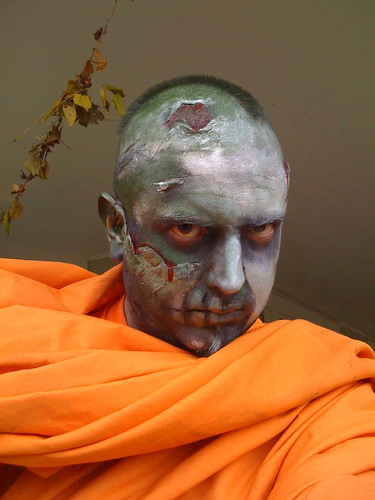
[This post was written before the news of Daido Roshi's death on Friday October 9th. Daido Roshi has always been a great influence to me...especially the way that he accepted and encouraged lay-practice. And in doing so, aided in my own development and growth. I take this time to reflect upon his teachings and ability; his compassion and his wisdom. He is a giant in American Zen and his humble steps led to great vibrations in own growing community. Thank you and Cheers, Daido.]
Many zendos or places of practice will have the Evening Gatha displayed in some prominence with the words "Life and Death are of Primary Importance". Well...yes, obviously they are but Buddhism (at least some of the Buddhism that is currently espoused in the Western Convert community) place a huge emphasis on the living part and largely ignores to dying part. All butterflies and growth about "how to live more mindfully" or "how meditation can help you live a happier life" with the topic of death is largely belittled or ignored. That somber specter is glossed over with the sometimes saccharine perception of Modern Buddhist thought.
Buddhaghosa stated in Chapter VIII of the Visuddhimagga ("Path of Purification").
While nowhere near a bhikkhu, nor any plans to be one, I do understand that mindful attention to death is an important aspect to my Buddhist practice. To focus on the fact that life is impermanent is a daily, almost unconscious, task. But more importantly concern and focus one the fact that death is imminent. Concern with what would happen to my family if I were to die. Focus on this while driving to work, sitting at home or walking to the store. To focus on the fact that death could come at anytime, unbidden and unexpected, to me or to those closest to me. Yet with all this mindfulness the idea of death is still terrifying to me - even with the acceptance of my own impermanence.A bhikkhu devoted to mindfulness of death is constantly diligent. He acquires perception of disenchantment with all kinds of becoming (existence). He conquers attachment to life....Perception of impermanence grows in him, following upon which there appear the perceptions of pain and not-self. But while beings who have not developed mindfulness of death fall victims to fear, horror and confusion at the time of death as though suddenly seized by wild beasts, spirits, snakes, robbers, or murderers, he dies undeluded and fearless without falling into any such state. And if he does not attain the deathless here and now, he is at least headed for a happy destiny on the break up of the body.
Why was this so pressing?
People think that only others will die. They forget that sooner or later they will, too. They carry on without so much as a thought that death could possibly happen to them. Then they're shocked when it comes on them unexpectedly. How foolish! [Suzuki Shosan]
What is the primary concern in religious practice? - Put aside everything and only study death. Always study death, free yourself from death, and when death really comes you will not be flustered. In order to save others, knowledge is necessary. [Suzuki Shosan]
The study of and focus on was there but I was still insisting that I wasn't going to die. My focus was always on "if" I died or the possibility of something happening to me that was unexpected. It was never, in my mind, an absolute or a definite occurrence. I was an accident. Now the focus isn't on the "when" or "how". Those concepts are worthless and without meaning. The "if" of my impermanence turned to an actuality.
- I am of the nature to grow old. There is no way to escape growing old.
- I am of the nature to have ill health. There is no way to escape ill health.
- I am of the nature to die. There is no way to escape death.
- All that is dear to me and everyone I love are of the nature to change. There is no way to escape being separated from them.
- My actions are my only true belongings. I cannot escape the consequences
of my actions. My actions are the ground upon which I stand.
While Buddhaghosa focuses on the bhikkhu's perception and conception of death and while Shosan rolls on with the insistence of focusing on death as a meditative tool (almost like a koan) to unravel the true meaning of religion experience; the 5 Remembrances cuts through the noise and circumstance of death to the actual realization of it.
So...the "take home" message is simple: Zombies are much more Buddhist-y than Vampires. Vampires sit around and look pretty and never age - undead but ageless. Zombies force us to look at ourselves in the now. Zombies shamble around, slowly decaying, getting slower, they make more noise. We shamble around, slowly decaying, getting slower, we make more noise now than before (creaks and whistles and groans). Embrace your inner-zombie. Its not really Buddha-nature but it may help to focus on the fact that we will grow old and die and then (maybe) walk the earth as a mindless automaton.
So for Halloween I was going to be a Zombie but I'm going with this guy instead.
If that dude isn't a Zen Master in disguise, I don't know who is.
Cheers,
Remember if you meet the Buddha walking down the street, kill it. If you meet a zombie walking down the street, KILL IT. If you meet Zombie-Buddha walking down the street, RUUUNNNNN!!
Tuesday, October 6, 2009
A Roshi of Worth.

I have always been moved by Daido Roshi's work, words and ability. His book Finding the Still Point aided my practice as I began to sit again as well his translations of Dogen.
I plan to dedicate my practice tonight to Daido Roshi in thanks for all of his striving. I can hopefully dedicate something longer in the future. Please join me in this dedication.
Cheers,
Monday, October 5, 2009
Zendo Oops: From bad to worse and beyond...

Have fun with these - I thought I would lighten things up a bit. The "bad" category are all true occurances while the other categories are usually what I thought about immediately after the "oops" that kept me laughing for most of the sitting period.
I previously put these out as tweets.
Zendo Oops #1:
- Bad: Setting Hair on fire while opening altar.
- Worse: Setting hair on fire while opening altar and spontaneously screaming "Jesus Monkey F#ck Christ!"
- Beyond: Eating the altar.
Zendo Oops #2:
- Bad: Sucking on Jolly Racher during Zazen and having red drool come out of your mouth.
- Worse: Sucking on Jolly Rancher, having the red drool and then pretending to be a zombie during kinhin.
- Beyond: After zazen and kinhin with the red drool and zombie-walking - Screaming "Brrraaaaiiiinnnsssss!" repeatadly during the Heart Sutra.
Zendo Oops #3:
- Bad: Having your fly open during dokusan.
- Worse: Noticing that you fly is open and mention to Roshi that you think you just peaked into your "Buddha Nature"
- Beyond: Pretending your "Buddha-Nature" is a Keisaku and repeatedly striking practitioners for not paying attention.
Zendo Oops #4:
- Bad: Farting, at any time, in the zendo is pretty bad.
- Worse: Farting in rhythm to the Mokugyu during any chanting service or whenever suffering is mentioned.
- Beyond: Blaming it on Roshi and yelling "KATSU!"
Zendo Oops #5:
- Bad: Cracking jokes during Dharma talk.
- Worse: Joking about crack during Dharma Talks.
- Beyond: All of the above and then taking a hit.
Zendo Oops #6
- Bad: Punctuating any conversation in a zendo or during dokusan with "F#ck Yeah!"
- Worse: Follow it up with a "Dead-Arm" punch to the shoulder.
- Beyond: Have a deep conversation with the Buddha statue and then stare at everyone suspiciously.
Last Zendo Ooops:
- Bad: Dead leg after zazen and doing zombie walk kinhin *step, ddrraaaggg, step dddrrrraaaaagggg*
- Worse: Eating another Jolly Rancher and repeating Zendo Oops #2.
- Beyond: Giving the person in front of you a "Flat Tire" and then staring at them like they're the asshole.
Zendo Oops Bonus:
- Bad: Sharing aride to sesshin and singing "108 bottles of beer on the wall, 108 bottle of beer, take one down pass it around and into Buddhist hell you go!" for the entire ride.
- Worse: Actually drinking 108 bottles of beer on the way to sesshin.
- Beyond: The horrible beer farts during zazen the next day coupled with the hideous "Hotei's Log" you left as a present in the zendo's "Room of Thinking".
Cheers,
Saturday, October 3, 2009
No Place Like Home - Reflections of a Zen Home Practitioner

Going Back to the Sangha -
I recall the reason why I went back to sitting with a brick and mortar sangha - the upcoming birth of my daughter about 15 months ago. During my wife's pregnancy I got an urge to get back into my practice in a very "real" way; to find people around my area that I could connect with on the level that I felt that my practice was at. This is not to say that I thought my practice was any stellar event. However, when my father refers to my practice as my daily yoga and my wife occasionally rolls her eyes when I talk about it, one comes to the conclusion that a different atmosphere and perhaps, venue, is needed. Either way, I was feeling the need to substantiate it in some way.
I did my research and looked into some area sanghas - one Tibetan, one Theravada and one Zen. I made the phone calls and asked about how each group approached their practice. Was it on a regular schedule? Lay or monastic? Was it completely independent or associated with a larger institution? Mostly meditation or devotional? Large or small group? Cost and Fees?
More importantly, how did the people feel to me when I spoke to them on the phone or in person? Lucky for me, each group was what I was looking for. Small, personal with only loose affiliations to larger centers or organizations and no or minimal costs and fees. I was taking my time, enjoying this new search and exploration. I still can not believe my luck in finding so many small, independant sanghas in my area.
My search somewhat changed when I heard on the news about a father that threw his 18 month years old baby across a room and into a wall. I knew the foster family (I worked with the foster mother) that was taking care of the child previously and they just recently had to give up the child to the actual parents who were just out of rehab. It wasn't two months later that this happened. The foster family cared deeply about the children under there care and repeatedly made mention of the fact that they believed the children to be in danger.
I don't think too many people realized how much this affected me when it occurred. I couldn't stop thinking that it could easily be me as that father. Not really that father since, he was a drug addict and just out of jail. Rather, a father that loses control, gets frustrated and in a moment of stupidity - does something horrible. I was never a violent person. Never got into fights or started altercations with people but I was always angry and intense. Would it really be that small of a leap?
The next day I walked into that little zendo and started to accelerate my practice. I never really expressed how much it would have taken me to get through those doors again otherwise. It was difficult to approach strangers about something as personal as my home-practice. But the idea that I would soon be walking into fatherhood - a situation that was completely unknown to me and with which I had no previous experience - pushed me through those doors. I started to sit again with a group and chant and engage other Buddhists. I started this blog.
When I walked into the zendo for the first time, a long-time member walked up to me and we started to talk about why I was interested in starting my practice there. I told her that I would be having a daughter soon and I wanted to prepare myself for it by engaging in public Buddhist practice again. To myself, however, I told the truth. The truth that I wanted to start out of compassion for my daughter - out of the fear that I would be as horrible as that man who threw his child.
Before we walked into the meditation room to start the first sitting the lady I was talking to mentioned that she heard that the little boy in the news that got thrown had just died from his injuries. I sat that day harder than I ever sat before or since. In between my sore ankles and burning thighs, I sat for the benefit of one sentient being that morning and have been striving ever since.
When I walked out the lady came up to me and said "I wish more fathers would sit". I agreed. The whole concept of "sitting for the benefit of all sentient beings" became slightly less esoteric that morning.
Cheers,
Friday, October 2, 2009
Unrequited Vipassana Love Demons
 Picture from Wat Arun, Thailand
I love Brooke from Wandering Dhamma - I know it's sudden - but sometimes she blows my mind. I have never heard a more clear and concise description of the secular Buddhism as this...
Because Buddhist meditation, especially vipassana, has been divided out from and is seen as separate from the Buddhist religion, it can be considered an example of a portable and exportable version of an indigenous Asian tradition. It has become portable because of its non-specific religiosity and few institutional connections. Among Western Buddhists, vipassana meditation has been popular because it has been interpreted as having this universal, transcultural quality. This kind of thinking is certainly true in some American Buddhist circles. In Wendy Cadge’s study of a convert community in Cambridge, Massachusetts, titled Heartwood, she finds that the Buddha’s teachings are primarily conveyed through meditation instruction. Many Western vipassana meditation teachers adapt and present the teachings in a Westernized way so that practitioners often call themselves vipassana meditation students rather than students of Theravada Buddhism.
I especially like this definition which, from my experience, is how many of my Sangha-mates view Buddhism in general and Zen practice in particular (not overtly or specifically religious). This way that compartmentalized aspect of "an indigenous Asian tradition"moves into whatever devotional or cosmological framework you already have established (from your experience or upbringing). And while Brooke is primarily referencing vipassana in her post; I think that the same can be said of Zen meditation as well.
Since this portable Buddhism has sort of a luggage theme running with it, I'm not sure if I would call those that utilize meditation in the course of their spiritual and religious explorations converts. I believe I will call them Buddhist Travelers and they will be required to identify themselves by wearing pointed red hat like that gnome from the Expedia commercials.
So Brooke...I know we are both already attached but there is always reincarnation, right? Maybe we will come back as bunnies.
Too much?
Cheers,
Thursday, October 1, 2009
Cookie-Cutter Buddhist Practice

All roads lead to the same mountaintop.
Be a lamp unto yourself. Work out your liberation with diligence.
We all have a responsibility; to ourselves and to others, to those we never met and those that we spend our daily lives with, to strangers and to lovers, to aspire to our own liberation. Damn, those words sound far too lofty to be coming from me. I am a bag of wind.
However, it seems to me that we are often stuck in the middle of a pissing match between opposing (really?) schools and sects. Teachers and roshis engage in a Dharma Combat that seems more appropriate for the Jerry Springer Show than for a meditation hall.
Organizational Buddhism is fine but don't get too wrapped up into the hype that it sometimes represents. When someone, Roshi or not, tells you that their path is the correct one and all others are wrong - they are stifling your growth and building their own ego. For me, the truth seems simple. The mountain has many paths to the top but not every one is right for every practitioner. We choose our own route. Take the time to learn about the other paths and incorporate what seems right into your own practice. Ignore the boundaries that the patriarchs and the past have placed upon us. Ignore whether or not it is "authentic" or not. Ignore whether or not your practice is the same practice that your sangha-mates participate in. If your practice includes other religious and spiritual outlets, then go with it.
In the long run, all of us (Roshis, monks and lay persons) are walking bags of dung but even dung-sacks deserve a practice that is individual to them. Be a Buddhist pirate and pillage these schools for what is useful to you and leave the rest. Settle down with one if you pillaging days are over but remember that it may only be temporary. It may be time to take to the seas again.
Pirates are awesome.
Cheers,
Pirates are awesome.
Cheers,
Wednesday, September 30, 2009
Only Half a Buddhist

A post in the blog All Considering came up with a quick and easy definition of what a "real" Buddhist is...
A real Buddhist, in my view, and in the Traditional Asian view, is someone who has taken refuge. That is, in a solemn ritual they have taken refuge in the Buddha, the Dharma and the Sangha. I have not done that so I'm not officially a Buddhist.
Really? A ceremony makes a Buddhist real? While I won't stomp over some one's opinion or their personal definitions of Buddhism, I will make an attempt to better define what a Buddhist is. Although, granted, my definition will be as flimsy as any other definition offered. It is next to impossible to say what being a Buddhist means to such a diverse group of practitioners but I can go deeper into how I define myself as a Buddhist.
The ceremonial aspect of taking refuge in the 3 Jewels is important step in the practice of Buddhism but does not define a Buddhist as real or not. Most Buddhists will take those vows eventually in the evolution of their practice but it is by no means necessary to make it "official" by involving a monk or priest or piece of paper. I made those vows for myself one morning after a horrific event in my life. The bottom of my pail fell out and it was time to refill it. I took the vows and I began daily practice and I am a Buddhist. If I took those same vows in front of a monk or priest they would have meant next to nothing compared to when I was driven through my own experience to make them. Which would make me a "real" Buddhist, I wonder.
This is not to say that the "official" taking of refuge (or the precepts or intense meditative retreats) is without merit. They serve a purpose in deepening one's commitment to their practice and to Buddhism. Also, if one is looking for guidance with their own exploration of Buddhism then it is important to ascertain whether or not a teacher is "authentic". In the end it is really up to the individual how much emphasis they put on the ritualistic or organizational aspects of Buddhist practice. I put great emphasis on the ritualistic but very little on the organizational. This is not a definite - It is just my practice now.
Whether you want to call your self a Buddhist is up to you, the individual, to decide. If you are a practicing Christian or Jew and wish to label yourself as a Buddhist as well - then by all means - Do so. If it helps your practice and understanding of the Dharma then do it. If you don't feel that the label of Buddhist is right for you or if you think that your practice is contrary to the fundamental teachings of the Buddha then do not call yourself one. It means very little to me whether or not you consider yourself a Buddhist. If you are applying the Dharma to your own life in a way that fits your life - Then I couldn't be happier.
Now, I may be mistaken but a "solemn" ritual does not necessarily entail monastic representation for one to take refuge. I take refuge daily in my own practice but I have no specific ceremonial experience to speak of. Do I really need someone to tell me that it isn't "real" unless it is witnessed by a monastic or lay-ordained practitioner? I don't try to pretend to be anything that I am not. I am not lay-ordained or a monastic and I have very little experience in the realm of monastic practice. My practice is mostly home-centered and with a small lay sangha (mostly, two are lay-ordained). This does not make my practice and experience any less relevant compared to someone with more practice in a monastic setting.
My thoughts are simple in this manner - You learn from what resources are available to you at this time in your life. Don't spend your days wishing that you had a larger sangha or a monastery close by. Or a specific school or sect that is nearer to what you think Buddhist practice should be. Use what is available to you now. Your only enemy is a lack of striving.
Its really all just tools. We are trying to build something...why would you worship the specific hammer that you are using when the big picture is the process of building. Zen is my hammer for now but it may be that sometime in the future a new tool is needed...just have to wait and see.
Cheers,[Jack Daw is a non-lay-ordained home practitioner of Buddhism. He has no specific lineage or teacher. Instead he grabs what he can like a crow picking a carcass. He currently practices Zen but that could change as the wind does not blow from the same direction everywhere. He does however think that all beings deserve compassion. He is also fighting a three day flu and feeling quite pissy right now - but this will pass.]
Monday, September 28, 2009
The Asian Welder and Bonfires
 I woke up this morning, headed to the dump to drop off some recycling and pick up some wild plums from a friend to make plum wine when I saw a package hanging out of my mailbox. What do you suppose was within the package? Well, a brand new t-shirt from my new Sangha-sibling Hazel from "The Asian Welder" blog!
 So we had a great day of curry, pho (Vietnamese Noodle Soup), spiced cider and bonfires. And I got to wear my fancy new shirt the entire time. The front says "Spark This" if you can't tell from the picture.
 So, please stop by The Asian Welder, check out her work, read a little Buddhism and thank Hazel for me for sending me the sweet, sweet shirt. I can't afford to buy them new anymore so if you got a t-shirt you want me to wear about anything drop a me a line on twitter, send it to me and I'll wear it.
I am a whore for this sort of attention and frankly I love me some t-shirts...maybe next time I'll even pose sexy-like...
Cheers,
Thursday, September 24, 2009
Silent Chanting

One of my biggest concerns when I began an actual flesh and blood sangha practice was the prospect of chanting aloud. I have sat in meditation for years (not in one stretch) and was comfortable with that aspect of public practice. The altar opening, ritual, bowing and prostrations were equally familiar to me since I spent years performing them on my own in my home. I did not feel self-conscious or nervous about applying in public what I already did at home for a number of years.
Chanting on the other hand, I approached with extreme trepidation. On the surface level, there was the fact that some of the chants were in Japanese or Sanskrit that led to my nervousness. I screwed up the pronunciation of many of the Japanese phonemes or would get lost on the page as my eyes struggled to keep up with the chanting and my brain was lagging far behind in reminding my lips which phonemes were pronounce in which ways.
But language was really only scratching the surface. The material contained in the "Pure Land" sutras seemed shockingly similar to the prayers that were offered in a Christian prayer. It felt like I was asking or beseeching some outer-worldly power to intervene in my behalf. It was not aiding me in focusing on my practice at all. In fact, it was doing the opposite.
Until I ran across this explaination by Ven. Anzan Hoshin roshi that helped put this into perspective:
Chanting on the other hand, I approached with extreme trepidation. On the surface level, there was the fact that some of the chants were in Japanese or Sanskrit that led to my nervousness. I screwed up the pronunciation of many of the Japanese phonemes or would get lost on the page as my eyes struggled to keep up with the chanting and my brain was lagging far behind in reminding my lips which phonemes were pronounce in which ways.
But language was really only scratching the surface. The material contained in the "Pure Land" sutras seemed shockingly similar to the prayers that were offered in a Christian prayer. It felt like I was asking or beseeching some outer-worldly power to intervene in my behalf. It was not aiding me in focusing on my practice at all. In fact, it was doing the opposite.
Until I ran across this explaination by Ven. Anzan Hoshin roshi that helped put this into perspective:
In chanting practice you needn’t be shy, needn’t hold back and whisper. You’re not praying to gods or angels or Buddhas. You are manifesting the power and integrity of breath, sound, and posture as this sound of the moment. Allow the sound to swell from the hara in your lowest natural voice register. Abandon hesitation and self-consciousness and feel the sounds vibrating in belly, throat, and mouth. Feel air as breath being drawn in and released as sound. Penetrate the ten directions with this chanting and wake up all beings by exerting both the dignity of the words and the dignity of your expression of them.
Just as when I focus my breathing while meditating, I began to focus on my breathing while chanting. The actual words became less and less important as they became more internalized in to my routine. I would start chanting and continue without reading the words or even thinking about the words as they came out of my mouth. My voice is still horrible and I fumble (horribly) over the Japanese sometimes but I rarely even care. I like to yell. Its fun. And it has no focus beyond the pushing of the air out of this poor wind bag.
The mind is clear and traceless, it does not ponder the meaning of the words as you chant. An alert posture, pure intention, and moment to moment awareness actualize the meaning of the words.
"Pure Land" sutras or not. It doesn't matter as much anymore. I may not particularly "like" a particular sutra for some reason but in essence reciting it is the same as reciting any other one - its just air being pushed from my lungs.
Focus on the sutra's whole presence first, then focus on the words that come and then on the sounds that arise, leave your mouth and disperse. Soon, you don't even hear the words anymore, they don't matter. Just like the ringing of a bell, the sound is impermanent and drifts into silence - You know that they were there but they're is no evidence of there presence. In understanding the origin and trajectory of those sounds we pay homage to our own innate Buddha-Nature. It doesn't matter what the content is or if the language is familiar or not. It all breaks down in the same way. They all disperse into silence. We chant silence.
Chanting, allow this jewel to shine and, in so doing, see that the jewel has no boundaries and is never limited by any single facet or reflection of light. The Four Great Vows are the essence of the Bodhisattva’s energy, the Heart sutra the Bodhisattva’s mind and so on. Express and actualize these in each sound, each moment of chanting, sitting, walking, working, breathing. In so doing, liberate all beings, all times, all directions, all sounds, all breaths.Cheers,
South Dakota - Buddhist Purgatory
 I woke up this morning to a wonderful post by the Reformed Buddhist mentioning the Purgatory State - South Dakota.
Invent a Buddhist Purgatory and put it in South Dakota where there
really is no difference.
Well, thank you Kyle for thinking of us, luckily the Hungry Ghosts and pretas have left us alone for the moment so Samsara baby and myself could enjoy some zazen this morning (thus the picture, taken only moments before a random attack from roaming Hungry Ghosts). Just so you know what we are up against here is the description of what I have to fight against to get into work every day.
Pretas are invisible to the human eye, but some believe they can be discerned by humans in certain mental states. They are described as human-like, but with sunken, mummified skin, narrow limbs, enormously distended bellies and long, thin necks. This appearance is a metaphor for their mental situation: they have enormous appetites, signified by their gigantic bellies, but a very limited ability to satisfy those appetites, symbolized by their slender necks. [http://en.wikipedia.org/wiki/Preta]
Very scary and you thought ZombieLand was bad! And let me tell you, the Blood Pool Hell Sutra leaves some talking points as well. But, well, home is home and we do our best.
Cheers and Happy Zombie hunting!

Wednesday, September 23, 2009
To sit or not to sit.

Every Sunday I discover the same dilemma when I get up in the morning and get ready to head to the zendo for our morning practice - I look at my wife and child and get a pang of guilt. Guilty that I am heading out to do something enriching for myself instead of stay back and doing something enriching with or for them. Now I wish I had wonderful sutra quotes to insert here or wisdom from ancient or contemporary masters, but I don't. So I went with the only thing I do have - my gut.
And my gut decided to hang back and go with my daughter to the local park for some time on the swings and let my wife work on her thesis in peace. No sitting and staring at a wall for me. No chanting of the Heart Sutra or prostrations. Instead I was heading to a park. But it all came together for me in shocking brilliance when I got to hear her (my little Samsara Baby of 16 months) say "Weee!" for the first time on the swings. We then spent 20 minutes throwing pieces of recycled shredded-tire padding up a slide and watching them come down. It was meaningful and mindful - Maybe it wasn't zazen and all austere and Buddhisty and stuff but it was me and my daughter sharing a moment that will never repeat itself. One that will never come again. One that faded away as quickly as it arose. One that probably, for her, is already forgotten.
So my home-practice oscilates between sitting zazen with a sangha and living the daily life of a homemaker. The life of a Buddhist and a father. Trying to remove oneself from the attachments of daily life but taking such joy in them at the same time.
Sometimes the words of the Evening Gatha mean so much more outside of the zendo:
Let me respectfully remind you,
life and death are of supreme importance. Time swiftly passes by,
and opportunity is lost. Let us awaken,
awaken. Take heed,
do not squander your life.
To me this is simply a fact of knowing when to bow - To humbly accept the teaching and opportunities presented in front of me at that specific time and place. To squander those opportunities would be poor form and weak practice. We awaken to the moment as that moment itself awakens in front of us. No plans and no schedules. I planned to sit that day but an opportunity blossomed in front of me. If I rigidly stuck to my Sunday schedule I would have missed the chance to see my daughter happy at that moment and at that time.
I suppose the Evening Gatha was written with enlightenment in mind -telling us not to squander what little time we have in frivolous activities. Instead we should strive ever-forward to realize ourselves. Well, I'm no monk nor am I a "serious" student but I think I can see the Path when she looks up at me, smiles and takes my hand.
Pretty soon my Samsara Baby will be Samsara Grown-Up and hopefully will still be willing to take my hand, smile and lead me to a bar.
Cheers y'all. Don't squander.

Tuesday, September 22, 2009
Virtual Dharma

A new conversation started on the authenticity and utility of "virtual" sanghas vs. "flesh and bone" sanghas has started up.
- Illusory Flowers in an Empty Sky - Virtual isn't real
- Angry Asian Buddhist - Online sanghas
- The Reformed Buddhist - The snobs show their colors: take two
- The Reformed Buddhist - iSangha
Personally, I think both are viable and real outlets of the Dharma and perfectly good training and practicing tools. Each has its own strengths and weaknesses. A "virtual" sangha gives an opportunity for many of us in the more rural areas of the US connect with teachers, practitioners and schools that we would not ordinarily be privy to due to geographic and logistical constraints. At the same time a "virtual" sangha does not provide the same type of support as a "flesh and bone" sangha nor does it give the same depth of practice.
I do believe that while I do connect with my "flesh and bone" sangha (I am fortunate that my locale does sport two, formerly three, small sanghas). However, being able to branch out online did much to prepare me for eventual daily practice as well as gave me the support to approach my local sangha with my interest in practice. As with most things, I think a combination of both produces the best results. I sit weekly with a "flesh and bone" sangha but attend virtual retreats (due to time and monetary restraints) online. I am not in the position to attend "real" Dharma Talks but ones podcasted by zendos and by AudioDharma, ZenCast and DharmaRealm serve the purpose more than addequately.
To call this support "not nourishing" seems drastic (I wash plenty of dishes). A sangha is partly about communication. By discouraging virtual sanghas you also discourage teachers to actual reach out to practitioners that don't have a local sangha to practice as well as discouraging individuals to broaden their horizons past what is outside their front door.
I will concede that eventually, a serious Buddhist practitioner needs to confront an actual, authentic teacher for instruction. But whether it is online or face-to-face - It doesn't matter, there is some benefit to be gotten. The bottom line is that any practitioner that is serious needs to access what is available to them by virtue of their situation and location. Whether that be online blogging and chats with other practitioners or sitting with a group or combination of both. At the same time any teacher that is serious about reaching people (especially those that do not have the luxury of local temple or monastery to guide their growth) needs to utilize emerging tools to reach them.
So thank you to all of my "Virtual" Sangha-siblings and Dharma-guides. You all inspire me to practice daily and critically examine myself constantly. You keep me striving.
Cheers,
Saturday, September 19, 2009
Profiles of Buddhist Bloggers
I have been wanting to do a list of some of my favorite Buddhist bloggers out there in the Buddhoblogosphere (I hate that word) and decided that if I was going to do it, I was going to make it somewhat entertaining and make some jokes at my expense as well as the expense of others. So here are a few of the bloggers that I respect and read religiously with some added humor in the form of everyone's favorite thing - categories!
A wise man once told me that the line between humor and disrespect was a fine one - and then he never talked to me again - I assume that I crossed that line.
[Have a good laugh on this. Everything was meant in love and we really need to have a sense of humor about ourselves - especially after so much disagreement. So enjoy and If you have some additional profiles I missed, let me know so I can add them!]

The Home-Practicing Hick - Stuck in the Midwest or Deep South, this Buddhist blogger will go on and on about "practical" Buddhism and will act as if he/she eats lotus blossom and shits out petals. In reality this blogger sits maybe once a week and studies under a guy named "Steve" and conducts his Dharma talks at the local Hooters. Most religious paraphernalia was probably purchased from Hot Topic or Old Navy with rituals being carried out in his old Judo gi.

The Angry Asian Buddhist - If you are white or any non-Asian you are on notice, my friend. There is no flying under the radar with this blogger manning the helm! If you happen to slip up in your terminology or nomenclature you are immediately regulated to the lowest pits of esoteric Buddhist Hell. Best bone up on your Japanese social strata and grab a sociology primer because you are going to need it.

The Prick - No pun is too low or picture too naughty. If you want to talk about Dharma or serious Buddhism, steer clear of this blogger, Dear Reader. Expect any retort to involve squirrel testicles, crack whores or dirty, filthy, potty humor. Just reading this blog will lead to numerous viruses on your hard drive and possibly syphilis. Be WARNED!! If this blogger ever actually teamed up with the Angry Asian Buddhist profile, they would be well-nigh unstoppable. Our only hope is to keep them at constant odds with each other. Its mean, I know, but this is national security we are talking about here.

The Professional Writer - Ugh! Posts that last at least two kalpas and have been proofread by the Virgin Mary, herself. Immaculate! These year long treatises will weave in and out of consciousness (or at least you will be weaving in and out of consciousness while reading them). Be sure to read the review that they have written on EVERY book on Buddhism they ever read and comments on everything their teacher ever said.
Cheers,
A wise man once told me that the line between humor and disrespect was a fine one - and then he never talked to me again - I assume that I crossed that line.
[Have a good laugh on this. Everything was meant in love and we really need to have a sense of humor about ourselves - especially after so much disagreement. So enjoy and If you have some additional profiles I missed, let me know so I can add them!]

The Home-Practicing Hick - Stuck in the Midwest or Deep South, this Buddhist blogger will go on and on about "practical" Buddhism and will act as if he/she eats lotus blossom and shits out petals. In reality this blogger sits maybe once a week and studies under a guy named "Steve" and conducts his Dharma talks at the local Hooters. Most religious paraphernalia was probably purchased from Hot Topic or Old Navy with rituals being carried out in his old Judo gi.
- Favorite Food: Can you put hot dogs in Curry? Yes. Then that.
- Example: Ummmmmm.....ehhhh....me?

The Angry Asian Buddhist - If you are white or any non-Asian you are on notice, my friend. There is no flying under the radar with this blogger manning the helm! If you happen to slip up in your terminology or nomenclature you are immediately regulated to the lowest pits of esoteric Buddhist Hell. Best bone up on your Japanese social strata and grab a sociology primer because you are going to need it.
- Favorite Food: It doesn't matter. Your weak Caucasian palate could never appreciate the flavors.
- Example: Well...the Angry Asian Buddhist for one.

The Prick - No pun is too low or picture too naughty. If you want to talk about Dharma or serious Buddhism, steer clear of this blogger, Dear Reader. Expect any retort to involve squirrel testicles, crack whores or dirty, filthy, potty humor. Just reading this blog will lead to numerous viruses on your hard drive and possibly syphilis. Be WARNED!! If this blogger ever actually teamed up with the Angry Asian Buddhist profile, they would be well-nigh unstoppable. Our only hope is to keep them at constant odds with each other. Its mean, I know, but this is national security we are talking about here.
- Favorite Food: The souls of nice Buddhists and societal norms
- Example: The Reformed Buddhist
The Scholarly Complainer/Avenger/Compromiser - This blogger of many talents graduated from any Community College Divinity program or mail-order degree factory. Most of their posts will consist of whining about how "commercial" Buddhism has gotten and then quickly run to the closest Borders to pick up the newest Brad Warner rag and read Tricycle from cover to cover. The professional mediator - this blogger will attempt to relieve any tension in the community by flinging Dharma quotes around as if they were magical, thought-provoking Frisbees.

- Favorite Food: Anything made of tofu...as long as it tastes like hot dogs.
- Example: The Buddha is my DJ, Wandering Dhamma, The Reverend Horton Heat

- Favorite Food: His own self-worth
- Example: The Zennist *pause* whew! No grenades.

The Professional Writer - Ugh! Posts that last at least two kalpas and have been proofread by the Virgin Mary, herself. Immaculate! These year long treatises will weave in and out of consciousness (or at least you will be weaving in and out of consciousness while reading them). Be sure to read the review that they have written on EVERY book on Buddhism they ever read and comments on everything their teacher ever said.
- Secret Aspiration: To publish their blog in book form or to sell it to rich Swedes (Swedes love Buddhism)
- Example: Dangerous Harvests, Home Brew Dharma, American Buddhist Perspective, DigitalZendo
The Saint - You would think that following 5 precepts is enough or maybe 10 but this blogger will follow all 108 and then add 50 more that the Buddha "probably just forgot". Be prepared to be regaled by stories of beautiful temples in far-off places that you will never visit because you are probably just not serious enough a Buddhist. Oddly enough, this blogger's shit does actually smell like jasmine and ginger due to their insane daily amount of tea intake. You may think that there is a halo surrounding their heads but it is actually just the aftereffects of acquiring so much awesome merit.

- Favorite Food: Nothing. Bodhisattvas don't need to eat.
- Examples: Marcus's Journal
Cheers,
Tuesday, September 15, 2009
Smile, Sit, Eat Curry!

There is no way of avoiding cultural difference within the Buddhist practice. At whatever shores Buddhism arrives, differences are bound to arise. New perceptions of Buddhist practice will bloom and older ones will fade away. Some are resilient while others do not fit into a new, emerging framework.
Like a curry whose ingredients remains unaffected by the added spices to the recipe (that's right, I'm hungry), Buddhism will adapt a new flavor but nourish all the same. Just like curry, Buddhism gets adapted into new cultures. Indian, Japanese, Thai and even American (the place by me in South Dakota pretty much goes the meat and potatoes route) cultures enjoy the taste without arguing which is more or less authentic than the curry they had in Philly or New York (or Bangkok or Kyoto). We may like certain styles better but brother, in the end, curry is curry and Buddhism is Buddhism.
Each culture will have specific ways of approaching practice - from the rites and rituals, scents and clothing to the language and cultural make-up of the sanghas. Its a whole lotta differences with the same ideal and pay-off in the end. Some people will fret over the changes that occur (or will occur) and others will take it on without a thought. Some people complain and fret over labels and constructs. They deconstruct rather than create.
Labels and constructs are, for the most part, a waste of time. Some of us attempt to use them to structure our thoughts (far from being perfect) other use them to categorize and pigeon-hole others.
If you want to hit the keyhole with the arrow, here is what you do:
- Practice - That's it just practice.
- Welcome - Invite others - If someone wants to practice with you, welcome them.
- Repeat - There. You are a sangha. Now repeat.
Cultures are different, yes. Religion is intertwined with culture, yes. Some sanghas will be primarily one ethnicity rather than another. Some will be a mix. As an example, Greeks will congregate at a Greek Orthodox Church, that Church will be full of Greeks. That church is serving two functions; one religious and one cultural. Greeks learn about their heritage and their language and history as well as about their religion. These are both important. I can't express how important they are. Someone - a non-Greek - walks in and sees a bunch of crap (and there is a bunch of crap in a GO Church) and figures that it detracts from the core teachings. There is nothing inherently racist in this situation. The congregation will accept a newcomer and a newcomer will get used to (or learn the significance of) the "crap".
OK, back to Buddhism. Huge difference is that any Convert Buddhist has no cultural attachment to the religion. They switched over purely (usually from my point of view) for doctrinal reasons. As such the outlook between a White/Black/Hispanic/Asian (many Asian do fall right smack into the "convert" camp, lest we forget) Convert and an Asian Buddhist w/cultural affinities will differ. This is not inferring one is better than the other or that one is a more "pure" form of Buddhism. It is simply stating that those cultural ties lead to a much deeper involvement into the religion. For example, I am still Greek and am tied culturally to that Greek Orthodox Church no matter what I call myself or what path I take spiritually.
So to anyone that cares enough to read this, let me make one more suggestion - Ignore those last two paragraphs - they are full of crap. Go back to the beginning and practice, welcome others and repeat. That should be enough ( if it isn't now then it will be evenutally). Then smile, sit, chant nembutsu, read sutras, drink tea, have a beer and laugh.
Nothing else is needed. Everything else is worthless. If someone calls you "homespun" or stupid or racist or ignorant then just sit, welcome them to sit with you and repeat. Don't offer the beer until after you know where they stand on the 5th Precept, however - that can get ugly too - but tea is just as good.
Cheers,
Saturday, September 12, 2009
Buddhism, Race and Class in the West

Well, Nathan addressed that 500 pound gorilla in the room in his recent post on encouraging youth engagement in Buddhist sanghas. Well, if he's gonna throw it out there, I might as well comment on some of it. It was a very large post so I am just going to touch on...
Large Issue 1. Collectively, Buddhist communities in the "West", especially "convert" ones, need to address issues of race and class more head on.
Ok, yes, I suppose we do but I do have to admit that when this is addressed "head on" it gathers so much momentum that we begin and end with discussing race rather than Buddhism. So while this needs to be an ongoing discussion "in-the-flesh" and on-line, it really needs to be contained somewhat into a discussion that actually produces results. So, other than arguing back and forth, what do we do?
A. We need to change the way our sanghas appear in the physical world.
I just think it is funny that all of the points that Nathan brings up here...
that people of color don't attend these sanghas in great numbers is that they have had "no say" in the space itself, and do not feel at home in it. For many of you, this might be pretty abstract sounding, but lets bring it into the concrete right now. Have you ever been in places where you felt something was off, but couldn't put a finger on it? Or maybe a place where you almost instantly felt "out of place" right away, despite how the people there acted towards you? In our busy, distracted lives we forget how much physical space effects us. We forget, for example, that one of the main reasons we love our homes (when we do) is that we were able to create it in a way that expressed ourselves, who we are and what brings out the best in us.
..are the exact reason that I don't utilize a mostly Asian congregation as my primary place of practice. I love and respect the Asian culture but sometimes (actually, most of the times) I feel "out of place, right away" even though the practitioners are friendly and proactive towards the fact that I am (sometimes) the only white person there. So how much say should I have in the way a primarily Asian congregation chooses to organize their practice space? Holy Shit, I can just imagine if I went in and suggested that there should be less golden Buddhas or a more "comfortable" space for me. Would I have an equal say? We always assume that "western" Buddhism does not include Asian congregations and it does. So would a Jodo Shinshu sangha in a Japanese community alter their appearance or layout easily because a few White folk (or any person of color) don't feel comfortable? [I do understand that some Shin temples have changed at great amount of tradition to accomodate Western palates (mostly for meditation) but I sit back and wonder...why? B/c of a few whiny non-Asian practitioners a long tradition is altered? It seems to me to be sad. Or was it to drum up more enrollment? Either way, and my personal opinions aside, it was a difficult choice to change the standard and one I am sure was not taken lightly.]
I agree with the statement that the layout of a sangha will turn away some people and not others but I am somewhat at a lost concerning what should be changed. My sangha meets and practices in the backroom of a yoga studio. Four walls, a ceiling and some shelves for mats. Is this too "white-washed"? Most of the sanghas I have sat with (with the exception of my current one) have a distinctively Asian motif. Usually the standard reductionist, austere Zen set-up. How is this "white-space" other than the fact that white people are present? For the most part it seems to be an "Asian-space".
Perhaps my experience is limited or perhaps I am just lucky but any experience I have had in any sangha has been welcoming regardless of my race or the racial/social make-up of the sangha.
B. We need to address the costs of practice better.
Ah! No argument there. I love my small sangha just for this reason. I work two jobs and weekend shifts so the chances of me getting to a retreat is almost none but the sangha will provide financial help to anyone that needs it. Unfortunately my issue is half with money and half with time so I'm screwed either way.
But just looking at the "dues" that are required at some places exclude me from ever practicing there. So I can imagine that they do limit the practitioners at those specific temples or Zen Centers to a certain racial and economic bracket. This also excludes many "casual" practitioners. People that are only able to practice once or twice a week or month due to family or work obligations. Obligations that do take precedence (despite what others may infer) over any time staring at a wall or chanting.
On-line retreats like the ones offered by Wild Fox Zen is a great way to supplement your practice without having to shell out huge amounts of cash or time. While not the same as an intensive weekend or wekk-long retreet, this medium of practice is much more palatable to those pesky youngsters thateare trying to finish college, start a career or a family.
C. We need to diversify how the dharma is structured and taught.
Dharma does not need to be particularly dense or structured in order for it to be understood. The reason why many of us are attracted to Zen, whether college educated or not, is because we are not primarily interested in the scholarly pursuit of Buddhist teachings and thought. Rather, we are interested in the practice and experience of it.
I think the emphasis on retreat and extensive meditation practice is a huge barrier for many people, and could be one the things that keeps Buddhism in the "West" a small, marginal movement.
I agree completely. We are committed to the aspects of Buddhist practice that we can fit into our daily lives not into the aspects that alienate us from our family, friends and livelihood. A few days ago I had the option of practicing one morning with the local sangha or sitting at home with a beer and my little samsara baby. The choice was easy and obvious. The beer was delicious and samsara baby and I had a great time at the park.
Cheers,
Friday, September 11, 2009
Practicing our Faults in Zen

In a recent post by Jaye over at digitalZENDO he mentioned that...
1. There's only one barrier to not Awakening the Mind. Ourselves. Intellect can be a nice prize, but it doesn't work out to well in Zen. I'm not sure if I mentioned this but it's possible to be "too smart," in Zen. Sometimes we are so intellectual that it makes it impossible to connect and express our intuitive, non-analytical nature. Put another way, intellectualizing is like having a hurricane force wind and then trying to shoot an arrow though a keyhole that's 300 feet away. Good luck with that.
...and while Jaye had a myriad of good points over there and I would love to comment on all of them, I am going to stick with just the concept of over-intellectualizing Zen practice.
When we read too much and attach to much to the philosophy of Buddhism I think we lose touch with the practical, day to day practice of Zen. This is not to say that study is bad or detrimental but it can not be our sole understanding of Buddhism. If we only understand Buddhism through the written record of the sutras or recent commentaries we are limiting ourselves to the understanding of how others practice rather than how we practice.
So...how do we practice? [I am taking a quick break to play in the dirt with Eliza] The quick answer is - we strive. That is it. We strive to be better parents, neighbors, workers, bosses, spouses and offspring. How we do that is completely up to the individual and that individual's history. When people start tossing out terms like "enlightenment", "Luminous Mind" or "Buddha-Nature" they are over-intellectualizing it. We need to move away from the actualizations of those concepts and more towards the actions we take. Those actions will be determined by our faults. If we need to intellectualize anything - we should intellectualize how much we suck in the Three Worlds (I sucked in the past, I suck in the present and in all likelihood I will suck in the future).
To borrow the metaphor introduced by Jaye: We need to stop staring at the keyhole and start paying attention to the actual crafting of our arrows and the stringing of our bows. Without which we will never even have a ghost of a chance of hitting that keyhole.
In the words of Suzuki Shosan:
I don't know the value of the Buddha Way but when it comes to my faults, I know them all too well...you'll have to be prepared to hear over and over about my regret...I know of nothing else of value. You may think that I'm just being humble, but I'm actually sinking into the lowest pit of hell.
I agree. All I know are my faults and those faults craft my present and future practice. I am striving to better myself and remove those faults. Only then can I fashion an arrow to hit that keyhole.
Cheers,
Booze and Buddhism

Since everyone had so much fun discussing the topic of the 5th Precept - I thought that I would line up some of the articles for easy reference (in somewhat lazy chronological order):
- Compassionate teaching of Zen with Beer - Sweep the Dust, Push the Dirt
- Suramerayamajja-pamadatthana-veramani - Marcus's Journal
- Dharma Drinks - Sweep the Dust. Push the Dirt
- Booze and suramerayamajja pamadatthana - The Reformed Buddhist
- Discipline of Sobriety - Marcus's Journal
- Comments of the 5th Precept - Dangerous Harvests
- To Brew or not to Brew - Home Brew Dharma
- One more thought on the 5th Precept - Home Brew Dharma
- To Drink or not to Drink - Barbara's Buddhism Blog
- Proud Fundamentalist Buddhist Scholar - American Buddhist Perspective
- Comment on the 5th Precept - Angry Asian Buddhist
- Dharma Police - The Buddhist Blog
- You're No Buddhist - Love of all Wisdom
I don't really have anything more constructive to add on the subject. I thought that the opinions provided in the above posts varied from a literal and concrete interpretation of the precepts to a more adapted view to complete and utter drunkenness.
If I missed any interesting contributions; feel free to include in comments along with your favorite drink (with or without the alcohols).
Cheers,
Subscribe to:
Posts (Atom)


