Tuesday, October 6, 2009

A Roshi of Worth.


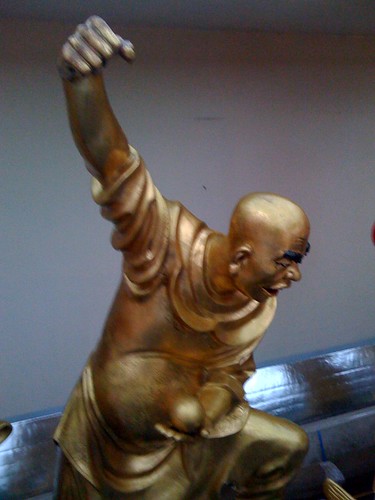
I have always been moved by Daido Roshi's work, words and ability. His book Finding the Still Point aided my practice as I began to sit again as well his translations of Dogen.

I plan to dedicate my practice tonight to Daido Roshi in thanks for all of his striving. I can hopefully dedicate something longer in the future. Please join me in this dedication.


Cheers,

The Worth and Worthlessness of Roshis


Wild Fox Zen produces some great posts but I loved this one. It spoke to me as a practitioner with a sangha (both online and "brick and mortar"), as a home-practitioner and as one seeking guidance. Of course by saying I loved it, I mean that I disagreed with it as much as I agreed with it.

It opens with a definition of "self-styled" Zen:


we ought to pick and choose practices that seem right to us and we ought to do practice in a way that we like and we don't need to make a commitment to go deeply into any one tradition because teachers are bums and make mistakes and so it's best to dig many shallow wells.


That is all well and good and true except for that last statement - "we don't need to make a commitment". Yes, we should mold and create our own practice. We should not be limited by what the ancients told us about their practice. We should not follow in their footsteps. It is a waste of time to mimic the masters. We need to forge our own practice and commit ourselves to it. We are the stick hits us to keep our attention. We, in the long run, are our own best teachers. All teachers make mistakes and are flawed. That does not mean that we don't learn from them. Even in one zendo with one teacher their will be as many "ways" as students sitting.


In contradiction, and imHo, all the old ways teach that a precondition to really beginning to practice Buddhadharma is to recognize that "our way" is the way of suffering and the necessary (but insufficient) first step on the path for both home leavers and home dwellers is some form of renunciation, a dropping our self-styled ideas and taking up the way of freedom.

In other words, you gotta be sick of your self to begin practice.


I believe that one's practice of Buddhism does not really start until the bottom of the pail falls out or you have some sort of epiphany. One can practice Buddhism before that event and it is a legitimate practice. However, from my own personal experience, one's practice does not deepen until they hit the bottom and get to look up. I hate to think that this sounds very "born-again" but the reason for our practice is suffering and suffering will deepen it. When our suffering (whatever that suffering may be) reaches a point where we see the stark reality of it and we truly realize the 4 noble truths then our practice is deepened. Meditation or teachings or guidance may be an aid to deepening our practice but in the end it comes from us. You can't fake this shit. It just happens.


Of course, in entering the kind of practice I'm talking about, a wise person investigates a teacher and tradition carefully for several years and if they jump in the ocean.


I think the choice of following a specific teacher or lineage is an important step in deepening one's practice but it is not a step to be taken lightly. Too many rush to teachers with the thought that practice would be meaningless without one. With or without a teacher, the person that will be deepening your practice with be YOU and you alone.

I also don't think that one teacher is all that you need. As your practice develops, evolves and matures I think that you will navigate yourself towards a teaching that is appropriate to your goals. A teacher is not a lifelong commitment - it is a pit stop in your life-long practice. I started with secular Buddhism and moved to Zen as I got older and my practice began to ripen. I expect that as it matures more it may lead me to a specific teacher and guide or to a completely different expression of the Dharma altogether.


One qualifier: especially for home-based practitioners, it isn't so simple as doing exactly what you're told, although that might be a good thing at the beginning. As a person develops practice legs, it is important that they walk on their own and to declare the truth with their own voice.


Yes! Finally someone who doesn't equate home-practice with ease. Usually if you mention that you are a home-practitioner you are recieved as a neophyte - a person with only the barest understanding of the Dharma because you are not affilliated with a teacher. For whatever reason that a home-practitioner chooses that practice - it is unfair to assume that it is less than practice with a sangha or in a monastic setting.

A home practitioner usually has difficulty in determining how and when to practice so there is an unusually long period of "trail and error". As you sculpt your practice with little or no guidance from a teacher, you discover what works and what doesn't. A teacher may be able to blaze the same trail in a shorter period of time but the home-practitioner proudly wields a machete in clumbsy swings as they begin to hew themselves a path.

Sometimes that path leads to a zendo or meditation hall or temple and sometimes it doesn't. Either way our shoes should be worn through and our machete sharp.

Cheers,

Monday, October 5, 2009

Zendo Oops: From bad to worse and beyond...


Have fun with these - I thought I would lighten things up a bit. The "bad" category are all true occurances while the other categories are usually what I thought about immediately after the "oops" that kept me laughing for most of the sitting period.

I previously put these out as tweets.


Zendo Oops #1:


  • Bad: Setting Hair on fire while opening altar.

  • Worse: Setting hair on fire while opening altar and spontaneously screaming "Jesus Monkey F#ck Christ!"

  • Beyond: Eating the altar.

Zendo Oops #2:


  • Bad: Sucking on Jolly Racher during Zazen and having red drool come out of your mouth.

  • Worse: Sucking on Jolly Rancher, having the red drool and then pretending to be a zombie during kinhin.

  • Beyond: After zazen and kinhin with the red drool and zombie-walking - Screaming "Brrraaaaiiiinnnsssss!" repeatadly during the Heart Sutra.

Zendo Oops #3:


  • Bad: Having your fly open during dokusan.

  • Worse: Noticing that you fly is open and mention to Roshi that you think you just peaked into your "Buddha Nature"

  • Beyond: Pretending your "Buddha-Nature" is a Keisaku and repeatedly striking practitioners for not paying attention.

Zendo Oops #4:


  • Bad: Farting, at any time, in the zendo is pretty bad.

  • Worse: Farting in rhythm to the Mokugyu during any chanting service or whenever suffering is mentioned.

  • Beyond: Blaming it on Roshi and yelling "KATSU!"

Zendo Oops #5:


  • Bad: Cracking jokes during Dharma talk.

  • Worse: Joking about crack during Dharma Talks.

  • Beyond: All of the above and then taking a hit.

Zendo Oops #6


  • Bad: Punctuating any conversation in a zendo or during dokusan with "F#ck Yeah!"

  • Worse: Follow it up with a "Dead-Arm" punch to the shoulder.

  • Beyond: Have a deep conversation with the Buddha statue and then stare at everyone suspiciously.

Last Zendo Ooops:


  • Bad: Dead leg after zazen and doing zombie walk kinhin *step, ddrraaaggg, step dddrrrraaaaagggg*

  • Worse: Eating another Jolly Rancher and repeating Zendo Oops #2.

  • Beyond: Giving the person in front of you a "Flat Tire" and then staring at them like they're the asshole.

Zendo Oops Bonus:

  • Bad: Sharing aride to sesshin and singing "108 bottles of beer on the wall, 108 bottle of beer, take one down pass it around and into Buddhist hell you go!" for the entire ride.

  • Worse: Actually drinking 108 bottles of beer on the way to sesshin.

  • Beyond: The horrible beer farts during zazen the next day coupled with the hideous "Hotei's Log" you left as a present in the zendo's "Room of Thinking".

Cheers,

Saturday, October 3, 2009

No Place Like Home - Reflections of a Zen Home Practitioner


Going Back to the Sangha -


I recall the reason why I went back to sitting with a brick and mortar sangha - the upcoming birth of my daughter about 15 months ago. During my wife's pregnancy I got an urge to get back into my practice in a very "real" way; to find people around my area that I could connect with on the level that I felt that my practice was at. This is not to say that I thought my practice was any stellar event. However, when my father refers to my practice as my daily yoga and my wife occasionally rolls her eyes when I talk about it, one comes to the conclusion that a different atmosphere and perhaps, venue, is needed. Either way, I was feeling the need to substantiate it in some way.


I did my research and looked into some area sanghas - one Tibetan, one Theravada and one Zen. I made the phone calls and asked about how each group approached their practice. Was it on a regular schedule? Lay or monastic? Was it completely independent or associated with a larger institution? Mostly meditation or devotional? Large or small group? Cost and Fees?


More importantly, how did the people feel to me when I spoke to them on the phone or in person? Lucky for me, each group was what I was looking for. Small, personal with only loose affiliations to larger centers or organizations and no or minimal costs and fees. I was taking my time, enjoying this new search and exploration. I still can not believe my luck in finding so many small, independant sanghas in my area.


My search somewhat changed when I heard on the news about a father that threw his 18 month years old baby across a room and into a wall. I knew the foster family (I worked with the foster mother) that was taking care of the child previously and they just recently had to give up the child to the actual parents who were just out of rehab. It wasn't two months later that this happened. The foster family cared deeply about the children under there care and repeatedly made mention of the fact that they believed the children to be in danger.


I don't think too many people realized how much this affected me when it occurred. I couldn't stop thinking that it could easily be me as that father. Not really that father since, he was a drug addict and just out of jail. Rather, a father that loses control, gets frustrated and in a moment of stupidity - does something horrible. I was never a violent person. Never got into fights or started altercations with people but I was always angry and intense. Would it really be that small of a leap?


The next day I walked into that little zendo and started to accelerate my practice. I never really expressed how much it would have taken me to get through those doors again otherwise. It was difficult to approach strangers about something as personal as my home-practice. But the idea that I would soon be walking into fatherhood - a situation that was completely unknown to me and with which I had no previous experience - pushed me through those doors. I started to sit again with a group and chant and engage other Buddhists. I started this blog.


When I walked into the zendo for the first time, a long-time member walked up to me and we started to talk about why I was interested in starting my practice there. I told her that I would be having a daughter soon and I wanted to prepare myself for it by engaging in public Buddhist practice again. To myself, however, I told the truth. The truth that I wanted to start out of compassion for my daughter - out of the fear that I would be as horrible as that man who threw his child.


Before we walked into the meditation room to start the first sitting the lady I was talking to mentioned that she heard that the little boy in the news that got thrown had just died from his injuries. I sat that day harder than I ever sat before or since. In between my sore ankles and burning thighs, I sat for the benefit of one sentient being that morning and have been striving ever since.


When I walked out the lady came up to me and said "I wish more fathers would sit". I agreed. The whole concept of "sitting for the benefit of all sentient beings" became slightly less esoteric that morning.
Cheers,

Saturday Morning Dharma Mouth-Punch


This is going to be a new ongoing weekly feature of my blog - The Saturday Dharma Mouth-Punch!

The concept is simple: I will review a blog -from the past week that either gave me a good Dharma punch in the face (good) or deserves a good kick in Hotei's sack (bad). Get it? It works both ways. I can either give it or receive it. I'm like a sour patch kid...I start off sour but I can be sweet in the end.

For my first run at this - I am bringing back an old favorite - Mujaku from the The Zennist. Mujaku delivered a sweet Dharma Mouth-Punch with his post on Stuart Lach's article The Zen Master in America: Dressing the Donkey with Bells and Scarves. Stuart does an amazing job of outlining, in a respectful manner, some of the more dramatic American Zen scandals as well as successfully dismantling the "Roshi Ideal" so prevalent in the West. Any practitioner of Buddhism (not just Zen) needs to read this before following any teacher, guru, roshi or rishi.

The truly amazing part about the article is that Lach actually is able to steer away from sensationalizing these scandals and succeeds in making you feel for the Roshi's own human failings (for the most part, at least). Equally amazing is that Mujaku was able to devote an entire post to someone else's opinion without bashing Western Buddhism in the process. My lip is still bleeding - The Dharma it has a killer left.


However, Mujaku is also receiving a good kick in Hotei's sack for stealing a post that I have been toying with for three months. I have been playing around with a Zen scandal post - tweaking here and editing there - and was hoping to post it soon and Mujaku just *zip* pulls the rug from under me.

Fie on you Mujaku and your beautiful post! Now go get some ice on that sack!

Cheers,

Friday, October 2, 2009

Unrequited Vipassana Love Demons

Picture from Wat Arun, Thailand


I love Brooke from Wandering Dhamma - I know it's sudden - but sometimes she blows my mind. I have never heard a more clear and concise description of the secular Buddhism as this...

Because Buddhist meditation, especially vipassana, has been divided out from and is seen as separate from the Buddhist religion, it can be considered an example of a portable and exportable version of an indigenous Asian tradition. It has become portable because of its non-specific religiosity and few institutional connections. Among Western Buddhists, vipassana meditation has been popular because it has been interpreted as having this universal, transcultural quality. This kind of thinking is certainly true in some American Buddhist circles. In Wendy Cadge’s study of a convert community in Cambridge, Massachusetts, titled Heartwood, she finds that the Buddha’s teachings are primarily conveyed through meditation instruction. Many Western vipassana meditation teachers adapt and present the teachings in a Westernized way so that practitioners often call themselves vipassana meditation students rather than students of Theravada Buddhism.

I especially like this definition which, from my experience, is how many of my Sangha-mates view Buddhism in general and Zen practice in particular (not overtly or specifically religious). This way that compartmentalized aspect of "an indigenous Asian tradition"moves into whatever devotional or cosmological framework you already have established (from your experience or upbringing). And while Brooke is primarily referencing vipassana in her post; I think that the same can be said of Zen meditation as well.


Since this portable Buddhism has sort of a luggage theme running with it, I'm not sure if I would call those that utilize meditation in the course of their spiritual and religious explorations converts. I believe I will call them Buddhist Travelers and they will be required to identify themselves by wearing pointed red hat like that gnome from the Expedia commercials.


So Brooke...I know we are both already attached but there is always reincarnation, right? Maybe we will come back as bunnies.


Too much?


Cheers,

Thursday, October 1, 2009

Cookie-Cutter Buddhist Practice


All roads lead to the same mountaintop.
Be a lamp unto yourself. Work out your liberation with diligence.

We all have a responsibility; to ourselves and to others, to those we never met and those that we spend our daily lives with, to strangers and to lovers, to aspire to our own liberation. Damn, those words sound far too lofty to be coming from me. I am a bag of wind.


However, it seems to me that we are often stuck in the middle of a pissing match between opposing (really?) schools and sects. Teachers and roshis engage in a Dharma Combat that seems more appropriate for the Jerry Springer Show than for a meditation hall.


Organizational Buddhism is fine but don't get too wrapped up into the hype that it sometimes represents. When someone, Roshi or not, tells you that their path is the correct one and all others are wrong - they are stifling your growth and building their own ego. For me, the truth seems simple. The mountain has many paths to the top but not every one is right for every practitioner. We choose our own route. Take the time to learn about the other paths and incorporate what seems right into your own practice. Ignore the boundaries that the patriarchs and the past have placed upon us. Ignore whether or not it is "authentic" or not. Ignore whether or not your practice is the same practice that your sangha-mates participate in. If your practice includes other religious and spiritual outlets, then go with it.


In the long run, all of us (Roshis, monks and lay persons) are walking bags of dung but even dung-sacks deserve a practice that is individual to them. Be a Buddhist pirate and pillage these schools for what is useful to you and leave the rest. Settle down with one if you pillaging days are over but remember that it may only be temporary. It may be time to take to the seas again.

Pirates are awesome.

Cheers,