Friday, October 9, 2009

Meditation on Death, Zombies and Buddhas


[This post was written before the news of Daido Roshi's death on Friday October 9th. Daido Roshi has always been a great influence to me...especially the way that he accepted and encouraged lay-practice. And in doing so, aided in my own development and growth. I take this time to reflect upon his teachings and ability; his compassion and his wisdom. He is a giant in American Zen and his humble steps led to great vibrations in own growing community. Thank you and Cheers, Daido.]

Many zendos or places of practice will have the Evening Gatha displayed in some prominence with the words "Life and Death are of Primary Importance". Well...yes, obviously they are but Buddhism (at least some of the Buddhism that is currently espoused in the Western Convert community) place a huge emphasis on the living part and largely ignores to dying part. All butterflies and growth about "how to live more mindfully" or "how meditation can help you live a happier life" with the topic of death is largely belittled or ignored. That somber specter is glossed over with the sometimes saccharine perception of Modern Buddhist thought.

Buddhaghosa stated in Chapter VIII of the Visuddhimagga ("Path of Purification").

A bhikkhu devoted to mindfulness of death is constantly diligent. He acquires perception of disenchantment with all kinds of becoming (existence). He conquers attachment to life....Perception of impermanence grows in him, following upon which there appear the perceptions of pain and not-self. But while beings who have not developed mindfulness of death fall victims to fear, horror and confusion at the time of death as though suddenly seized by wild beasts, spirits, snakes, robbers, or murderers, he dies undeluded and fearless without falling into any such state. And if he does not attain the deathless here and now, he is at least headed for a happy destiny on the break up of the body.


While nowhere near a bhikkhu, nor any plans to be one, I do understand that mindful attention to death is an important aspect to my Buddhist practice. To focus on the fact that life is impermanent is a daily, almost unconscious, task. But more importantly concern and focus one the fact that death is imminent. Concern with what would happen to my family if I were to die. Focus on this while driving to work, sitting at home or walking to the store. To focus on the fact that death could come at anytime, unbidden and unexpected, to me or to those closest to me. Yet with all this mindfulness the idea of death is still terrifying to me - even with the acceptance of my own impermanence.


Why was this so pressing?


People think that only others will die. They forget that sooner or later they will, too. They carry on without so much as a thought that death could possibly happen to them. Then they're shocked when it comes on them unexpectedly. How foolish! [Suzuki Shosan]

What is the primary concern in religious practice? - Put aside everything and only study death. Always study death, free yourself from death, and when death really comes you will not be flustered. In order to save others, knowledge is necessary. [Suzuki Shosan]


The study of and focus on was there but I was still insisting that I wasn't going to die. My focus was always on "if" I died or the possibility of something happening to me that was unexpected. It was never, in my mind, an absolute or a definite occurrence. I was an accident. Now the focus isn't on the "when" or "how". Those concepts are worthless and without meaning. The "if" of my impermanence turned to an actuality.

    1. I am of the nature to grow old. There is no way to escape growing old.
    2. I am of the nature to have ill health. There is no way to escape ill health.
    3. I am of the nature to die. There is no way to escape death.
    4. All that is dear to me and everyone I love are of the nature to change. There is no way to escape being separated from them.
    5. My actions are my only true belongings. I cannot escape the consequences
      of my actions. My actions are the ground upon which I stand.

While Buddhaghosa focuses on the bhikkhu's perception and conception of death and while Shosan rolls on with the insistence of focusing on death as a meditative tool (almost like a koan) to unravel the true meaning of religion experience; the 5 Remembrances cuts through the noise and circumstance of death to the actual realization of it.


So...the "take home" message is simple: Zombies are much more Buddhist-y than Vampires. Vampires sit around and look pretty and never age - undead but ageless. Zombies force us to look at ourselves in the now. Zombies shamble around, slowly decaying, getting slower, they make more noise. We shamble around, slowly decaying, getting slower, we make more noise now than before (creaks and whistles and groans). Embrace your inner-zombie. Its not really Buddha-nature but it may help to focus on the fact that we will grow old and die and then (maybe) walk the earth as a mindless automaton.

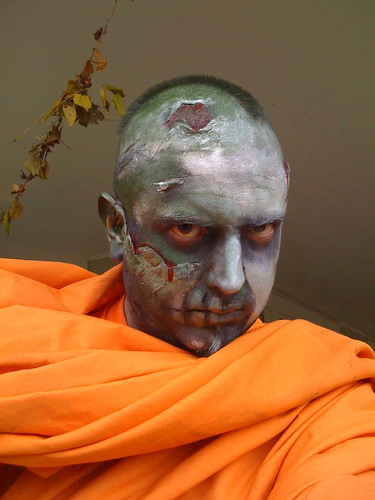
So for Halloween I was going to be a Zombie but I'm going with this guy instead.


If that dude isn't a Zen Master in disguise, I don't know who is.


Cheers,


Remember if you meet the Buddha walking down the street, kill it. If you meet a zombie walking down the street, KILL IT. If you meet Zombie-Buddha walking down the street, RUUUNNNNN!!


Thursday, October 8, 2009

"True Buddhism in Virtual Reality"

Yuttadhammo over at "Truth is Within" had an interesting idea for furthering our iSangha practice - eChanting!


We've managed to set up a karaoke style international chanting session over the Internet; participants hear the leader's (me's) voice and follow along based on the text that pops up verse by verse. An interesting experiment; not sure if it will catch on, but it does seem like a nice idea allowing people to come together to hear and reflect upon the Buddha's teaching from around the world. Afterwords I will sometimes give a verse by verse explanation of the Pali and concepts discussed therein. Here's a picture:


Indeed, a great idea! Chanting by oneself loses so much of the experience of what can be an integral part of your home practice. It may not catch on but it seems worth a shot and I appreciate the effort.

Follow this link to The Buddha Center. I love their slogan "True Buddhism in Virtual Reality". It seems to be a virtual reality monastery or temple with avatars walking around different rooms for different events (I wonder if I can bring a staff and cast Cure Light Wounds?). That may be a bit much for me but I love the effort in capturing new technologies to reach out to home-practitioners.

Personally, I like to have resources like this in reserve for when I can't make it to the zendo (read: yoga studio backroom) to sit and chant with the sangha. I already have substituted podcasts of Dharma Talks for the "real" thing since there is a real lack of Dharma teachers out here in snowy South Dakota.


Cheers,

Buddhists on Twitter -THE TWANGHA!


I wasn't planning on posting this morning. I didn't really have too much to say but I came across Jaye's post over at digitalZENDO on the benefits and detriments of twitter in relation to Buddhist practice. That, plus the fact that I am presenting to the Library Board next week on the usefullness of twitter for expanding and marketing library services led me to want to reiterate a few of Jaye's points.


The expression, "Social Media," gets kicked around a lot, but what does that really mean? For me that's simple. Community. I live in an area where I'm very far away from actual Zen centers and temples. While I'm aware of a group that sits near by, it's like "theoretical physics zen," and I'm not really in to hyper-analytical posturing. That's not Zen. That's getting lost in the dark and you might not make it back.

The above being said is my motivation for using twitter. I'm looking help expand and support my practice and that of others. My teacher is in Seattle, Washington and though I have regular conversations with he and a few of the Sangha members there, I recognize that I find it useful, to have a steady and consistent group of people that I can share practice with, supporting each other through the grinds over day-to-day life.

Beautiful! The whole point is community and epxanding our practice by sharing it with and learning from practitioners we would never have contact with otherwise. Personally, I connected with Jaye via twitter and I know that he has helped me deepen my practice and I hope that I have done the same for him. Reciprocity is what twitter is all about.

I am also fairly far away from any temples or large zendos and always appreciate the fact that I can expand and broaden my practice and get into contact with other practitioners in a fairly quick and easy manner. I am also familiar with the "academic book club" school of Buddhist practice that Jaye is alluding to and I wholeheartedly agree that it is not my cup of tea. Academic discussions are fine but I need to find people who actually sit and ritualize in their practice.


Where twitter can be a hassle and hindrance to Zen practice is there's people with what I might call "wayward," motivation. The endless marketing can be a nuisance. The over-reliance of quotes can be disappointing. I feel like if you're using a quote, tell me how you applied it to your life, so that I can learn from you. Otherwise quotes are just dead words to me.

Again, I agree for all the good out in the Buddha-twittersphere-land, there is plenty of annoying crap. I try to keep my follower and folllowing list clear of those so feel free to peruse through and find some people that share your voice. Twitter can also become a distraction. While it is nice to connect with people we should also not forget that while it is enriching to contact with people far away, there are also probably a few good-old fashioned home-practitioners close by as well.
The one big difficulty is to actually express yourself the small window that twitter provides. I enjoy myself with my quotes and retweets and try to bring a small spark of humor into what can tend towards a solemn practice.

Here is the list that Jaye provided. I follow mostly the same group and agree that these are some good Twangha-folks!


And a few of my own...


I have to say that I have enjoyed the conversations I've had with other Buddhists on twitter. I get the opportunity to learn quite a bit and it gives me a taste of how others approach their practice.


Cheers,

Wednesday, October 7, 2009

The Story of Suddhipanthaka


@Margaret_Scott via twitter was nice enough to send me this link to one of my favorite Buddhist stories and also the one that I named this blog for. My earlier rendition of this tale was somewhat lacking and I was unable to find the source of the tale to improve it. Originally from the Amitabha Sutra.


The Story of Suddhipanthaka

Suddhipanthaka was in the group of people that represents foolishness and dull capacity. His foolishness and dull capacity were the workings of the law of cause and effect. He was also in the group that was diligent in eliminating karmic obstacles.

He was the slowest of the Buddha’s students and had the poorest memory. When he was taught a four-line verse, he could not memorize the lines even after several days of trying to learn them. When he chanted the first line, he forgot the next lines. When he was taught the second line, he forgot the first line.

His elder brother, also a monastic, told him that he was too slow to learn from the Buddha and that he should go home. Suddhipanthaka burst into tears. The Buddha saw this and asked Suddhipanthaka why he was crying. He told the Buddha that his brother wanted him to go home.

The Buddha told him to stay and gave him a broom. He then taught Suddhipanthaka to concentrate on the broom and sweep the floor every day. As he swept, Suddhipanthaka was to repeat just two words, “sweep” and “clean.”


Before long, Suddhipanthaka attained enlightenment and arhatship. The other monastics wondered how he had accomplished this. The Buddha said that Suddhipanthaka had been a highly accomplished Dharma master in the previous lifetime. But he always held back when he gave lectures because he was afraid that others would surpass him in their achievement if he taught everything he knew. His slowness in this lifetime was a karmic result of teaching grudgingly.


I love this tale. Thanks @Margaret_Scott, I am in your dept!


Cheers,


Tuesday, October 6, 2009

A Roshi of Worth.


I have always been moved by Daido Roshi's work, words and ability. His book Finding the Still Point aided my practice as I began to sit again as well his translations of Dogen.

I plan to dedicate my practice tonight to Daido Roshi in thanks for all of his striving. I can hopefully dedicate something longer in the future. Please join me in this dedication.


Cheers,

The Worth and Worthlessness of Roshis


Wild Fox Zen produces some great posts but I loved this one. It spoke to me as a practitioner with a sangha (both online and "brick and mortar"), as a home-practitioner and as one seeking guidance. Of course by saying I loved it, I mean that I disagreed with it as much as I agreed with it.

It opens with a definition of "self-styled" Zen:


we ought to pick and choose practices that seem right to us and we ought to do practice in a way that we like and we don't need to make a commitment to go deeply into any one tradition because teachers are bums and make mistakes and so it's best to dig many shallow wells.


That is all well and good and true except for that last statement - "we don't need to make a commitment". Yes, we should mold and create our own practice. We should not be limited by what the ancients told us about their practice. We should not follow in their footsteps. It is a waste of time to mimic the masters. We need to forge our own practice and commit ourselves to it. We are the stick hits us to keep our attention. We, in the long run, are our own best teachers. All teachers make mistakes and are flawed. That does not mean that we don't learn from them. Even in one zendo with one teacher their will be as many "ways" as students sitting.


In contradiction, and imHo, all the old ways teach that a precondition to really beginning to practice Buddhadharma is to recognize that "our way" is the way of suffering and the necessary (but insufficient) first step on the path for both home leavers and home dwellers is some form of renunciation, a dropping our self-styled ideas and taking up the way of freedom.

In other words, you gotta be sick of your self to begin practice.


I believe that one's practice of Buddhism does not really start until the bottom of the pail falls out or you have some sort of epiphany. One can practice Buddhism before that event and it is a legitimate practice. However, from my own personal experience, one's practice does not deepen until they hit the bottom and get to look up. I hate to think that this sounds very "born-again" but the reason for our practice is suffering and suffering will deepen it. When our suffering (whatever that suffering may be) reaches a point where we see the stark reality of it and we truly realize the 4 noble truths then our practice is deepened. Meditation or teachings or guidance may be an aid to deepening our practice but in the end it comes from us. You can't fake this shit. It just happens.


Of course, in entering the kind of practice I'm talking about, a wise person investigates a teacher and tradition carefully for several years and if they jump in the ocean.


I think the choice of following a specific teacher or lineage is an important step in deepening one's practice but it is not a step to be taken lightly. Too many rush to teachers with the thought that practice would be meaningless without one. With or without a teacher, the person that will be deepening your practice with be YOU and you alone.

I also don't think that one teacher is all that you need. As your practice develops, evolves and matures I think that you will navigate yourself towards a teaching that is appropriate to your goals. A teacher is not a lifelong commitment - it is a pit stop in your life-long practice. I started with secular Buddhism and moved to Zen as I got older and my practice began to ripen. I expect that as it matures more it may lead me to a specific teacher and guide or to a completely different expression of the Dharma altogether.


One qualifier: especially for home-based practitioners, it isn't so simple as doing exactly what you're told, although that might be a good thing at the beginning. As a person develops practice legs, it is important that they walk on their own and to declare the truth with their own voice.


Yes! Finally someone who doesn't equate home-practice with ease. Usually if you mention that you are a home-practitioner you are recieved as a neophyte - a person with only the barest understanding of the Dharma because you are not affilliated with a teacher. For whatever reason that a home-practitioner chooses that practice - it is unfair to assume that it is less than practice with a sangha or in a monastic setting.

A home practitioner usually has difficulty in determining how and when to practice so there is an unusually long period of "trail and error". As you sculpt your practice with little or no guidance from a teacher, you discover what works and what doesn't. A teacher may be able to blaze the same trail in a shorter period of time but the home-practitioner proudly wields a machete in clumbsy swings as they begin to hew themselves a path.

Sometimes that path leads to a zendo or meditation hall or temple and sometimes it doesn't. Either way our shoes should be worn through and our machete sharp.

Cheers,

Monday, October 5, 2009

Zendo Oops: From bad to worse and beyond...


Have fun with these - I thought I would lighten things up a bit. The "bad" category are all true occurances while the other categories are usually what I thought about immediately after the "oops" that kept me laughing for most of the sitting period.

I previously put these out as tweets.


Zendo Oops #1:


  • Bad: Setting Hair on fire while opening altar.

  • Worse: Setting hair on fire while opening altar and spontaneously screaming "Jesus Monkey F#ck Christ!"

  • Beyond: Eating the altar.

Zendo Oops #2:


  • Bad: Sucking on Jolly Racher during Zazen and having red drool come out of your mouth.

  • Worse: Sucking on Jolly Rancher, having the red drool and then pretending to be a zombie during kinhin.

  • Beyond: After zazen and kinhin with the red drool and zombie-walking - Screaming "Brrraaaaiiiinnnsssss!" repeatadly during the Heart Sutra.

Zendo Oops #3:


  • Bad: Having your fly open during dokusan.

  • Worse: Noticing that you fly is open and mention to Roshi that you think you just peaked into your "Buddha Nature"

  • Beyond: Pretending your "Buddha-Nature" is a Keisaku and repeatedly striking practitioners for not paying attention.

Zendo Oops #4:


  • Bad: Farting, at any time, in the zendo is pretty bad.

  • Worse: Farting in rhythm to the Mokugyu during any chanting service or whenever suffering is mentioned.

  • Beyond: Blaming it on Roshi and yelling "KATSU!"

Zendo Oops #5:


  • Bad: Cracking jokes during Dharma talk.

  • Worse: Joking about crack during Dharma Talks.

  • Beyond: All of the above and then taking a hit.

Zendo Oops #6


  • Bad: Punctuating any conversation in a zendo or during dokusan with "F#ck Yeah!"

  • Worse: Follow it up with a "Dead-Arm" punch to the shoulder.

  • Beyond: Have a deep conversation with the Buddha statue and then stare at everyone suspiciously.

Last Zendo Ooops:


  • Bad: Dead leg after zazen and doing zombie walk kinhin *step, ddrraaaggg, step dddrrrraaaaagggg*

  • Worse: Eating another Jolly Rancher and repeating Zendo Oops #2.

  • Beyond: Giving the person in front of you a "Flat Tire" and then staring at them like they're the asshole.

Zendo Oops Bonus:

  • Bad: Sharing aride to sesshin and singing "108 bottles of beer on the wall, 108 bottle of beer, take one down pass it around and into Buddhist hell you go!" for the entire ride.

  • Worse: Actually drinking 108 bottles of beer on the way to sesshin.

  • Beyond: The horrible beer farts during zazen the next day coupled with the hideous "Hotei's Log" you left as a present in the zendo's "Room of Thinking".

Cheers,